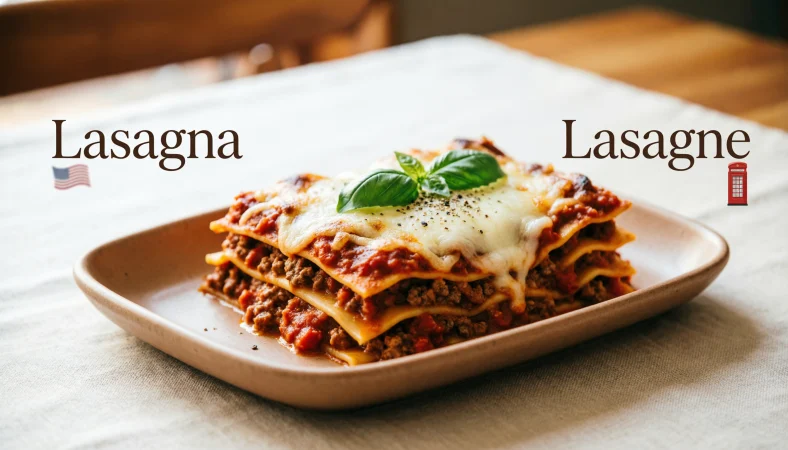
Both lasagna or lasagne are accepted spellings, but their use depends largely on regional English and the original Italian form. “Lasagna” is the more common spelling in American English, while “lasagne” is widely used in British English and Italian. Both refer to the layered pasta dish made with pasta sheets, sauce, and filling.
Lasagna and lasagne can look like competing spellings, especially when recipes, restaurant menus, cookbooks, and language guides use different forms. The difference is mainly regional rather than a difference in meaning. In American English, lasagna is the standard spelling most readers expect.
In British English, lasagne is commonly preferred. Understanding this distinction matters because choosing the less familiar spelling for your audience can make otherwise polished writing look inconsistent or unfamiliar.
The confusion becomes even more interesting because Italian uses related forms differently from English. In Italian, lasagna can refer to a single sheet of pasta, while lasagne is the plural form commonly associated with the finished dish. English has adapted these forms differently across regions.
For writers, students, editors, bloggers, restaurant owners, and anyone working with international audiences, the important point is simple: both spellings are legitimate. The best choice depends on the variety of English you are using and the audience you want to reach.
Lasagna vs Lasagne: What’s the Difference?
The difference between lasagna and lasagne is primarily one of spelling, regional convention, and linguistic history. The two forms generally refer to the same famous Italian pasta dish in English.
Lasagna is a noun. In American English, it is the usual spelling for the layered dish made with pasta sheets, meat or vegetables, sauce, cheese, and other ingredients.
Lasagne is also a noun. It is especially common in British English and remains closely connected to the Italian form.
| Feature | Lasagna | Lasagne |
| Part of speech | Noun | Noun |
| Main meaning | Layered pasta dish | Layered pasta dish |
| Common in American English | Yes | Less common |
| Common in British English | Less common | Yes |
| Italian connection | Adapted singular form | Italian plural form |
| Meaning in ordinary English | Pasta dish | Pasta dish |
| Suitable for formal writing | Yes | Yes |
| Suitable for menus | Yes | Yes |
The spelling difference does not normally indicate two different recipes.
If an American restaurant advertises “vegetable lasagna,” the dish is understood immediately. A British restaurant may advertise “vegetable lasagne,” and customers understand the same general food.
Quick Recap
Lasagna is especially common in American English.
Lasagne is especially common in British English.
Both forms can refer to the layered pasta dish.
The choice usually depends on regional English and audience expectations.
Neither spelling should automatically be treated as a misspelling.
Is Lasagna vs Lasagne a Spelling, Vocabulary, or Usage Issue?
The difference is primarily a spelling and regional usage issue, rather than a major vocabulary distinction.
A vocabulary difference would normally mean that two words have different meanings. That is not what happens here. A person ordering lasagna in New York and someone ordering lasagne in London are generally asking for the same type of food.
The distinction becomes clearer when English is viewed as a group of regional varieties rather than one completely uniform language.
American English has generally favored lasagna. This form appears frequently in American cookbooks, restaurant menus, grocery products, and everyday conversation.
British English commonly uses lasagne. This spelling also appears in British menus, recipes, newspapers, and general writing.
The distinction is similar to many other cases where English varieties adopt or preserve different spellings. Neither variety is inherently more correct. What matters is consistency with the intended audience.
Formal and Informal Usage
Both forms work in formal writing. There is no reason to consider one spelling informal simply because it is more common in one country.
For example:
“The restaurant serves traditional vegetable lasagna.”
“The restaurant serves traditional vegetable lasagne.”
Both sentences are grammatically acceptable.
Academic and Casual Usage
Academic writing should follow the spelling convention appropriate to the chosen variety of English. If a paper uses British English throughout, lasagne may fit naturally. If it follows American English conventions, lasagna will generally be more appropriate.
In casual communication, either spelling is usually understood.
The main problem arises when a writer switches between the two forms without a reason. Consistency makes writing look more deliberate and professional.
How to Use Lasagna Correctly
Lasagna is particularly useful when writing for an American English audience.
The word normally functions as a singular countable noun when referring to a dish, although usage can vary depending on whether the writer means a prepared dish, a portion, or the food category more generally.
Consider a workplace example:
“Our team ordered lasagna for the office lunch.”
Here, lasagna identifies the dish chosen for the meal.
An academic example could be:
“The study examined consumer preferences for vegetarian lasagna.”
In this sentence, the word identifies a particular food category being discussed.
A technology example might appear in an online ordering system:
“Select your preferred lasagna from the menu.”
The spelling works naturally because many digital products and services aimed at American users follow American English conventions.
Usage Recap
Use lasagna when your content follows American English.
It is suitable for menus, recipes, articles, academic writing, and everyday communication.
It is not an incorrect version of the word.
For an American audience, it is usually the most familiar choice.
How to Use Lasagne Correctly
Lasagne is widely used in British English and is also closely associated with the original Italian form.
For a British audience, this spelling may look more natural and familiar.
A workplace example might be:
“We ordered vegetable lasagne for the staff meeting.”
An academic example could be:
“The research examined the nutritional content of commercially prepared lasagne.”
A technology example could appear in an online food ordering application:
“Choose a portion of beef lasagne.”
The word is perfectly appropriate in these contexts.
British English writers should not feel the need to replace lasagne with lasagna simply because the latter is common in American publications.
Usage Recap
Use lasagne naturally when writing in British English.
The spelling is standard in many British contexts.
It is also closely connected with Italian usage.
It should not be treated as a spelling error simply because American English often uses another form.
When You Should NOT Use Lasagna or Lasagne
There are several situations in which choosing between these spellings can create unnecessary inconsistency.
1. Do not switch spelling randomly
If an article begins with “lasagna” and later changes to “lasagne,” readers may wonder whether you are referring to different things.
Choose one regional convention and maintain it.
2. Do not assume lasagne is a typo
A British writer may use lasagne throughout an article. Correcting every occurrence to lasagna can introduce an unnecessary American English preference.
3. Do not assume lasagna is an incorrect Italian form
English has adapted many foreign words over time. American English commonly uses lasagna for the dish.
4. Do not mix regional conventions without a purpose
A publication written entirely in British English should normally maintain British spelling conventions.
Likewise, an American publication should generally use its established conventions.
5. Do not change the spelling merely for search variation
SEO writing should remain natural. Repeatedly alternating between lasagna and lasagne simply to target both spellings can make the article sound unnatural.
6. Do not describe the two forms as completely different foods
In ordinary English usage, both forms commonly identify the familiar layered pasta dish.
7. Do not treat one spelling as universally correct
English has several regional standards. A spelling can be standard in one variety while another form is preferred elsewhere.
8. Do not ignore the audience
A restaurant menu intended for British customers may benefit from the spelling lasagne, while an American food website will normally favor lasagna.
Common Mistakes and Decision Rules
The easiest way to understand the difference is to examine how each form behaves in real sentences.
| Correct sentence | Incorrect sentence | Explanation |
| I made lasagna for dinner. | I made lasagne for dinner. | The second sentence is not grammatically wrong, but lasagna is more natural for American English. |
| We ordered beef lasagne. | We ordered beef lasagna. | The second sentence can be understood, but lasagne fits British English conventions more naturally. |
| This recipe makes a rich lasagna. | This recipe makes a rich lasagne. | American style normally favors lasagna. |
| The menu includes vegetable lasagne. | The menu includes vegetable lasagna. | British style commonly favors lasagne. |
| Lasagna is popular in many countries. | Lasagne is popular in many countries. | Both are understandable, but regional style determines the preferred form. |
Decision Rule Box
- If your audience uses American English, choose “lasagna.”
- If your audience uses British English, “lasagne” is usually the more familiar choice.
- If you are discussing Italian terminology specifically, explain the Italian distinction rather than treating English usage as identical to Italian grammar.
This rule is more accurate than claiming that one spelling is always right and the other is always wrong.
Lasagna and Lasagne in Modern Technology and AI Tools
Modern technology has made regional spelling differences easier to notice.
Search engines, recipe platforms, online grocery stores, food delivery applications, spell checkers, and artificial intelligence systems encounter both forms regularly. As a result, users may see lasagna and lasagne within the same digital environment.
AI writing tools can also produce either spelling depending on the language setting, training patterns, prompt wording, and surrounding context.
For example, a user asking an AI assistant to write a recipe in American English may receive lasagna. A request specifically asking for British English may produce lasagne.
This is an important lesson for content creators. Automated tools can recognize both forms, but writers still need to establish the intended language variety.
For websites, consistency remains more important than trying to force both forms into every paragraph. A page aimed at American readers can naturally use lasagna while mentioning lasagne when explaining the regional difference.
Where Do Lasagna and Lasagne Come From?
The history of these spellings helps explain why the difference exists.
The English forms come from Italian, but the linguistic history of the word is older and more complicated than a simple spelling variation.
In modern Italian, lasagna can refer to a single sheet or layer of pasta, while lasagne is the plural form. The name of the completed dish is commonly associated with the plural form.
English, however, did not preserve this distinction in exactly the same way across all varieties.
American English established lasagna as the familiar name of the finished dish. British English commonly retained lasagne, which is closer to the Italian plural form.
This illustrates an important principle in language: borrowed words do not always enter another language with precisely the same grammatical behavior they had in the source language.
Expert Style Insight
“When two spellings belong to different established varieties of English, correctness depends on context, audience, and consistency rather than on choosing one form as universally superior.”
This principle applies well beyond food vocabulary.
Two Practical Case Studies
Case Study 1: An American Recipe Website
Imagine an American recipe website publishing a guide called “Easy Homemade Lasagna.”
Throughout the article, the writer uses lasagna in the title, headings, recipe instructions, ingredient notes, and conclusion.
The result is a consistent American English presentation.
If the same page suddenly changes several sections to lasagne, readers may interpret the variation as an editing mistake.
The practical result is clear: maintaining one regional spelling produces a cleaner and more consistent article.
Case Study 2: A British Restaurant Menu
Now imagine a British restaurant preparing a menu for local customers.
The menu lists “Classic Beef Lasagne,” “Vegetable Lasagne,” and “Spinach and Ricotta Lasagne.”
The spelling matches the convention familiar to many British readers.
Changing only one menu item to “lasagna” would not make the dish wrong, but it could make the menu appear inconsistent.
The practical result is again consistency. The intended audience determines which established spelling fits naturally.
Error Prevention Checklist
Always Use Lasagna When
- You are writing primarily for an American English audience.
- Your publication follows American spelling conventions.
- Your recipe, menu, or article already uses American English consistently.
- Your target readers are more familiar with the American form.
- You want the most familiar American spelling for the dish.
Always Use Lasagne When
- You are writing primarily for a British English audience.
- Your publication follows British spelling conventions.
- Your menu or recipe collection uses British English consistently.
- You are specifically following a British editorial style.
- Your audience commonly expects the British form.
Never Treat Either Form as Automatically Wrong
The biggest mistake is assuming that regional variation equals incorrect spelling.
Both forms have established usage in English. The important question is not simply which spelling exists, but which spelling fits the language variety and context.
Related Grammar and Spelling Confusions You Should Master
Understanding regional spelling can make many other English comparisons easier.
- Color or colour
American English generally favors color, while British English generally favors colour.
Favorite is common in American English, while favourite is common in British English.
- Center or centre
Center is the usual American form, while centre is common in British English.
- Theater or theatre
Both forms are established, with regional preferences influencing usage.
- Catalog or catalogue
American English commonly favors catalog, while British English often uses catalogue.
- Traveling or travelling
American English generally uses traveling, while British English commonly uses travelling.
- Canceled or cancelled
Both forms are used, with regional spelling conventions affecting preference.
- Practice or practise
British English distinguishes the noun practice from the verb practise, while American English commonly uses practice for both.
- Gray or grey
Gray is common in American English, while grey is common in British English.
- Aging or ageing
Aging is common in American English, while ageing is frequently used in British English.
These examples demonstrate why English spelling cannot always be judged through a single universal rule.
FAQs:
Is lasagna or lasagne correct?
Both spellings are correct in established English usage. Lasagna is especially common in American English, while lasagne is especially common in British English.
Is lasagne British or American?
Lasagne is strongly associated with British English. American English generally uses lasagna when referring to the same layered pasta dish.
Is lasagna the American spelling?
Yes. Lasagna is the standard and familiar spelling used in American English for the layered pasta dish.
Why do British people spell it lasagne?
British English commonly uses lasagne because the form is closer to the Italian plural form traditionally associated with the dish.
What is the Italian spelling of lasagna?
Italian uses both lasagna and lasagne with different grammatical roles. Lasagna can refer to a single pasta sheet, while lasagne is the plural form and is commonly associated with the finished dish.
Is lasagne a misspelling of lasagna?
No. Lasagne is an established spelling, particularly in British English. It should not automatically be corrected to lasagna.
Is lasagna singular or plural?
In English, lasagna generally functions as the name of the dish and is commonly treated as a singular noun. Italian grammar has a more specific distinction between lasagna and lasagne.
Should I use lasagna or lasagne in an American article?
For an American English article, lasagna is generally the more natural choice. You can mention lasagne when explaining the regional spelling difference.
Should I use lasagne or lasagna in British English?
For British English, lasagne is generally the more familiar form. The spelling fits naturally with British usage and editorial conventions.
Are lasagna and lasagne different foods?
Usually, no. In ordinary English usage, both spellings refer to the familiar layered pasta dish. The main difference is regional spelling and linguistic history.
Conclusion:
The choice between lasagna or lasagne depends mainly on regional English rather than a difference in the food itself. American English generally favors lasagna, while British English commonly uses lasagne. Both forms are established, understandable, and appropriate in the right context.
For content creators, the best approach is to identify the audience first. If you are writing for American readers, use lasagna consistently. If you are writing in British English, lasagne is usually the natural choice.
The distinction also provides a useful reminder about English itself. Borrowed words can develop differently across regions, and a spelling that looks unfamiliar is not necessarily incorrect. Good writing respects those regional conventions while maintaining consistency throughout the page.
When in doubt, think about your audience, your chosen variety of English, and the style used throughout the rest of your content. That simple approach will prevent most spelling confusion and keep your writing clear, polished, and natural.