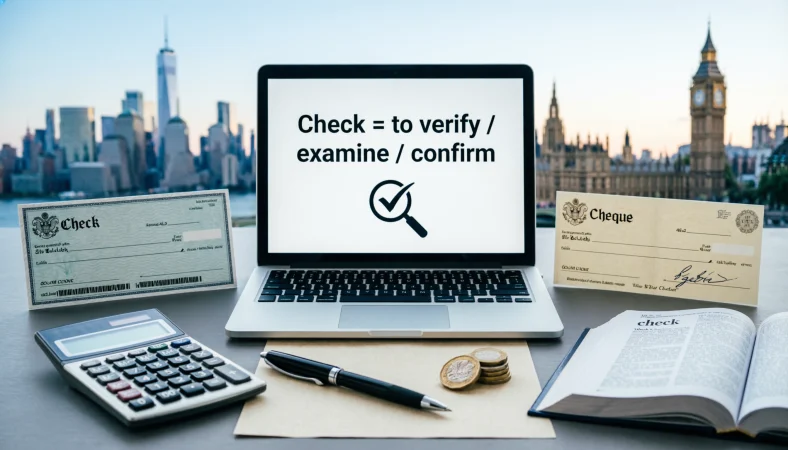
Check and cheque are related English words, but they do not always have the same meaning. Check is the standard spelling in American English and has several meanings, including verification and a bank payment document. Cheque is the British spelling for the paper payment document used to instruct a bank to pay money.
When people search for check or cheque, they are usually trying to determine which spelling is correct. The answer depends largely on what you mean and which variety of English you are using. The words can refer to very different concepts, so choosing the wrong form can create confusion in financial writing, workplace communication, and everyday instructions.
The distinction becomes especially important because check has many meanings beyond banking. You can check a document, check an answer, check a door, or check information. Cheque, by contrast, has a much narrower meaning in modern English. It refers specifically to a written financial instrument.
Check vs Cheque: What’s the Difference?
The difference between check and cheque depends on both meaning and regional spelling.
When the word refers to a paper payment issued through a bank, check is generally used in American English, while cheque is the standard British English spelling.
However, check has many additional meanings that cheque does not have.
| Feature | Check | Cheque |
| Part of speech | Noun and verb | Noun |
| Financial meaning | A written bank payment document in American English | A written bank payment document |
| Verification meaning | To examine or verify something | Not normally used |
| American English | Standard spelling | Rare for the financial meaning |
| British English | Standard for many meanings | Standard for the banking document |
| Pronunciation | Usually pronounced “check” | Usually pronounced “check” |
| Main financial difference | American spelling | British spelling |
| Meaning as a financial document | Payment instrument | Payment instrument |
The most important distinction is simple.
Check has a broad range of meanings.
Cheque is primarily used for the financial document in British English and related varieties.
For example:
Please check the figures before submitting the report.
Here, check means examine or verify.
But:
I received a cheque from the company.
Here, cheque refers to a financial document.
Quick recap
Check can mean examine, verify, stop, restrain, or a bank payment document.
Cheque specifically refers to a bank payment document in British style writing.
American English normally uses check for the financial meaning.
British English normally uses cheque for the financial meaning.
Is Check vs Cheque a Grammar, Vocabulary, or Usage Issue?
The issue is primarily one of spelling, meaning, and regional usage.
It is not usually a grammar problem.
Grammar determines how a word functions within a sentence. Both check and cheque can function as nouns, but they are not interchangeable in every context because cheque does not carry all the meanings of check.
Are check and cheque interchangeable?
Only in a specific context.
If you are talking about a paper bank payment, American English uses check, while British English uses cheque.
For example:
I wrote a check to the landlord.
This is natural American English.
I wrote a cheque to the landlord.
This is natural British English.
However, you cannot simply replace check with cheque in every sentence.
Consider:
Please check your email.
The verb check means examine or look at something.
You cannot normally write:
Please cheque your email.
That is incorrect because cheque does not have the general verb meaning of examine or verify.
Formal vs informal usage
Both forms can appear in formal writing when used appropriately.
A financial report written in American English might say:
The customer paid by check.
A British financial report might say:
The customer paid by cheque.
The choice reflects regional convention rather than different levels of formality.
Academic vs casual usage
Academic writers may encounter both forms when discussing financial systems, economics, banking, or historical documents.
The correct choice depends on the variety of English being followed.
For an American academic publication:
The payment was made by check.
For a British publication:
The payment was made by cheque.
Neither is inherently more academic.
Check: When and How to Use It
Check is one of the most versatile words in English.
As a verb, it can mean to examine, verify, inspect, confirm, or monitor something.
Please check the spelling before publishing the article.
I need to check the figures again.
Check whether the door is locked.
As a noun, check can refer to an inspection or verification.
The accountant performed a final check of the records.
It can also refer to a financial document in American English.
She mailed the check yesterday.
Workplace example
Please check the figures before sending the report to the client.
Here, check means verify or examine.
Another example is:
The manager asked the assistant to check the inventory.
Again, the meaning has nothing to do with banking.
Academic example
Researchers should check their calculations before drawing conclusions.
In this context, check means verify accuracy.
A student might also write:
I checked the references before submitting the paper.
This is standard English.
Technology example
Technology uses check constantly.
Check your internet connection before restarting the application.
The software checks the file for errors.
Check the settings before installing the update.
In these examples, check means examine, verify, or inspect.
Financial example
American English uses check for the banking meaning:
The company sent me a check for the refund.
British English would normally use cheque:
The company sent me a cheque for the refund.
Usage recap
Use check when you mean examine, verify, inspect, or confirm.
Use check for a financial document when writing American English.
Do not assume that every occurrence of check refers to money.
Cheque: When and How to Use It
Cheque is a noun associated primarily with banking.
It refers to a written instruction from an account holder directing a bank to pay a specified amount to another person or organization.
The spelling cheque is standard in British English and is also used in several other English speaking regions influenced by British conventions.
Workplace example
The supplier received a cheque for the outstanding balance.
Here, cheque clearly refers to a financial payment instrument.
Academic example
The study examined the decline in cheque usage as electronic payments became more widespread.
This is a formal use of the word in an academic context.
Technology example
Although physical cheques have become less central to modern payment systems, technology has changed how they are processed.
The bank’s mobile application allows customers to deposit a cheque by photographing it.
This sentence uses the British spelling while describing a modern banking process.
Usage recap
Use cheque when referring to a bank payment document in British English.
It is a noun, not the general verb meaning examine or verify.
American English normally uses check for the same financial document.
Why Do Check and Cheque Have Different Spellings?
The spelling difference has historical roots in the development of English and the influence of French.
The financial term entered English through historical forms related to French cheque, while English developed different spelling conventions in different regions.
American English eventually standardized check for the financial instrument.
British English retained cheque.
The spelling therefore became one of many visible differences between American and British English.
This is similar to other regional spelling pairs such as:
color and colour
center and centre
traveler and traveller
catalog and catalogue
The important lesson is that regional spelling differences do not necessarily indicate different concepts.
American English vs British English
The financial meaning provides the clearest regional distinction.
American English
American English normally uses:
check
For example:
I wrote a check for $500.
It also uses check for the general verb:
Check the address carefully.
British English
British English normally uses:
cheque
for the financial document.
For example:
I wrote a cheque for £500.
But British English still uses check for many other meanings.
Check the address carefully.
This is an important point. British English did not replace every occurrence of check with cheque.
The distinction is largely this:
Check remains the normal word for examine, verify, inspect, or confirm.
Cheque is used specifically for the banking document.
When You Should NOT Use Check or Cheque
Understanding when not to use these words can prevent several common mistakes.
1. Do not use cheque to mean verify
Incorrect:
Please cheque the information.
Correct:
Please check the information.
Cheque is not the normal British spelling of the verb check.
2. Do not assume cheque is the British spelling of every use of check
British English still uses check in many expressions.
- Check your email.
- Check the results.
- Check the temperature.
Replacing these with cheque would be incorrect.
3. Do not use cheque for an electronic payment
A bank transfer is not automatically a cheque.
If money moves electronically between accounts, terms such as bank transfer, electronic payment, or online payment may be more accurate.
4. Do not use check when a British financial document requires regional consistency
The American form is understandable internationally, but a British financial document may conventionally use cheque.
5. Do not treat check and cheque as two pronunciation choices
They are normally pronounced alike when used as the financial term.
The spelling is the major difference.
6. Do not assume every financial context uses physical cheques
Modern banking has increasingly moved toward cards, electronic transfers, direct deposits, and mobile payments.
Use the word only when the transaction actually involves a cheque or check.
7. Do not use check as a noun for every kind of payment
A bank check is a specific financial instrument.
A card payment, cash payment, bank transfer, and cheque are different methods of payment.
Common Mistakes and Decision Rules
| Correct sentence | Incorrect sentence | Explanation |
| Please check the report. | Please cheque the report. | Check means examine or verify. |
| I deposited a cheque. | I deposited a check in a British English document. | The second form is common in American English, while cheque is the standard British financial spelling. |
| I wrote a check to the landlord. | I wrote a cheque to the landlord in American English. | American English normally uses check for the financial document. |
| Check your email. | Cheque your email. | Cheque does not have the general verb meaning of check. |
| The bank processed the cheque. | The bank processed the cheque meaning verified the report. | Cheque refers specifically to the financial instrument. |
Decision Rule Box
If you mean examine, verify, inspect, or confirm, use check. If you mean a written bank payment, use check in American English and cheque in British English.
This one rule handles most everyday questions about the two forms.
Check and Cheque in Modern Technology and AI Tools
Modern technology has changed the way both words are used.
Digital banking has reduced reliance on physical checks and cheques in many markets. However, the vocabulary remains important because financial systems still process these instruments.
Technology also uses check extensively in a completely different sense.
Software can check a file for errors.
An application can check whether a password meets security requirements.
An AI system can check a document for spelling or grammatical problems.
For example:
The writing assistant checks the document for spelling errors.
Here, check means examine.
Artificial intelligence has made this usage particularly visible. AI writing tools, search systems, coding assistants, and automated quality systems frequently perform checks on user input.
The financial word cheque remains much narrower.
The banking application allows customers to photograph a cheque.
Understanding this difference prevents confusion when writing about finance and technology in the same article.
Check or Cheque in Business and Banking
Business communication is one of the areas where regional spelling matters most.
Suppose an American company writes:
Your refund will be issued by check.
That is standard American usage.
A British company might write:
Your refund will be issued by cheque.
Both sentences are correct within their respective regional conventions.
The problem occurs when writers mix styles without realizing it.
A document intended for a British audience might use cheque, colour, and organisation. An American document might use check, color, and organization.
Neither style is inherently superior.
The strongest professional choice is consistency.
Etymology and Historical Development
The financial meaning of check and cheque has a complicated history connected with the broader history of banking and French influence on English.
The English financial term developed alongside the concept of a written banking order. British English settled on cheque, while American English adopted check.
The verb check, however, has a separate and much broader history and meaning. It developed into a common English verb meaning to restrain, examine, stop, or verify.
This helps explain why the words are not complete synonyms.
The American spelling check covers both the financial noun and the general verb.
The British spelling system uses cheque specifically for the financial noun while retaining check for the general verb.
That distinction is the key to understanding the pair.
Authority and Trust: What Professional Editors Recommend
A useful editorial principle is to identify the meaning first and the regional variety second.
An expert style explanation would be:
“Choose the spelling according to meaning and regional convention, rather than assuming that cheque is simply a British version of every use of check.”
That distinction is important because many spelling questions are actually meaning questions.
If someone writes cheque your work, changing the spelling alone does not solve the problem. The intended verb is check.
If someone writes I received a check, the spelling may be completely appropriate in American English and regionally unexpected in British English.
Case study 1: American business communication
An American company sends a customer a financial document:
Your refund check is enclosed.
The use of check is correct because the document follows American English.
Changing it to cheque would introduce a spelling convention that does not match the company’s chosen variety.
Case study 2: British banking communication
A British bank writes:
Please sign the back of the cheque before depositing it.
Here, cheque is the appropriate regional form because the sentence refers to a financial document in British English.
In both cases, the result is clearer when the spelling matches the audience.
Author expertise: Written from a professional English usage perspective, with attention to regional spelling, grammar, financial terminology, and practical editorial consistency.
Error Prevention Checklist
Always use check when
- You mean examine something.
- You mean verify information.
- You mean inspect something.
- You mean confirm a fact.
- You are writing American English and referring to a bank payment document.
- You are discussing software that examines information.
Always use cheque when
- You mean a written bank payment document.
- You are writing British English or another variety that follows British financial spelling conventions.
- You need to distinguish the financial noun from the verb check.
Never use cheque when
- You mean verify.
- You mean inspect.
- You mean examine.
- You mean confirm.
- You are describing a software verification process.
Related Grammar Confusions You Should Master
If you are studying regional English and commonly confused terms, these pairs are useful to know:
- Color or colour: American and British spelling
- Center or centre: Regional spelling variation
- Catalog or catalogue: Different established forms
- License or licence: Noun and regional spelling differences
- Practice or practise: A common British English distinction
- Program or programme: American and British preferences
- Traveler or traveller: Regional spelling conventions
- Canceled or cancelled: Different spelling preferences
- Learned or learnt: Regional and stylistic variation
- Toward or towards: Different usage preferences
Learning these distinctions makes it easier to recognize when an apparent spelling problem is actually a question of regional English.
FAQs
Is check or cheque correct?
Both can be correct. Check is the standard American spelling for the financial document, while cheque is the standard British spelling. Check is also a separate English word meaning examine, verify, or inspect.
Is cheque British or American?
Cheque is primarily associated with British English and other varieties influenced by British spelling. American English generally uses check for the same financial document.
Is check the American spelling of cheque?
For the financial meaning, yes. American English normally uses check where British English uses cheque. However, check also has many other meanings that cheque does not have.
Can I use cheque in American English?
Readers in American English will generally understand cheque, but check is the normal American spelling for the financial document. For professional American writing, check is usually the more appropriate choice.
Can I use check in British English?
Yes, but the meaning matters. British English uses check for meanings such as examine or verify. For the financial document, cheque is the conventional British spelling.
Is cheque a verb?
Cheque is generally used as a noun meaning a bank payment document. It is not normally used as the British spelling of the verb check.
Why do Americans spell cheque as check?
American English developed its own spelling conventions and standardized check for the financial instrument. British English retained cheque as the conventional financial spelling.
Are check and cheque pronounced the same?
When they refer to the financial document, they are normally pronounced the same. The difference is primarily written rather than spoken.
Is a check the same as a bank transfer?
No. A check or cheque is a written financial instrument instructing a bank to pay money. A bank transfer moves money electronically between accounts.
Which spelling should I use in a professional document?
Follow your intended variety of English. Use check for American English financial writing and cheque for British English financial writing. For the general verb meaning examine or verify, use check.
Conclusion:
The choice between check or cheque becomes easy once you separate meaning from regional spelling. When you mean examine, verify, inspect, or confirm, the correct word is check. When you mean a written bank payment, American English uses check, while British English generally uses cheque.
So, the two forms overlap only in the financial sense. They are not interchangeable in every sentence because check has several meanings that cheque does not have.
If you’re writing for an American audience, choose check for both the general verb and the financial document. If you’re writing British English, use check for the verb and cheque for the financial document. Once you understand that distinction, the spelling choice becomes straightforward.











1 thought on “Cheque Or Check: Meaning, Spelling, Difference & Correct Usage For 2026”