Smoky is the standard spelling in most English writing, especially when describing something filled with or resembling smoke, such as “a smoky room.” Smokey is also used, but it is more commonly seen as a proper name, nickname, or informal spelling. For general writing, smoky is usually the preferred choice.
Have you ever wondered whether the correct spelling is smokey or smoky? The two forms look almost identical, but they don’t have exactly the same usage. Smoky is the standard adjective for something related to or resembling smoke, while Smokey is often used as a name, nickname, or informal variation. This guide explains the spelling difference, meaning, grammar, and practical examples based on standard English usage so you can choose the right form confidently.
Smokey or Smoky: What’s the Difference?
The confusion between smokey or smoky is mainly a spelling and usage issue, not a difference in pronunciation. Both forms can appear in English, but they do not have the same role.
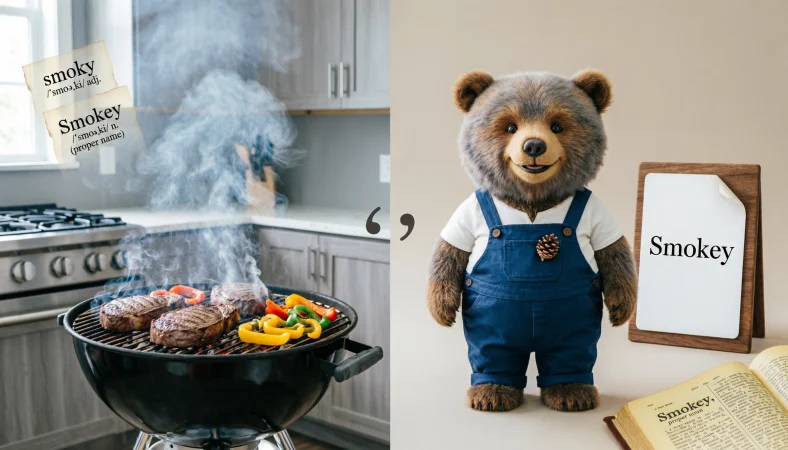
Smoky is the standard adjective used to describe something that contains smoke, smells of smoke, looks smoky, or has a flavor associated with smoke.
Smokey is most often found in proper names and established names. It can also appear as a personal nickname or surname. One of the best known examples is Smokey Bear, the American wildfire prevention character.
That distinction matters because adding the letter e can change an ordinary descriptive adjective into a name or a stylistic spelling.
| Word | Part of speech | Main use | Example |
| Smoky | Adjective | Describes smoke, smoke like qualities, or smoky flavor | The room was smoky. |
| Smokey | Usually a proper name or nickname | Used in established names and personal names | Smokey Bear is a famous wildfire prevention character. |
| Smoke | Noun or verb | Refers to the substance or the act of producing it | Smoke filled the room. |
| Smoked | Adjective or past participle | Describes something prepared or exposed to smoke | We ordered smoked salmon. |
The simplest rule is this:
Use smoky when you are describing something associated with smoke.
Use Smokey when it is part of a recognized name, nickname, or title.
For ordinary English writing, smoky is almost always the form you want when the adjective means “full of smoke” or “having the characteristics of smoke.”
Is Smokey or Smoky a Grammar, Vocabulary, or Usage Issue?
This is primarily a spelling and usage distinction.
The two forms are related because they developed from the same underlying word, smoke. However, modern English has given them different functions.
Is smoky the standard spelling?
Yes. Smoky is the standard spelling of the adjective when describing something that contains smoke or resembles smoke.
Examples include:
The kitchen became smoky after the food burned.
The fireplace gave the room a smoky smell.
I like the smoky flavor of grilled vegetables.
The mountain disappeared behind a smoky haze.
In each example, smoky describes a quality or characteristic.
Is Smokey wrong?
No. Saying that Smokey is always wrong would be inaccurate.
The spelling is established in names and nicknames. The most famous example is Smokey Bear, a character associated with wildfire prevention in the United States.
A person could also have Smokey as a nickname. In that situation, changing the spelling to Smoky would incorrectly change the person’s name.
Formal versus informal usage
In formal writing, use smoky when you need the ordinary adjective.
If you are writing about a person, organization, character, product, place, or other entity whose official name contains Smokey, preserve the established spelling.
This is similar to many English words that have an ordinary dictionary form while a capitalized variation appears in a proper name.
Academic versus casual usage
Academic writing should normally use smoky when describing an atmosphere, odor, appearance, chemical process, or flavor.
For example:
The researchers observed a smoky appearance above the combustion chamber.
However, an academic article discussing a specific named character would preserve the name:
Smokey Bear has been used in public wildfire prevention campaigns.
The difference is not about formality alone. It is about what the word is doing in the sentence.
How to Use Smoky Correctly
Smoky is an adjective. Its most common meaning is “containing smoke,” “filled with smoke,” or “having characteristics associated with smoke.”
It can describe a physical environment, smell, appearance, flavor, sound, color, or atmosphere.
Workplace example
Imagine a restaurant manager writing an incident report:
“The dining area became smoky after the ventilation system stopped working.”
Here, smoky describes the condition of the room.
A workplace safety notice might say:
“Employees should leave the smoky area immediately.”
Again, smoky is simply describing an environment.
Academic example
In scientific writing, smoky can describe an observable condition:
“The reaction produced a smoky cloud above the container.”
It can also be used when discussing air quality, combustion, fire behavior, or atmospheric conditions.
Technology example
Technology writers may use smoky to describe visual effects in photography, film, video games, or computer graphics.
For example:
“The software creates a smoky visual effect around the object.”
The adjective describes the appearance of the effect rather than naming a particular product or person.
Smoky for food and flavor
One especially common use occurs in food writing.
A food can have a smoky flavor because it was cooked over fire, exposed to wood smoke, or prepared with ingredients that produce a smoke like taste.
Examples include:
The sauce has a rich smoky flavor.
The grilled vegetables developed a smoky aroma.
This cheese has a slightly smoky taste.
This usage is extremely common in restaurant descriptions, recipes, food reviews, and everyday conversation.
Usage recap
Use smoky when you are describing a quality associated with smoke. It is the normal adjective for smoke filled air, smoke like appearances, smoky aromas, and smoky flavors.
How to Use Smokey Correctly
Smokey has a narrower role in contemporary standard English. It commonly appears as a proper name, nickname, surname, or established name.
The capitalization is important when the word is being used as a proper name.
Smokey Bear
One of the most recognizable examples is Smokey Bear.
The name refers to the American wildfire prevention character created as part of a national public awareness campaign. Because Smokey is part of the character’s established name, it should not be changed to Smoky merely because smoky is the ordinary adjective.
Personal names and nicknames
A person may also be called Smokey.
For example:
Smokey is coming to the meeting this afternoon.
If Smokey is the person’s chosen nickname, the spelling should be preserved.
Fictional characters
Authors and creators may give a character the name Smokey. Once it functions as the character’s name, it should be treated as a proper noun.
Brand and product names
Some businesses, products, organizations, songs, places, or other named entities may use Smokey as part of their official identity.
The important principle is simple: names belong to the entity that owns or uses them. You should not automatically change a name to match the ordinary dictionary spelling.
Usage recap
Use Smokey when it is part of an established name, nickname, or title. Do not use it as the default spelling of the ordinary adjective.
When You Should NOT Use Smokey or Smoky
Knowing when not to use each spelling can prevent several common errors.
1. Do not write Smokey when you mean full of smoke
Incorrect:
The room was smokey.
Preferred:
The room was smoky.
The adjective describing the room is smoky.
2. Do not change a person’s name
If someone’s name or nickname is Smokey, do not automatically correct it to Smoky.
Names are not ordinary spelling exercises.
3. Do not change an established title
If an official title uses Smokey, retain that spelling.
Changing a proper name because another spelling is more common can introduce an actual error.
4. Do not use smoky as a replacement for a person’s name
If the character or person is named Smokey, writing Smoky can make the reference look incorrect.
5. Do not assume every occurrence of Smokey is a mistake
This is one of the most important points. Seeing the spelling Smokey does not automatically mean the writer has made an error.
First determine whether it is functioning as a name.
6. Do not assume every occurrence of smoky is informal
Smoky is the standard adjective and works perfectly well in formal, academic, technical, and professional writing.
7. Do not rely only on pronunciation
In many varieties of English, the two spellings may sound identical or nearly identical. That means pronunciation alone cannot tell you which spelling is appropriate.
8. Do not treat the distinction as a simple British versus American spelling difference
Unlike pairs such as colour and color, smoky and Smokey are not simply standard British and American versions of the same adjective.
Common Mistakes and Decision Rules
| Correct sentence | Incorrect or inappropriate sentence | Explanation |
| The kitchen was smoky. | The kitchen was smokey. | Use smoky for the ordinary adjective. |
| The barbecue gave the meat a smoky flavor. | The barbecue gave the meat a smokey flavor. | The standard adjective is smoky. |
| Smokey Bear is a recognized character. | Smoky Bear is a recognized character. | The established name uses Smokey. |
| My dog is named Smokey. | My dog is named Smoky. | Preserve the chosen name. |
| The air looked smoky after the fire. | The air looked smokey after the fire. | The word describes an environment. |
| Smokey joined the group. | Smoky joined the group. | If Smokey is the person’s established name, retain it. |
Decision Rule: If you are describing something affected by or resembling smoke, use smoky. If you are referring to a person, character, nickname, or established name spelled Smokey, preserve Smokey.
Smokey or Smoky in Modern Technology and AI Tools
The distinction becomes especially interesting in digital communication because spelling correction systems often treat smokey as a possible error when the writer actually intends a proper name.
An automated writing tool may see:
“The room became smokey.”
and recommend:
“The room became smoky.”
That correction is sensible if the writer means the room contained smoke.
However, consider:
“Smokey will appear in the next scene.”
An automated system that changes Smokey to Smoky could accidentally alter a character’s name.
This illustrates a broader issue in natural language processing. Correct spelling depends not only on individual words but also on context.
Modern AI systems increasingly use context to distinguish ordinary adjectives from names. Capitalization, surrounding words, sentence structure, and known entities can all help determine whether a word is being used descriptively or as a proper noun.
For writers, the practical lesson is valuable: never correct a name solely because it resembles a more common dictionary spelling.
The Etymology of Smoky and Smokey
The history begins with the noun smoke, an old English word with Germanic roots.
From smoke, English developed the adjective smoky, meaning something associated with or characterized by smoke.
The suffix y is productive in English. It can turn nouns into adjectives describing a quality or characteristic. Similar formations include rainy, cloudy, muddy, and windy.
Thus:
smoke → smoky
The spelling Smokey developed and became established in names and other specialized uses. Over time, it gained independent recognition in proper names and nicknames.
This explains why both spellings exist today without being completely interchangeable.
The ordinary adjective follows the expected spelling pattern:
smoke → smoky
A name can follow its own established spelling:
Smokey
That distinction between dictionary vocabulary and proper names is common throughout English.
Why the Extra E Causes Confusion
The extra e looks minor, but English spelling makes small differences surprisingly important.
Readers often assume that two nearly identical spellings must represent regional variations. In this case, that assumption can be misleading.
The most useful way to think about the distinction is:
Smoky describes.
Smokey identifies.
That is not an absolute rule because names can sometimes use unusual spellings for stylistic reasons. Still, it provides an excellent starting point for everyday writing.
Consider these examples:
a smoky room
a smoky smell
smoky barbecue
a smoky atmosphere
All four use the descriptive adjective.
Now consider:
Smokey Bear
Smokey, my neighbor’s dog
Here, Smokey functions as a name.
The surrounding context immediately changes the grammatical and semantic role.
Authority and Trust: Why Context Matters More Than Spell Check
A good language decision should consider three things: spelling, grammar, and context.
Spell check can identify common patterns, but it cannot always determine what a writer intends. Proper names are especially difficult because they may deliberately use uncommon spellings.
A useful expert principle is:
“Correct spelling depends on meaning and context, not appearance alone.”
That principle explains why blindly replacing every occurrence of Smokey with smoky is not reliable editing.
A professional editor would first ask what the word refers to. If it describes smoke, smoky is normally appropriate. If it identifies a named person, character, or entity, the established spelling should remain.
Two Practical Case Studies
Case Study 1: Restaurant description
Imagine a restaurant menu containing this sentence:
“Our grilled chicken has a deep smokey flavor.”
The intended meaning is clearly that the chicken tastes of smoke.
In standard descriptive English, the better spelling is:
“Our grilled chicken has a deep smoky flavor.”
The word describes the flavor, so smoky is the natural choice.
This is the kind of error commonly found in menus, recipes, food blogs, and casual online writing.
Case Study 2: Proper name
Now consider:
“Smokey Bear became a familiar symbol of wildfire prevention.”
Changing the spelling to Smoky Bear would not improve the sentence. It would change the established name.
The lesson is straightforward. The same sequence of sounds can require different spelling depending on whether the word describes something or identifies something.
Error Prevention Checklist
Always use smoky when
- You describe smoke filled air.
- You describe an aroma associated with smoke.
- You describe a smoke like appearance.
- You describe a flavor produced by smoking or grilling.
- You describe an atmosphere associated with smoke.
- You are using the ordinary adjective in formal or academic writing.
Always preserve Smokey when
- It is someone’s established name.
- It is a nickname.
- It is part of a character’s name.
- It appears in an official title.
- It is part of a recognized brand or entity name.
The entity itself uses that spelling.
Before changing Smokey to smoky, ask
Is this word describing something?
Or is it identifying someone or something?
If it is descriptive, smoky is normally correct.
If it is a proper name, preserve the established spelling.
Related Grammar Confusions You Should Master
The smokey or smoky distinction belongs to a larger group of English spelling and usage questions where tiny differences can affect meaning.
- Gray or grey: Understanding a genuine regional spelling difference.
- Catalog or catalogue: Recognizing regional and stylistic variation.
- Advisor or adviser: Choosing between two accepted noun forms.
- Traveler or traveller: Understanding differences in spelling conventions.
- Canceled or cancelled: Comparing American and British spelling patterns.
- Practice or practise: Distinguishing noun and verb usage in varieties of English.
- Affect or effect: Separating two commonly confused words.
- Lose or loose: Avoiding a frequent spelling error.
- Signor or signer: Distinguishing an Italian title from a person who signs.
- Flutist or flautist: Understanding two established terms for a flute player.
Learning these distinctions helps writers make better choices without assuming that every spelling difference represents a simple typo.
FAQs:
Is smoky or smokey correct?
Both spellings can be correct, but they normally serve different purposes. Smoky is the standard adjective meaning associated with or containing smoke. Smokey is commonly found in proper names, nicknames, and established names.
Is Smokey a real word?
Yes. Smokey is used as a proper name and nickname and appears in established names. It should not automatically be treated as a misspelling of smoky.
Is smoky the standard spelling?
Yes. Smoky is the standard spelling when the word functions as an ordinary adjective describing smoke, a smoke like quality, or a smoky flavor or smell.
Why is Smokey Bear spelled with an e?
Smokey Bear is an established proper name. The spelling is part of the character’s identity, so it should be preserved rather than changed to the ordinary adjective smoky.
Should I write smoky flavor or smokey flavor?
Use smoky flavor in standard descriptive writing. The word describes a flavor associated with smoke, so smoky is the conventional spelling.
Is smokey an American spelling of smoky?
Not in the straightforward sense of a standard regional spelling difference. Smoky is the ordinary adjective in standard English. Smokey has specialized uses, particularly in names and nicknames.
Is smoky a noun or an adjective?
Smoky is an adjective. It modifies nouns by describing something associated with smoke, such as a smoky room, smoky smell, smoky atmosphere, or smoky flavor.
Can a person be named Smokey?
Yes. Smokey can function as a personal name or nickname. If someone uses that spelling as their name, it should be preserved.
Which is correct for a smoky room?
The correct ordinary adjective is smoky.
For example:
“The room became smoky after the fire.”
Is Smokey always capitalized?
Not necessarily in every historical or informal use, but when Smokey is functioning as a proper name, it should be capitalized. Ordinary descriptive smoky is not capitalized unless it begins a sentence or appears in another position requiring capitalization.
Conclusion
The choice between smokey or smoky becomes simple once you identify the word’s role in the sentence. Smoky is the standard adjective for describing something filled with smoke, resembling smoke, smelling of smoke, or having a smoke associated flavor. Smokey is commonly used in names, nicknames, and established titles.
If you’re describing a room, smell, flavor, atmosphere, or visual effect, choose smoky. If you’re referring to a person, character, nickname, or established entity named Smokey, keep the established spelling.
The key distinction is therefore not simply the extra letter. It is description versus identification. Once you understand that difference, choosing the correct spelling becomes much easier.