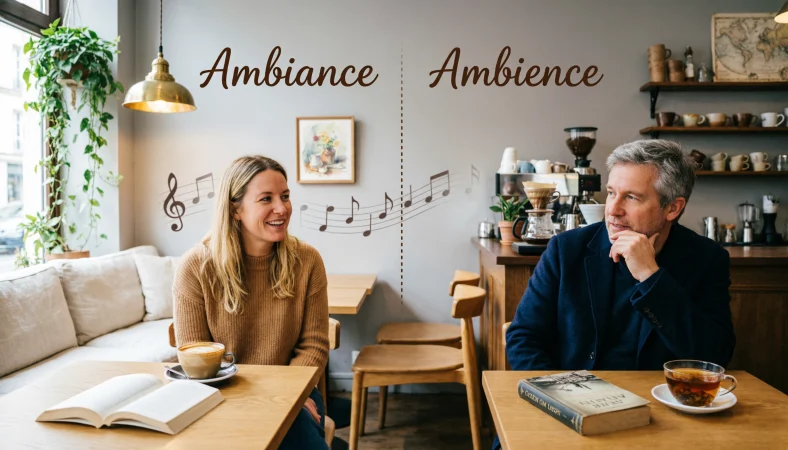
Ambiance or ambience both refer to the distinctive atmosphere, mood, or feeling created by a place, setting, or environment. The two spellings have the same meaning and pronunciation in standard English. Ambiance is especially common in American English, while ambience remains particularly common in British English and other varieties influenced by British usage.
When choosing between ambiance or ambience, you are generally choosing between two accepted spellings of the same noun rather than two different words. Both describe the overall character or atmosphere of a place. A restaurant can have a warm ambience, a hotel can create a luxurious ambiance, and a classroom can have a relaxed atmosphere.
The confusion matters because spelling conventions vary by country, publication, audience, and style guide. Choosing the form associated with your intended variety of English can make writing look more consistent and professionally edited.
Ambiance vs Ambience: What’s the Difference?
The simplest answer is that ambiance and ambience mean the same thing. Both are nouns describing the atmosphere, mood, or overall character of a particular environment.
Here is the key distinction:
The important point is that neither spelling represents a different definition.
Both forms can describe the emotional or sensory quality of an environment. The word can refer to lighting, decoration, music, architecture, noise, furnishings, colors, or even the behavior of people in a particular setting.
For example:
The restaurant has a sophisticated ambience.
You could replace ambience with ambiance without changing the meaning:
The restaurant has a sophisticated ambiance.
The choice is therefore mainly a matter of spelling preference and regional convention.
Quick recap:
Both spellings are correct.
Both are nouns.
Both mean atmosphere or mood.
Ambience is strongly associated with British English.
Ambiance is especially common in American English.
Is Ambiance vs Ambience a Grammar, Vocabulary, or Usage Issue?
This is primarily a spelling and usage issue, not a grammar problem.
Grammar determines how words function in sentences. In this case, both words function as nouns and can occupy the same grammatical positions.
Consider these examples:
The ambience was relaxing.
The ambiance was relaxing.
The grammatical structure is identical. The only difference is the spelling of the noun.
Are the two forms interchangeable?
Yes, in ordinary usage they are interchangeable.
You can use either spelling when describing the atmosphere of a restaurant, hotel, home, office, event, shop, or other environment.
For example:
The café has a cozy ambience.
The café has a cozy ambiance.
There is no meaningful difference in the atmosphere being described.
Is one spelling more formal?
No. Neither spelling is inherently more formal.
A formal British publication can use ambience, while a formal American publication can use ambiance. Likewise, either form can appear in casual writing.
The important factor is consistency.
If an American company consistently uses American English, ambiance may feel more natural. If a British publication follows British spelling conventions, ambience may be the preferred choice.
What about academic writing?
Both spellings can appear in academic writing when the concept of atmosphere is relevant.
However, academic writers should choose the spelling that matches the linguistic variety required by their institution, publisher, journal, or intended readership.
For example:
The ambience of the historic building contributed to visitors’ perception of authenticity.
There is nothing informal about this sentence.
Likewise:
The ambiance of the gallery influenced participants’ responses.
Both are grammatically sound.
Ambiance: When and How to Use It
Ambiance is a noun meaning the atmosphere or overall mood of a place.
It is especially familiar in American English and is widely used in descriptions of restaurants, hotels, entertainment venues, homes, retail spaces, and hospitality experiences.
Workplace example
The new office has a professional ambiance that encourages collaboration.
Here, the word refers to the overall feeling created by the office environment.
It could involve lighting, furniture, layout, noise levels, colors, and the way employees interact.
Academic example
Researchers examined how the ambiance of a classroom affected student engagement.
The word is suitable for serious analytical writing because it refers to an observable characteristic of an environment.
Technology example
Modern technology can also influence ambiance.
The smart lighting system allows users to change the ambiance of a room with a mobile application.
Here, lighting technology directly affects the perceived atmosphere.
This demonstrates an important feature of the word. Ambiance isn’t limited to restaurants or luxury spaces. Any environment can have an ambiance.
Usage recap
Use ambiance when you want to describe the overall mood or atmosphere of a setting. It works in casual, professional, marketing, and academic contexts. It is particularly familiar to readers accustomed to American English.
Ambience: When and How to Use It
Ambience has exactly the same basic meaning. It describes the atmosphere, character, or mood of a place.
It is especially familiar in British English and is widely used in British, Australian, and other international varieties of English.
Workplace example
The hotel has carefully designed its ambience to appeal to business travelers.
The noun describes the total impression produced by the environment.
Academic example
The study considered the ambience of public libraries as a factor in users’ willingness to remain in the space.
This use is completely appropriate in formal writing.
Technology example
Digital controls allow the homeowner to adjust the lighting and music to create a different ambience.
Again, the word refers to the atmosphere created by multiple environmental elements.
Usage recap
Use ambience when you want the same meaning as ambiance, particularly when following British English spelling conventions. It is fully acceptable in formal and informal contexts.
Why Do Ambiance and Ambience Have Two Spellings?
The story begins with French.
Both English spellings are connected to the French word ambiance, which refers to atmosphere or surrounding conditions. English adopted the word and developed spelling variation over time.
The ending became particularly interesting because English has historically adapted French vocabulary in different ways. The spelling ambiance retains a form closer to French, while ambience developed as an established English spelling.
This is not unusual. English contains thousands of words whose spelling reflects their historical journey through different languages.
The important lesson is that spelling variation does not necessarily indicate a difference in meaning.
In this case, the two forms developed into accepted English nouns with essentially the same definition.
American English vs British English
Regional English is one of the biggest reasons writers encounter both forms.
In American English, ambiance is highly familiar and frequently preferred.
In British English, ambience is especially well established.
That does not mean American writers cannot use ambience, or British writers cannot use ambiance. Both spellings are recognized in English.
The distinction is better understood as a matter of regional preference rather than correctness.
Consider a restaurant review written for an American audience:
The restaurant combines excellent food with a sophisticated ambiance.
Now consider a British publication:
The restaurant combines excellent food with a sophisticated ambience.
Both sentences communicate precisely the same idea.
Why consistency matters
Imagine a document that otherwise follows British spelling conventions but repeatedly uses American spelling choices. The individual words may not be wrong, but the document can appear inconsistently edited.
Professional writers should therefore think about the variety of English being used throughout the document.
If your article uses colour, favourite, and organise, for example, ambience may fit naturally with the overall British spelling pattern.
If your article uses color, favorite, and organize, ambiance may fit more naturally with American spelling conventions.
This is a style decision rather than a question of right versus wrong.
When You Should NOT Use Ambiance or Ambience
Although both words are useful, they aren’t appropriate in every situation.
1. Do not use either word when you simply mean physical surroundings
If you’re referring specifically to the physical objects around someone, environment, surroundings, or setting may be more precise.
The surrounding environment contained several large machines.
Using ambiance here could make the sentence unnecessarily subjective.
2. Do not use either word when you mean temperature
A room can certainly have a particular atmosphere, but if you specifically mean how hot or cold it is, say so.
The temperature in the laboratory was carefully controlled.
The word ambience does not directly mean temperature.
3. Do not use either word as a synonym for decoration
Decor can contribute to ambience, but decoration and ambience aren’t identical.
The restaurant’s decorations included wooden tables and hanging plants.
The decorations are physical features. The ambience is the overall impression created partly by those features.
4. Do not assume the word means mood in every context
Ambience usually concerns the atmosphere of a place or environment. When discussing someone’s personal emotional condition, mood may be more precise.
She was in a cheerful mood.
That sentence is usually more natural than trying to describe the person’s personal mood as ambience.
5. Do not treat the spellings as different concepts
There is no need to assign one spelling a special meaning.
Ambiance does not mean a more luxurious atmosphere.
Ambience does not mean a more traditional atmosphere.
The spelling does not change the definition.
6. Do not switch spellings randomly within one document
Choose the spelling that fits your audience and maintain it.
Consistency is particularly important in edited publications, business websites, educational content, and professional reports.
7. Do not assume one form is universally correct
English is a global language. A spelling that seems more natural to one reader may feel less familiar to another.
Regional preference is an important part of effective communication.
Common Mistakes and Decision Rules
Decision Rule Box
If you mean the overall atmosphere or mood of a place, use either spelling. If you mean a specific physical feature, choose a more precise noun such as lighting, decoration, setting, or environment.
Ambiance or Ambience in Modern Technology and AI Tools
Technology has expanded the contexts in which people discuss atmosphere.
Smart lighting, connected speakers, digital displays, home automation, virtual environments, and immersive entertainment systems can all influence the ambience of a space.
Artificial intelligence can also contribute indirectly. AI driven systems can adjust music, lighting, temperature, and visual displays according to user preferences or environmental conditions.
For example:
The intelligent lighting system automatically changes the ambiance throughout the evening.
The noun still means atmosphere. Technology has simply created new ways to produce and control that atmosphere.
This distinction is useful for content creators because modern discussions of ambiance often involve user experience.
A website can have an atmospheric visual identity. A virtual reality environment can create a particular feeling. A digital game can establish a tense or peaceful atmosphere through sound and visual design.
The underlying concept remains the same.
Ambiance and Ambience in Marketing and Hospitality
Hospitality is one of the areas where these words appear most frequently.
Restaurants often describe their ambience in relation to lighting, music, seating, architecture, and décor. Hotels may discuss the ambience of their lobbies, rooms, lounges, and restaurants.
Marketing writers use the term because customers don’t evaluate an experience solely through individual physical features.
A restaurant might have attractive furniture, soft lighting, quiet music, and carefully designed menus. Together, those elements contribute to the restaurant’s overall atmosphere.
That overall impression is what ambience or ambiance can describe.
For example:
The restaurant combines warm lighting, natural materials, and soft music to create a welcoming ambience.
This sentence is more than a description of individual objects. It explains how those features work together to produce a particular experience.
How to Choose the Right Spelling
The easiest method is to consider your audience first.
- If you’re writing primarily for an American audience, ambiance is often the natural choice.
- If you’re writing primarily for a British audience, ambience is often the natural choice.
- If you’re writing for an international audience, either is acceptable. Consistency matters more than selecting one supposedly superior form.
A useful editing question is:
What spelling am I using elsewhere in this document?
If the document consistently follows one regional variety of English, choose the form that complements it.
A practical example
Suppose you’re writing a British English article:
The café’s cosy ambience makes it popular with local customers.
That spelling fits naturally with British conventions.
For American English:
The café’s cozy ambiance makes it popular with local customers.
The difference extends beyond this one word. The surrounding spelling can reinforce the intended regional style.
Authority and Trust: What Linguists Mean by Correct Usage
A useful principle in English language editing is that correctness depends on established usage, context, and consistency.
An editor would not normally mark ambiance as wrong simply because ambience is more familiar in a particular variety of English. Both forms have established usage.
An expert style explanation would be:
“When two spellings carry the same meaning, the strongest choice is usually the one that matches the variety of English and editorial style used throughout the surrounding text.”
That principle applies far beyond these two words.
English contains many regional spelling differences, including pairs such as color and colour, favorite and favourite, and organize and organise.
The important skill is not memorizing which spelling is supposedly superior. It is understanding why different forms exist and selecting the one appropriate for the context.
Case study 1: Restaurant content
Imagine a restaurant website targeting customers in the United States. Its copy repeatedly uses American spelling.
A sentence such as:
Enjoy the elegant ambiance of our dining room.
fits naturally with that editorial style.
Changing the word to ambience would not make the sentence incorrect, but it could introduce an unnecessary variation.
Case study 2: British hospitality content
Now consider a British hotel website using British spelling throughout its content.
A sentence such as:
Guests can enjoy the peaceful ambience of our countryside retreat.
fits naturally with that style.
Again, the choice is not about one spelling being grammatically superior. It is about linguistic consistency and audience expectations.
Author expertise: Written from a professional English usage perspective, with attention to spelling variation, regional conventions, grammar, and practical editorial style.
Error Prevention Checklist
Always use ambiance when
- You are writing primarily for an American audience.
- Your publication follows American spelling conventions.
- Your surrounding text consistently uses American English.
- You want a standard noun meaning atmosphere or mood.
Always use ambience when
- You are writing primarily for a British audience.
- Your publication follows British spelling conventions.
- Your surrounding text consistently uses British English.
- You want a standard noun meaning atmosphere or mood.
Never treat one as a different meaning
- Do not claim that ambiance refers to luxury while ambience refers to ordinary atmosphere.
- Do not invent a pronunciation difference where none is intended.
- Do not classify one spelling as grammatical and the other as ungrammatical.
- Do not switch between spellings without a stylistic reason.
Related Grammar Confusions You Should Master
If you’re interested in spelling and usage differences, these related pairs are worth learning:
- Color or colour: American and British spelling preferences
- Favorite or favourite: Regional spelling variation
- Organize or organise: A common difference in English varieties
- Center or centre: American and British spelling
- Theater or theatre: Regional and stylistic variation
- Catalog or catalogue: Different established English forms
- Learned or learnt: Regional and usage differences
- Burned or burnt: Variation in past participle usage
- Toward or towards: Different preferences across English varieties
- Among or amongst: Closely related forms with stylistic differences
Understanding these pairs helps writers recognize an important truth about English: variation does not automatically mean error.
FAQs
Is ambiance or ambience correct?
Both are correct. They are standard English nouns with the same basic meaning. The main difference is regional preference. Ambiance is especially common in American English, while ambience is particularly common in British English.
Is ambience British or American?
Ambience is strongly associated with British English and is widely used in British writing. It is also understood and accepted in other forms of English, including American English.
Is ambiance American English?
Ambiance is especially common in American English. It is a standard spelling and appears frequently in American writing about restaurants, hotels, design, entertainment, and other environments.
Does ambiance mean the same as ambience?
Yes. The two words have the same essential meaning. Both refer to the atmosphere, mood, or overall character of a place or environment.
How do you pronounce ambiance and ambience?
They are generally pronounced the same in standard English. The spelling difference does not normally create a meaningful difference in pronunciation.
Which is more formal, ambiance or ambience?
Neither is inherently more formal. Both are suitable for formal and informal writing. The preferred form usually depends on regional English and editorial style.
Should I use ambience in British English?
Ambience is a very natural choice in British English. If your writing consistently follows British spelling conventions, using ambience can help maintain a coherent editorial style.
Should I use ambiance in American English?
Yes. Ambiance is a natural and widely used choice in American English. It works well in business writing, restaurant descriptions, academic contexts, marketing content, and everyday communication.
Can I use ambiance and ambience interchangeably?
Yes. They can normally be substituted for one another without changing the meaning of a sentence. The main consideration is consistency with your audience and chosen variety of English.
Is ambiance a French word?
The English word has French origins. English adopted it from French, and both ambiance and ambience became established spellings in English. Their shared history helps explain why the two forms have the same meaning.
Conclusion:
The choice between ambiance or ambience is not a choice between two different meanings. Both words are nouns meaning the atmosphere, mood, or overall character of a place. The major distinction is regional and stylistic. Ambiance is particularly common in American English, while ambience is particularly common in British English.
For everyday writing, either form is correct. The best choice is the one that matches your audience, publication style, and surrounding spelling conventions. If you’re writing American English, ambiance will usually feel natural. If you’re writing British English, ambience is often the better fit.
Most importantly, don’t treat one spelling as a mistake. Understanding regional variation is a key part of writing clear, confident English.