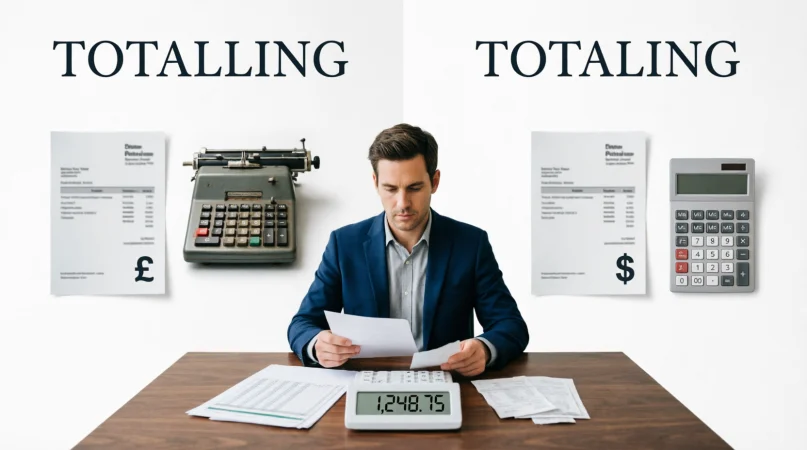
Both totalling or totaling are correct spellings of the present participle and gerund form of total. The difference is regional: totalling is standard in British English and many other varieties that follow British spelling, while totaling is standard in American English. Neither spelling is inherently wrong, but consistency with your chosen English variety matters.
The question of totalling or totaling often causes confusion because both forms appear in reputable English writing. Unlike many spelling pairs where one form is simply incorrect, this is a genuine regional spelling difference. British English generally doubles the final consonant before adding a suffix beginning with a vowel, while American English often keeps a single consonant in words such as totaling.
This distinction matters in financial reports, invoices, academic writing, business documents, software interfaces, and international communication. Choosing one form and using it consistently helps readers understand which spelling convention you are following.
Totalling vs Totaling: What’s the Difference?
Totalling and totaling come from the verb total.
The verb total means to add numbers together and calculate their complete amount. It can also mean to reach a particular amount when used in expressions describing a combined quantity.
The present participle is formed by adding the suffix ing.
British English generally writes:
totalling
American English generally writes:
totaling
The difference comes from spelling conventions rather than meaning.
| Feature | Totalling | Totaling |
| Word class | Verb form and gerund | Verb form and gerund |
| Base word | total | total |
| Meaning | Adding amounts together or reaching a total | Adding amounts together or reaching a total |
| British English | Standard | Less common |
| American English | Less common | Standard |
| Meaning difference | None | None |
| Example | The expenses are totalling £2,000. | The expenses are totaling $2,000. |
The important point is that totalling and totaling have the same meaning.
British English normally favors totalling.
American English normally favors totaling.
The spelling difference does not change the pronunciation or grammatical function.
When writing for an international audience, either form can be understood, but following the spelling convention used throughout the rest of the document is usually the clearest approach.
Is Totalling vs Totaling a Grammar, Vocabulary, or Usage Issue?
This is primarily a spelling and regional usage issue.
The underlying grammar is the same. Both forms are based on the verb total, and both can function as a present participle or gerund.
Consider:
The accountant is totalling the invoices.
And:
The accountant is totaling the invoices.
Both sentences communicate the same action.
The difference is the spelling convention associated with the variety of English being used.
Are Totalling and Totaling Interchangeable?
In meaning, yes.
In regional spelling, they are not normally treated as the preferred form in exactly the same varieties of English.
A British English writer will generally choose totalling.
An American English writer will generally choose totaling.
This pattern is similar to several other spelling differences between British and American English.
Formal Versus Informal Usage
Both forms are suitable for formal writing when they match the appropriate regional convention.
For example, a British financial report can correctly say:
The current expenses are totalling £48,500.
An American financial report can correctly say:
The current expenses are totaling $48,500.
Neither form is more formal than the other.
The important consideration is consistency.
Academic Versus Casual Usage
Academic writers should follow the spelling convention required by their institution, publication, instructor, or intended audience.
A British academic publication may use totalling.
An American academic publication may use totaling.
In casual communication, readers usually understand both forms without difficulty.
How to Use Totalling in British English
Totalling is the preferred spelling in British English.
The word is commonly used when discussing calculations, expenses, quantities, costs, scores, or other combined amounts.
For example:
The invoices are totalling £15,000.
Here, totalling describes the combined amount represented by the invoices.
Workplace Example
The department is totalling the quarterly expenses before preparing the report.
This sentence describes an employee adding together the relevant expenses.
Academic Example
The researchers recorded 240 responses, totalling 120 pages of data.
Here, totalling introduces the combined quantity.
Technology Example
The application is totalling the values entered into the spreadsheet.
A British English interface or technical document may use this spelling.
Financial Example
The outstanding payments are totalling £7,850.
The word describes the combined amount of the payments.
Usage Recap
Use totalling when writing in British English or another variety that follows British spelling conventions. Its meaning is exactly the same as totaling.
How to Use Totaling in American English
Totaling is the standard American English spelling.
It has the same grammatical function and meaning as totalling.
For example:
The expenses are totaling $8,500.
The sentence means that the combined expenses amount to $8,500.
Workplace Example
The invoices are totaling more than $20,000.
This is natural American business English.
Academic Example
The study included 500 observations, totaling approximately 100 hours of recorded data.
Here, totaling identifies the combined quantity.
Technology Example
The software is totaling the values automatically.
American software documentation commonly uses this spelling convention.
Financial Example
The charges are totaling $1,250.
The word describes the combined amount of the charges.
Usage Recap
Use totaling when writing in American English. It is the standard spelling in American professional, academic, financial, and general writing.
Why Does British English Use Totalling?
The spelling difference becomes easier to understand when you look at a broader pattern.
British English often doubles a final consonant when adding certain suffixes to words in which the final syllable carries the relevant stress or when established spelling conventions call for doubling.
This produces forms such as:
travelling
cancelling
modelling
labelled
The same general tendency can produce:
totalling
American English often uses a simpler spelling pattern in these situations.
Therefore, American English commonly writes:
traveling
canceling
modeling
labeled
And:
totaling
The important point is that the British spelling is not adding an extra letter randomly. It reflects a broader spelling tradition.
Likewise, the American form is not a careless shortened version. It follows American spelling conventions.
When You Should Not Use Totalling or Totaling
There are several situations in which writers can make mistakes with these forms.
1. Do Not Treat One Regional Form as a Universal Rule
If your document follows British English, use totalling.
If it follows American English, use totaling.
2. Do Not Mix Regional Spellings Carelessly
A document that uses British spellings throughout can look inconsistent if it suddenly uses totaling.
Likewise, American English writing can look inconsistent when it uses totalling alongside other American spellings.
3. Do Not Assume Totalling Is Incorrect
Totalling is not a misspelling. It is a standard British English form.
4. Do Not Assume Totaling Is Incorrect
Totaling is not an error in American English. It is the standard American spelling.
5. Do Not Confuse Total With Totally
Total is the base word.
Totally is the adverb.
The cost is totaling $5,000.
The result was totally unexpected.
These forms have different grammatical functions.
6. Do Not Confuse Totalling With Totalled
Totalling describes an ongoing action or can function as a gerund.
Totalled is the past tense and past participle in British English.
American English normally uses totaled.
For example:
The expenses are totalling £4,000.
The expenses totalled £4,000.
American English:
The expenses are totaling $4,000.
The expenses totaled $4,000.
7. Do Not Change Spelling Without Considering Your Audience
A spelling choice should fit the variety of English used by your readers.
8. Do Not Correct a Regional Form Automatically
Seeing totalling in a British document does not mean you have found a spelling error.
Common Mistakes and Decision Rules
| Correct sentence | Incorrect sentence | Explanation |
| The costs are totalling £4,500. | The costs are totaling £4,500. | British English normally uses totalling. |
| The costs are totaling $4,500. | The costs are totalling $4,500. | American English normally uses totaling. |
| The expenses totalled £6,000. | The expenses totaled £6,000. | British English commonly doubles the consonant in this form. |
| The expenses totaled $6,000. | The expenses totalled $6,000. | American English normally uses totaled. |
| The figures are totalling the final amount. | The figures are totaling the final amount. | The first form follows British spelling. |
| The figures are totaling the final amount. | The figures are totalling the final amount. | The first form follows American spelling. |
Decision Rule Box
- If you are writing in British English, use totalling.
- If you are writing in American English, use totaling.
- If your audience or style guide specifies a regional variety, follow that convention throughout the document.
If no variety is specified, choose one convention and remain consistent.
Totalling and Totaling in Modern Technology and AI Tools
Technology has made regional spelling differences more visible.
Software products often serve users across several countries, which means their interfaces and documentation may follow different English conventions.
A British English application might describe a calculation as:
Totalling selected values.
An American application might use:
Totaling selected values.
Both expressions communicate the same action.
Artificial intelligence systems also need to recognize regional spelling. A language model may generate either form depending on the surrounding text, training patterns, requested regional English, and editorial instructions.
For content creators, the best practice is to establish the intended variety before producing a large document.
If the document uses British forms such as colour, organise, and travelling, totalling will generally fit that style.
If it uses American forms such as color, organize, and traveling, totaling will generally fit better.
This matters especially for websites, software documentation, educational resources, business reports, and publications serving a specific geographic audience.
The Etymology of Total and Its Modern Usage
The word total ultimately comes through French from Latin totalis, meaning whole or entire.
English developed the noun total for a complete amount and later developed the verb total, meaning to add amounts together or bring something to a total.
The verb has become extremely common in modern English.
- You can total a bill.
- You can total expenses.
- You can total scores.
- You can total sales.
- You can also use total as an adjective meaning complete or entire.
For example:
The total cost was $4,000.
The present participle then follows the regional spelling conventions discussed throughout this article.
British English writes:
totalling
American English writes:
totaling
The underlying word and meaning remain unchanged.
An Expert Perspective on Totalling and Totaling
“When two spellings represent the same word in different English varieties, consistency is more important than treating one regional form as universally correct.”
This principle is particularly useful for writers working with international audiences.
Regional spelling is a normal feature of English rather than a sign that one variety is inherently more correct.
The practical goal is to identify the intended variety and maintain it throughout the document.
Two Practical Case Studies
Case Study 1: British Financial Reporting
Imagine a British company preparing a quarterly financial report.
The report contains the sentence:
Operating costs are totaling £2.4 million.
The meaning is completely understandable, but the spelling does not match the document’s British English convention.
A consistent revision would be:
Operating costs are totalling £2.4 million.
The numerical information has not changed.
The grammatical meaning has not changed.
Only the regional spelling has been aligned with the surrounding style.
This matters when documents are edited professionally because consistency contributes to a polished and coherent editorial style.
Case Study 2: American Business Software
Now consider American accounting software that displays:
Totalling selected transactions.
The application uses American English throughout its interface.
A more consistent American English version would be:
Totaling selected transactions.
Again, the meaning remains identical.
The practical result is consistency between the interface language and the spelling convention expected by American users.
These examples show why the choice is not simply about identifying a correct and incorrect word. It is about matching the spelling to the intended English variety.
Error Prevention Checklist
Always use Totalling when
- You are writing in British English.
- Your publication follows British spelling.
- Your organization uses British English consistently.
- Your readers primarily expect British English.
- Your style guide specifies British spelling.
- You are maintaining a document that already uses related British spellings.
Always use Totaling when
- You are writing in American English.
- Your publication follows American spelling.
- Your organization uses American English consistently.
- Your readers primarily expect American English.
- Your style guide specifies American spelling.
- Your software documentation follows American English.
Never use either form when
- You actually need the base verb total.
- You need the noun total.
- You need the adjective total.
- You need the adverb totally.
- You are using the word without checking its grammatical role.
The spelling question only matters when you specifically need the present participle or gerund form.
Related Grammar Confusions You Should Master
Understanding regional spelling differences can help you handle other commonly confused forms.
1. Traveling or Travelling
American English normally uses traveling, while British English generally uses travelling.
2. Modeling or Modelling
American English commonly uses modeling, while British English generally uses modelling.
3. Canceling or Cancelling
American English commonly uses canceling, while British English generally uses cancelling.
4. Labeled or Labelled
American English generally uses labeled, while British English generally uses labelled.
5. Center or Centre
Center is standard American English, while centre is standard British English.
6. Color or Colour
Color is standard American English, while colour is standard British English.
7. Organize or Organise
Organize is standard in American English. British English commonly uses organise, although organize is also accepted in some British usage contexts.
8. Realized or Realised
Realized is the common American spelling, while realised is widely used in British English.
9. Offense or Offence
Offense is standard American English, while offence is standard British English.
10. Favorite or Favourite
Favorite is standard American English, while favourite is standard British English.
These examples show that English contains many legitimate regional spelling differences. The presence of two spellings does not necessarily mean that one is a mistake.
FAQs.
Is totalling or totaling correct?
Both spellings are correct. Totalling is the standard British English form, while totaling is the standard American English form. They have the same meaning and grammatical function.
Is totalling British or American English?
Totalling is primarily the British English spelling. It is also used in other varieties of English that generally follow British spelling conventions.
Is totaling American or British English?
Totaling is the standard American English spelling. American English generally does not double the final consonant in this word before adding the suffix ing.
Should I use totalling or totaling in academic writing?
Use the form required by your academic institution, publication, or intended English variety. British English writing normally uses totalling, while American English writing normally uses totaling.
Why does British English spell totalling with two l letters?
British spelling conventions often double a final consonant in certain forms when suffixes are added. This produces forms such as totalling, travelling, and modelling.
Why does American English use totaling?
American English commonly uses a single l in this form. Totaling follows an American spelling convention that differs from the British form totalling.
Is totalling a misspelling of totaling?
No. Totalling is a standard British English spelling. It is not a misspelling simply because American English uses totaling.
Is totaling a misspelling of totalling?
No. Totaling is the standard American English spelling. It is not an error when used within American English.
What is the past tense of total in British English?
The common British English past tense is totalled.
For example:
The expenses totalled £10,000.
What is the past tense of total in American English?
The common American English past tense is totaled.
For example:
The expenses totaled $10,000.
Conclusion:
The choice between totalling or totaling depends on the variety of English you are using.
Choose totalling for British English and other writing that follows British spelling conventions. Choose totaling for American English.
Neither form changes the meaning of the word. Both refer to adding amounts together or reaching a combined total.
The most useful rule is therefore regional consistency. If your document uses British spelling, totalling will normally fit naturally. If it uses American spelling, totaling is the appropriate choice.
This distinction is especially useful for writers working on financial documents, academic papers, websites, software interfaces, business reports, and international content. Once you understand the regional pattern, the choice becomes straightforward.
When editing your work, don’t automatically treat one spelling as wrong. First identify which English variety the document follows. Then use the corresponding form consistently.











4 thoughts on “Totalling vs. Totaling: Which Spelling Is Correct? British & American English Meaning, Usage & Examples For 2026”