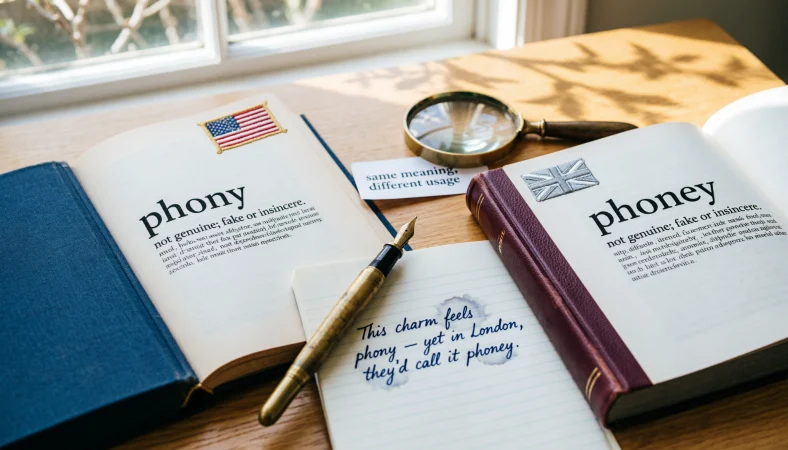
Phony and phoney are both correct spellings of the adjective meaning fake, false, or not genuine. Phony is more common in American English, while phoney is more common in British English. Both forms have the same meaning, so the best choice depends on your preferred variety of English and the audience you’re writing for.
Have you ever wondered whether to write phoney or phony? Both spellings are accepted, but their popularity varies between American and British English. Phony is generally preferred in American English, while phoney is more common in British English, which can make the spelling confusing for writers.
This guide explains phoney and phony in simple, beginner friendly language, covering their meaning, spelling, pronunciation, regional usage, and practical examples. Understanding this small difference can help you choose the form that best fits your audience and maintain consistency throughout your writing.
Phoney vs Phony: What’s the Difference?
The main difference between phoney and phony is regional spelling rather than meaning. Both words describe something that is fake, false, insincere, or designed to appear genuine when it is not.
In American English, phony is the usual spelling. In British English, phoney is traditionally common, although phony is also understood and increasingly encountered.
The two forms can function as adjectives and nouns.
As an adjective, the word describes something that is not genuine.
For example:
“His friendly attitude seemed phony.”
As a noun, it can describe a person who is pretending to be something they are not.
For example:
“He turned out to be a phony.”
| Feature | Phony | Phoney |
| Part of speech | Adjective and noun | Adjective and noun |
| Meaning | Fake, false, insincere | Fake, false, insincere |
| American English | Standard and very common | Less common |
| British English | Used and understood | Traditional and common |
| Meaning difference | None | None |
| Main distinction | Regional spelling | Regional spelling |
Mini Recap
Phony is the standard American spelling.
Phoney is especially associated with British English.
Both forms mean fake, false, or insincere.
Neither spelling changes the basic meaning.
Is Phoney vs Phony a Grammar, Vocabulary, or Usage Issue?
The phoney vs phony question is primarily a spelling and regional usage issue.
It isn’t a case where one word has one meaning and the other has a completely different meaning. Instead, the two spellings represent the same word in different varieties of English.
This distinction is similar to other regional spelling differences, such as:
“Color” and “colour”
“Favorite” and “favourite”
“Center” and “centre”
In each case, the intended meaning remains essentially the same, while spelling conventions vary by region.
Are Phony and Phoney Interchangeable?
In terms of meaning, yes.
A writer can use either spelling to communicate the idea of something fake or insincere. However, the choice should match the variety of English being used.
An American publication would generally prefer:
“The website looked phony.”
A British publication might use:
“The website looked phoney.”
Using phoney in an American context isn’t usually a comprehension problem, but it can look inconsistent with the spelling conventions of the rest of the text.
Formal vs Informal Usage
Both forms are associated with informal or conversational vocabulary.
The word can appear in journalism, fiction, conversation, commentary, and general writing. In highly formal writing, however, a more precise word may sometimes be preferable.
Instead of:
“The documents were phony.”
a formal report might say:
“The documents were fraudulent.”
The choice depends on the exact meaning.
Phony can describe something that is fake or insincere without necessarily establishing that it is legally fraudulent.
Academic vs Casual Usage
Academic writing often benefits from precise terminology.
For example, a researcher discussing misleading claims might use:
“false”
“fabricated”
“misleading”
“inauthentic”
“fraudulent”
The word phony is more conversational and can carry an emotional or judgmental tone.
That doesn’t make it incorrect. It simply means writers should consider whether the tone fits the context.
How to Use Phony in American English
Phony is the preferred spelling in American English.
It can describe a fake object, a false claim, an insincere emotion, a dishonest identity, or a person pretending to be someone they are not.
Consider these examples.
Workplace Example
“The manager became suspicious when he received a phony invoice.”
Here, phony means fake or not genuine.
Another example:
“She thought his apology sounded phony.”
In this sentence, the word describes insincerity rather than a physically fake object.
Academic Example
“The researcher identified several phony claims in the report.”
This sentence is understandable, but a formal academic version could use “false” or “fabricated” if that more precisely describes the evidence.
Technology Example
“Users should be careful when receiving messages from phony websites.”
Here, phony describes websites designed to appear legitimate when they are not.
It can also describe an identity:
“The account appeared to use a phony name.”
Usage Recap
Use phony when writing primarily in American English.
It can describe people, objects, claims, identities, websites, documents, and behavior.
Choose a more precise formal term when the context requires technical accuracy.
How to Use Phoney in British English
Phoney is traditionally associated with British English and remains a valid spelling.
The meaning is the same as phony.
For example:
“That excuse sounds phoney.”
“The caller gave me a phoney name.”
“He realized that the offer was phoney.”
The spelling fits naturally with British spelling conventions, although modern British usage also encounters the shorter form phony.
Workplace Example
“The customer complained that the advertisement was phoney.”
Here, the writer is describing an advertisement as fake or misleading.
Academic Example
“A phoney identity was created for the experiment.”
Depending on the subject, an academic writer might instead choose “false identity” or “fabricated identity” for greater precision.
Technology Example
“The message contained a link to a phoney website.”
This usage is particularly natural when discussing scams, impersonation, or deceptive websites.
Usage Recap
Use phoney when following British spelling conventions.
Its meaning is the same as phony.
Consistency with the rest of your writing is more important than treating one spelling as universally correct.
When You Should NOT Use Phoney or Phony
Although both spellings are correct, there are situations where neither word is the most precise choice.
1. When You Mean Legally Fraudulent
If you are discussing a confirmed fraudulent act, fraudulent may communicate the meaning more precisely.
2. When You Mean Factually Incorrect
Use false when the central issue is whether a statement is true or untrue.
3. When You Mean Manufactured Evidence
Words such as fabricated or forged may be more appropriate depending on the circumstances.
4. When You Mean Artificial but Not Deceptive
Something can be artificial without being phony.
For example, artificial flowers aren’t necessarily deceptive.
5. When You Need Highly Formal Language
A business report or academic paper may benefit from a more specific term.
6. When You Are Writing for Children
Simple words such as “fake” may be easier to understand.
7. When You Are Describing a Genuine Mistake
A mistake isn’t automatically phony.
Calling an accidental error phony incorrectly suggests deliberate deception or insincerity.
8. When Regional Consistency Matters
If the rest of your article follows American spelling, phony is generally the better choice. If it follows traditional British spelling, phoney may fit better.
Common Mistakes and Decision Rules
| Correct Sentence | Incorrect or Less Suitable Sentence | Explanation |
| His apology sounded phony. | His apology sounded phoney. | The second spelling is not wrong, but phony fits American English better. |
| The website was phony. | The website was phoney. | American spelling generally uses phony. |
| The advertisement looked phoney. | The advertisement looked phony. | Phoney fits traditional British spelling. |
| He was a phony. | He was a phoney. | Both are valid, but regional convention determines preference. |
| The documents were fraudulent. | The documents were phony. | Fraudulent is more precise when legal fraud is established. |
| The claim was false. | The claim was phony. | False is more precise when the issue is truth rather than appearance or sincerity. |
Decision Rule Box
If you are writing in American English, normally use phony.
If you are following traditional British English spelling, phoney is appropriate.
If you mean legally fraudulent, consider fraudulent instead.
If you mean factually untrue, consider false instead.
Phoney and Phony in Modern Technology and AI Tools
Modern technology has created many situations in which words such as phony and phoney are used to describe deceptive digital activity.
Examples include phony websites, phony accounts, phony profiles, phony messages, and phony identities.
Artificial intelligence has also made the distinction between genuine and fabricated content increasingly important.
For example, someone might describe an apparently authentic profile as “phony” if the identity behind it is fabricated.
However, terminology matters.
Calling something phony is a general description. It doesn’t necessarily explain how the deception occurred.
A more technical explanation might use terms such as:
“impersonation”
“fabricated identity”
“synthetic media”
“fraudulent account”
“misleading content”
“spoofed website”
The most appropriate word depends on what is actually happening.
AI tools can also produce text that sounds convincing without guaranteeing that every statement is true. In professional contexts, writers should therefore distinguish between something that merely appears genuine and something that has been independently verified.
Etymology of Phony and Phoney
The history of phony is closely associated with the noun phony, meaning a fake or fraudulent person or thing.
The word is generally understood to have developed from fawney, a term connected with a fake ring or fraudulent scheme. The spelling and pronunciation changed over time as the word became established in English.
The forms phony and phoney developed as spelling variants.
The extra e in phoney does not create a different meaning. It is simply part of the spelling convention associated particularly with British English.
This makes the pair a useful example of how English spelling can evolve differently across regions while preserving the same underlying vocabulary.
An Expert Perspective on Phony and Phoney
“The distinction between phony and phoney is primarily regional spelling, not a difference in meaning.”
That distinction is the key point to remember.
Writers sometimes assume that one spelling must be correct and the other must be incorrect. In this case, that assumption creates unnecessary confusion.
Both forms are established English spellings.
The more useful question is which spelling matches the variety of English you are writing.
Two Practical Case Studies
Case Study 1: American Business Writing
Imagine an American company writing an article about fraudulent online advertisements.
The writer might say:
“Consumers should be cautious of phony advertisements.”
The spelling phony fits American English.
If the same writer consistently uses American forms such as “color,” “favorite,” and “center,” switching to phoney would create a regional spelling inconsistency.
Result: Using phony maintains consistency with American English conventions.
Case Study 2: British Editorial Writing
Now imagine a British publication discussing an insincere public statement.
The writer might say:
“Readers quickly recognized the statement as phoney.”
Here, phoney fits the publication’s traditional British spelling style.
The meaning remains exactly the same as the American form.
Result: Using phoney maintains consistency with the publication’s regional spelling conventions.
These examples show why context and audience matter more than trying to identify one spelling as universally correct.
Error Prevention Checklist
Always use phony when:
- You are writing primarily in American English.
- Your publication follows American spelling conventions.
- You want the standard American form.
- The word describes something fake or insincere.
Always consider phoney when:
- You are following traditional British English spelling.
- Your publication uses British spelling conventions.
- Regional consistency is important.
- Your surrounding text uses British forms.
Never assume:
- Phoney is automatically incorrect.
- Phony has a different basic meaning.
- The spelling alone determines whether something is fraudulent.
- Every context requires an informal word such as phony.
Related Spelling Confusions You Should Master
Learning phoney or phony also helps with other regional spelling differences.
Color or Colour
Both forms describe the same concept, with different regional preferences.
Favorite or Favourite
American English generally uses “favorite,” while British English traditionally uses “favourite.”
Honor or Honour
The two forms differ primarily according to regional spelling conventions.
Center or Centre
American English generally prefers “center,” while British English traditionally uses “centre.”
Theater or Theatre
Both forms are established, with regional and contextual preferences.
Realize or Realise
American English commonly uses “realize,” while British English often uses “realise.”
Analyze or Analyse
The preferred form depends largely on the variety of English being used.
Catalog or Catalogue
Both forms are established, with different regional preferences.
Defense or Defence
American English generally uses “defense,” while British English traditionally uses “defence.”
Practice or Practise
This distinction requires more attention because British English traditionally treats the noun and verb differently, while American English commonly uses “practice” for both.
FAQs
Is phony or phoney correct?
Both phony and phoney are correct English spellings. Phony is the standard form in American English, while phoney is particularly associated with British English.
Is phony American or British English?
Phony is the standard spelling in American English. It is also understood and used elsewhere, including in British English.
Is phoney British English?
Phoney is traditionally associated with British English. It remains a valid spelling, although phony is also encountered in modern British usage.
What does phony mean?
Phony means fake, false, insincere, or not genuine. As a noun, it can refer to a person who pretends to be someone or something they are not.
What does phoney mean?
Phoney has the same basic meaning as phony. It can describe something fake, false, insincere, or not genuine.
Is phoney a misspelling of phony?
No. Phoney is an established spelling variant. It is particularly associated with British English.
Should I use phony or phoney in American English?
Use phony when following standard American English spelling conventions.
Should I use phony or phoney in British English?
Phoney is traditionally associated with British English, but phony is also understood and used. Follow the style guide and spelling conventions of your publication.
What is the difference between phony and fake?
They can be similar, but fake is generally broader and more neutral. Phony often suggests that something is presented as genuine when it is not, and it can also suggest insincerity or deception.
What is the difference between phony and fraudulent?
Phony is a broad, often informal term for something fake or not genuine. Fraudulent is more precise and is especially appropriate when deliberate deception for unlawful gain is involved.
Conclusion:
The choice between phoney or phony is mainly a matter of regional spelling. Both forms have the same fundamental meaning and can function as adjectives or nouns.
Phony is the standard spelling in American English, while phoney is traditionally associated with British English. Neither form should automatically be labeled incorrect.
The best choice depends on your audience and the spelling system used throughout your writing.
If you’re writing for an American audience, choose phony. If you’re following traditional British English conventions, phoney may be the more natural choice.
The distinction becomes even clearer when you consider the meaning of the word. Both forms can describe a fake object, an insincere statement, a fabricated identity, or a person pretending to be genuine.
For formal writing, however, consider whether a more precise word would communicate your meaning better. Terms such as false, fabricated, fraudulent, forged, or inauthentic may be more appropriate depending on the context.
The simplest rule is straightforward: phony for American English, phoney for traditional British English, and consistency throughout your writing matters most.