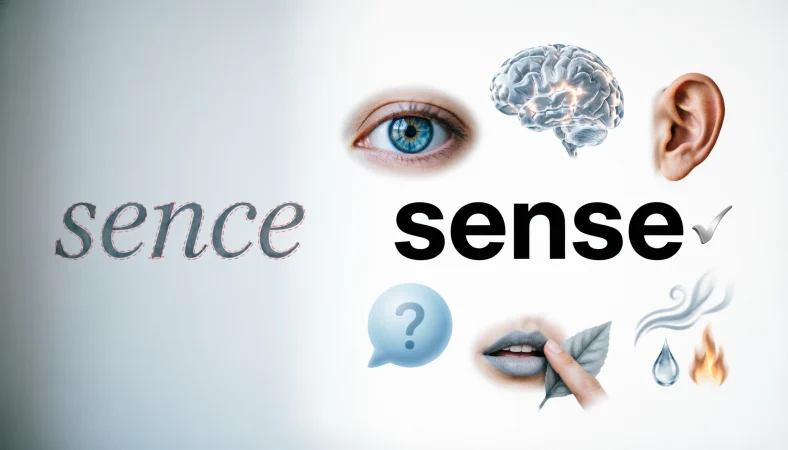
Sence or sense is a common spelling confusion, but only sense is the standard spelling in modern English. Sense is a noun or verb referring to meaning, perception, judgment, or awareness. Sence is generally a misspelling and should not be used in standard English writing, whether the context is academic, professional, casual, or digital.
The confusion often happens because sense contains a silent c sound pattern that can be difficult to remember when writing quickly. Since sence looks plausible, writers sometimes produce it by spelling the word according to its pronunciation. That small error can affect emails, essays, applications, website content, and other forms of written communication.
If you’re wondering which spelling belongs in a sentence, the reliable answer is simple: use sense. The word sence does not normally function as an accepted alternative spelling.
Sence vs Sense: What’s the Difference?
The difference between sence and sense is not a difference in meaning between two legitimate English words. In standard modern English, sense is the correct spelling.
| Feature | Sence | Sense |
| Standard English word | No | Yes |
| Part of speech | Not normally used as a standard English word | Noun and verb |
| Main meaning | Usually an error for sense | Meaning, perception, judgment, awareness, or understanding |
| Standard spelling | Incorrect in ordinary English | Correct |
| Common usage | Misspelling | Very common English word |
| Formal writing | Avoid | Appropriate |
| Academic writing | Avoid | Appropriate |
| Pronunciation | Usually intended as sense | Commonly pronounced /sens/ |
The word sense has several important meanings. It can refer to one of the five physical senses, such as sight or hearing. Also It can mean good judgment, as in “She has good sense.” It can also refer to meaning, as in “What is the sense of this sentence?”
As a verb, sense can mean to perceive or recognize something. For example:
I sensed that something was wrong.
Sence, by contrast, is generally what happens when someone attempts to spell sense incorrectly.
Quick recap
Sense is the correct standard spelling.
Sence is normally a misspelling.
Sense can function as both a noun and a verb.
The correct choice does not depend on American versus British English.
When writing in standard English, use sense.
Is Sence vs Sense a Grammar, Vocabulary, or Usage Issue?
This is primarily a spelling issue, although understanding the vocabulary and grammar of sense helps prevent the mistake.
Unlike pairs such as color and colour, there is no major regional spelling distinction here. British and American English both use sense.
That makes this confusion especially straightforward.
You should write:
That doesn’t make sense.
Not:
That doesn’t make sence.
You should write:
I can sense that she is upset.
Not:
I can sence that she is upset.
Are the two forms interchangeable?
No. In ordinary modern English, sence cannot be freely substituted for sense.
The two forms may look similar, but they don’t represent two accepted spelling variants. If you write sence when you mean sense, most readers will interpret it as a spelling mistake.
Formal versus informal usage
Sense is suitable in every register. You can use it in a casual text message, a professional report, an academic paper, or a formal speech.
For example:
That makes sense.
This is natural in conversation.
The findings make sense in light of the available evidence.
This is suitable for academic writing.
The word itself doesn’t belong to a particular level of formality.
Academic versus casual usage
Academic writing frequently uses sense in discussions of language, philosophy, psychology, perception, mathematics, and interpretation.
For example:
The term is used in a different sense in this chapter.
The spelling remains sense regardless of the subject.
How to Use Sense Correctly
Because sense has several meanings, understanding its different uses is more helpful than simply memorizing its spelling.
Sense as a noun meaning meaning
One of the most common uses of sense is to refer to meaning or interpretation.
What sense does this sentence make?
I don’t understand the sense of that argument.
This usage is particularly common when discussing language, communication, or ideas.
Sense as a noun referring to perception
Sense can also refer to one of the human faculties through which we perceive the world.
The traditional five senses are sight, hearing, smell, taste, and touch.
For example:
Dogs have an excellent sense of smell.
Here, sense refers to a capacity for perception.
Sense as a noun meaning good judgment
Another common meaning involves practical judgment.
You should use common sense.
She has a good sense of responsibility.
This meaning appears frequently in everyday speech and professional communication.
Sense as a noun referring to awareness
The word can also describe awareness of something.
He had a sense that someone was watching him.
This means he had an impression or feeling that something was happening.
Sense as a verb
As a verb, sense means to perceive, detect, or recognize something.
I sensed a change in his attitude.
The device can sense movement.
This form is especially common in technology and science.
Workplace example
The manager sensed that the team needed additional support.
Here, sense functions as a verb meaning to recognize or perceive.
Academic example
The word is used in a different sense in contemporary linguistics.
Here, sense functions as a noun meaning a particular meaning or interpretation.
Technology example
The sensor can sense changes in temperature.
In this sentence, sense is a verb connected with technological detection.
Usage recap
Use sense when referring to meaning, perception, awareness, judgment, or detection. It can work naturally as either a noun or a verb.
Why Do People Write Sence Instead of Sense?
The most likely reason is pronunciation.
The word sense is pronounced approximately like “sens.” The spelling does not transparently reveal every part of its written structure to someone learning English.
When people spell words based primarily on how they sound, they may produce forms that look reasonable but are not standard. Sence is one such example.
Another reason is visual similarity. English contains many words ending in ence, including difference, reference, experience, and sentence. That pattern can make sence look believable.
However, English spelling cannot always be predicted simply by pronunciation or by copying a familiar ending.
The best approach is to remember the standard spelling as a complete word:
sense
You can also connect it with familiar expressions such as:
common sense
sense of humor
sense of direction
make sense
sense of smell
sense of responsibility
Seeing the correct spelling repeatedly makes the pattern easier to remember.
When You Should NOT Use Sence or Sense
There are several situations where writers commonly make mistakes involving this word.
1. Do not write sence because it matches the pronunciation
English spelling is not completely phonetic. The fact that a spelling appears to match the sound doesn’t make it standard.
2. Do not treat sence as a British spelling
It isn’t the British equivalent of sense. British English uses sense as well.
3. Do not use sence in academic writing
Academic readers expect standard spelling. Use sense consistently.
4. Do not use sence in professional communication
A spelling error can make otherwise polished communication look careless.
5. Do not assume spell check will always save you
A spelling checker may identify sence, but you shouldn’t rely entirely on automated correction. Context and language knowledge remain important.
6. Do not confuse sense with since
These words look and sound somewhat similar in some accents, but they have different meanings.
7. Do not confuse sense with scents
Sense can refer to perception or meaning, while scents refers to smells.
8. Do not assume every similar looking form is a legitimate variant
English has many spelling variations, but sence is not normally an accepted alternative spelling of sense.
Common Mistakes and Decision Rules
| Correct sentence | Incorrect sentence | Explanation |
| That makes sense. | That makes sence. | Sense is the standard spelling. |
| I can sense danger. | I can sence danger. | The verb is spelled sense. |
| She has common sense. | She has common sence. | The fixed expression uses sense. |
| He has a good sense of humor. | He has a good sence of humor. | Sense is required. |
| What does this sentence mean in this sense? | What does this sentence mean in this sence? | The noun is spelled sense. |
| The machine can sense movement. | The machine can sence movement. | The verb is sense. |
Decision Rule Box
If you mean meaning, perception, judgment, awareness, or detection, use sense.
If you are tempted to write sence, check the word again. In standard English, sense is the spelling you normally need.
Sense in Modern Technology and AI Tools
The word sense is especially important in modern technology.
Sensors allow machines to detect environmental information such as temperature, pressure, movement, light, sound, or proximity. As a result, sense appears frequently in technical writing.
For example:
The camera can sense movement in low light.
Artificial intelligence also relies heavily on concepts associated with sensing and perception. AI systems may process visual information, audio signals, text, or other forms of data. Although machine perception is technically different from human sensory experience, the language of sensing remains common.
Writers creating technology content should therefore pay particular attention to the spelling. A typo such as sence can be especially noticeable in technical documentation, product descriptions, software explanations, and educational material.
Search engines and AI systems can often understand what a writer intended despite the spelling error, but that doesn’t make the error desirable. Correct spelling improves clarity, professionalism, and reader trust.
The Etymology of Sense
The history of sense helps explain why it is such a versatile word.
The English word comes through Old French and ultimately traces back to Latin sensus, meaning perception, feeling, or understanding. It is related to the Latin verb sentire, meaning to feel or perceive.
This historical connection helps explain why sense has developed several related meanings.
It can describe physical perception:
the sense of hearing
It can describe intellectual understanding:
That makes sense.
It can describe judgment:
Use common sense.
It can describe awareness:
I had a sense that something was wrong.
It can also describe detection:
The device senses heat.
These meanings are connected by the broader idea of perception, understanding, or recognition.
An expert style perspective
A useful way to remember the word is:
Sense connects perception with understanding.
You can perceive something through a physical sense, understand the meaning of something, or recognize something intuitively. The same spelling remains sense.
Two Real World Usage Case Studies
Case study 1: Professional communication
Consider an employee writing:
The proposed changes don’t sence because the original problem has already been solved.
The reader will almost certainly understand the intended meaning, but the spelling error weakens the professionalism of the message.
The corrected version is:
The proposed changes don’t make sense because the original problem has already been solved.
The correction is small, but it improves the credibility of the entire sentence.
Case study 2: Educational writing
Imagine a student writing:
In this sence, the author is using the word metaphorically.
The intended word is obvious, but the standard version is:
In this sense, the author is using the word metaphorically.
This example shows why spelling matters in academic work. A misspelled word can distract readers from an otherwise strong argument.
Error Prevention Checklist
Always use sense when
- You mean meaning or interpretation.
- You mean a physical faculty such as sight or hearing.
- You mean practical judgment.
- You mean awareness or an impression.
- You mean detection or perception.
- You are using the phrase “make sense.”
- You are writing professionally or academically.
Never use sence when
- You mean the standard English word sense.
- You’re writing an essay, report, article, email, or application.
- You’re describing perception or awareness.
- You’re discussing the meaning of a word or statement.
The safest habit is simple: whenever you mean the common English word pronounced like “sens,” write sense.
Related Spelling Confusions You Should Master
Understanding sence versus sense can help you recognize other common spelling problems.
1. Since or sense
Since usually refers to time or cause, while sense refers to meaning, perception, or judgment.
2. Scents or sense
Scents refers to smells, while sense has several meanings related to perception and understanding.
3. Sentence or sense
These words are related historically but have different meanings and spellings.
4. Advice or advise
Advice is normally a noun, while advise is a verb.
5. Affect or effect
These words have different grammatical roles and meanings despite their similar appearance.
6. Then or than
Then generally relates to time or sequence, while than is used in comparisons.
7. Their or there
Their indicates possession, while there generally refers to a place or introduces an expression.
8. Your or you’re
Your is possessive, while you’re is a contraction of you are.
9. Its or it’s
Its is possessive, while it’s normally means it is or it has.
10. Principal or principle
Principal commonly refers to a person or something primary, while principle refers to a rule, belief, or fundamental idea.
FAQs
Is sence a correct spelling?
No. In standard modern English, sence is generally considered a misspelling of sense. The standard spelling is sense.
Is sense or sence correct?
Sense is correct. Sence is normally an error.
What is the meaning of sense?
Sense can mean meaning, physical perception, awareness, practical judgment, or an ability to detect something. It can function as both a noun and a verb.
Why do people spell sense as sence?
The mistake probably comes from pronunciation and the appearance of similar English words ending in ence. Because sense is pronounced approximately “sens,” some writers spell it as sence.
Is sence a British spelling of sense?
No. British English uses sense. Sence is not the standard British alternative.
Does sence have a meaning?
In ordinary contemporary English, sence does not function as a standard alternative spelling of sense. If you encounter it, it is usually a spelling error.
How do you spell sense correctly?
The standard spelling is sense, with s at the beginning, followed by e, n, s, and e.
What is the difference between sense and since?
Sense relates to meaning, perception, awareness, or judgment. Since generally refers to a point in time or indicates a reason.
Is “make sence” correct?
No. The correct expression is make sense.
Is sense a noun or a verb?
It can be both. As a noun, it can mean perception, meaning, or judgment. As a verb, it can mean to perceive, detect, or recognize something.
Conclusion:
When choosing between sence or sense, the answer is clear: sense is the standard English spelling. Unlike some genuine regional spelling pairs, there is no normal American versus British distinction here. Both major varieties of English use sense.
Remember the word through its common expressions: make sense, common sense, sense of smell, and sense of direction. Whether you’re talking about meaning, perception, judgment, awareness, or detection, the correct spelling is the same.
A simple rule will prevent almost every mistake: if you mean the standard English word, spell it sense, not sence.