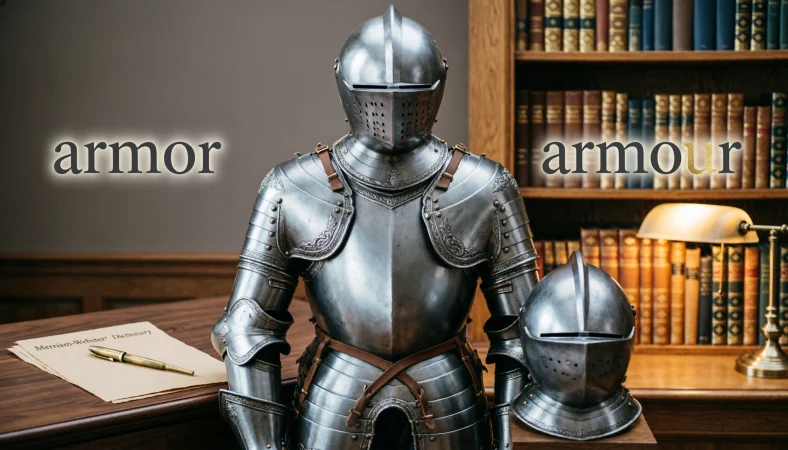
Armor or armour are two correct spellings of the same noun and verb. The main difference is regional: armor is the standard spelling in American English, while armour is standard in British English and many varieties influenced by British usage. Neither form is inherently more correct, but consistency with your chosen variety of English matters.
The question of armor or armour usually comes down to one simple issue: which variety of English are you writing in? Both spellings refer to protective equipment designed to shield the body, vehicles, buildings, or other objects from damage. They can also describe the protective quality of something, as in “the vehicle has heavy armor.”
The spelling difference is easy to overlook, but it can create problems in professional writing, academic work, publishing, product descriptions, historical writing, and international communication. A writer using American English may naturally choose armor, while someone following British English conventions will generally write armour.
Understanding the distinction is therefore less about memorizing a difficult spelling rule and more about recognizing regional English conventions. Once you know your audience and maintain consistency, choosing between the two becomes straightforward.
Armor vs Armour: What’s the Difference?
Armor and armour are spelling variants of the same English word. They have the same basic meanings, pronunciation, grammatical functions, and historical origin. The difference is primarily geographical.
| Feature | Armor | Armour |
| Part of speech | Noun and verb | Noun and verb |
| Meaning | Protective covering or equipment | Protective covering or equipment |
| Main variety | American English | British English |
| Common in | United States | United Kingdom, Australia, New Zealand, and other British influenced varieties |
| Pronunciation | Usually the same | Usually the same |
| Meaning difference | None | None |
| Formality | Standard | Standard |
| Historical origin | Same | Same |
In American English, armor is the expected spelling in most edited writing. For example, an American history textbook might discuss “medieval armor” or “body armor.”
In British English, armour is normally preferred. A British publication may refer to “medieval armour,” “body armour,” or “armoured vehicles.”
The distinction is similar to other spelling differences between American and British English, such as color and colour, center and centre, and favor and favour.
Quick recap
Armor and armour have the same meaning.
Armor is standard American English.
Armour is standard British English.
The choice should depend mainly on your intended variety of English.
Consistency is more important than choosing one spelling universally.
Is Armor vs Armour a Grammar, Vocabulary, or Usage Issue?
The difference between armor and armour is primarily a spelling and regional usage issue, not a grammar issue.
Both forms belong to the same vocabulary item. They function grammatically in the same ways, and replacing one with the other normally does not change the meaning of a sentence.
Consider these examples:
The knight wore heavy armor.
The knight wore heavy armour.
Both sentences communicate the same idea. The first follows American spelling conventions, while the second follows British spelling conventions.
The same applies to the verb:
The engineers armored the vehicle.
The engineers armoured the vehicle.
Again, the meaning remains essentially unchanged.
Formal versus informal usage
Neither spelling is informal. Both are standard forms within their respective English varieties.
A common misconception is that one spelling is more sophisticated or more formal. It isn’t. Armour isn’t automatically more traditional in every context, and armor isn’t automatically more modern or casual.
The appropriate spelling depends on the linguistic convention being followed.
Academic versus casual usage
In academic writing, consistency matters particularly strongly. If you’re writing according to American English conventions, use armor. If you’re following British English conventions, use armour.
The same principle applies to journalism, business writing, technical documentation, publishing, and educational material.
A paper written in American English should generally avoid switching between armor and armour without a specific reason. Such switching can look like an editing error.
How to Use Armor in American English
The spelling armor is the standard choice in American English.
American writers use it when discussing historical protective equipment, military technology, protective clothing, fictional characters, vehicles, and figurative protection.
Workplace example
A technical report might say:
The company developed lightweight armor for emergency response personnel.
Here, armor refers to protective equipment. The spelling fits American English conventions.
Academic example
A history paper could state:
European armor changed considerably between the medieval and early modern periods.
If the paper follows American English, armor is the expected spelling.
Technology example
Modern technology frequently uses the word in contexts involving vehicles and protective materials:
The new vehicle uses composite armor to improve protection without adding excessive weight.
This usage is common in American technical and military writing.
Other common American expressions
American English commonly uses expressions such as:
- body armor
- armor plating
- armored vehicle
- armor system
- armor protection
- armored personnel carrier
- armor design
The spelling remains armor throughout.
Usage recap
Use armor when following American English spelling conventions. It is appropriate in formal, academic, professional, technical, historical, and everyday writing.
How to Use Armour in British English
The spelling armour is the standard form in British English.
It appears in British writing about history, military equipment, protective clothing, vehicles, heraldry, literature, museums, and related subjects.
Workplace example
A British engineering document might state:
The vehicle’s armour was redesigned to reduce its overall weight.
The spelling reflects British English.
Academic example
A British historian might write:
Medieval armour developed alongside changes in weapons and battlefield tactics.
The spelling armour is conventional in British academic writing.
Technology example
British technical writing may use expressions such as:
The vehicle is equipped with advanced composite armour.
Again, armour follows British spelling conventions.
Other common British expressions
You may encounter:
- body armour
- armoured vehicle
- armour plating
- armour protection
- armoured personnel carrier
- armour system
- armour design
The extra u is retained in these related forms.
Usage recap
Use armour when writing in British English or another variety that generally follows British spelling conventions. It is fully standard and should not be treated as an incorrect version of armor.
When You Should NOT Use Armor or Armour
The biggest mistake isn’t choosing the “wrong” spelling in isolation. The bigger problem is mixing regional conventions without a reason.
Here are several situations where you should be careful.
1. Do not switch spelling styles randomly
If an article consistently uses American English, suddenly writing armour can make the text appear poorly edited.
2. Do not assume armour is always more historically accurate
Historical objects can be called armour in British writing and armor in American writing. The object itself doesn’t determine the spelling.
3. Do not change spelling inside an established title unnecessarily
If you’re reproducing the official title of a work, organization, product, or quotation, preserve its original spelling when appropriate.
4. Do not treat the two spellings as different objects
There isn’t one type of protective equipment called armor and another called armour. The spelling normally indicates English variety rather than physical design.
5. Do not mix American and British conventions in professional documents
A document can become inconsistent if it uses armor alongside British spellings such as colour, centre, and organisation.
6. Do not assume software will always correct the regional form
Spell checkers can be configured for different English varieties. A word marked as incorrect may actually be perfectly standard in another regional setting.
7. Do not use one form merely because it looks more formal
Both are standard. Regional consistency should guide your decision.
8. Do not confuse regional spelling with pronunciation
For most speakers, the two forms are pronounced essentially the same. The extra u in armour does not normally create a different spoken word.
Common Mistakes and Decision Rules
| Correct sentence | Incorrect sentence | Explanation |
| The soldier wore heavy armor. | The soldier wore heavy armour. | The second form is not grammatically wrong, but armor fits American English better. |
| The museum displayed medieval armour. | The museum displayed medieval armor. | The second form is acceptable in American English, while armour fits British English. |
| The vehicle has reinforced armor. | The vehicle has reinforced armour. | Use armor when following American conventions. |
| The vehicle has reinforced armour. | The vehicle has reinforced armor. | Use armour when following British conventions. |
| The engineers armored the vehicle. | The engineers armoured the vehicle. | American English normally uses armored. |
| The engineers armoured the vehicle. | The engineers armored the vehicle. | British English normally uses armoured. |
Decision Rule Box
- If your writing follows American English, use armor.
- If your writing follows British English, use armour.
- If you’re writing for an international audience, choose one convention and use it consistently.
This rule solves most spelling questions immediately.
Armor and Armour in Modern Technology and AI Tools
Modern technology has expanded the contexts in which this word appears.
In engineering, armor or armour can refer to protective layers used on vehicles, equipment, structures, cables, and specialized systems. The exact meaning depends on the technical field.
For example, protective vehicle construction may involve layered materials designed to resist impact or penetration. In electrical engineering, related terminology can describe protective coverings around cables. In cybersecurity, the word is sometimes used metaphorically to describe defensive systems.
AI tools also encounter both spellings because large language models are trained on text from multiple English varieties. If you ask an AI writing system for British English, it may produce armour. If you specify American English, it will generally favor armor.
That distinction matters for content creators. A writer preparing American focused website content should establish the desired English variety before generating or editing large amounts of text.
The same principle applies to automated spell checking, grammar tools, translation systems, and publishing software. Regional language settings can influence which spelling is recommended.
Why Does Armor Have Two Spellings?
The spelling difference reflects the broader history of English.
The word ultimately traces back through French and Latin influences associated with protective equipment and weapons. English spelling developed over centuries, and different varieties of English eventually established different conventions.
The u in armour reflects a spelling tradition associated with British English and French influenced forms. American English later developed a number of spelling preferences that removed letters considered unnecessary in certain words.
This pattern can be seen elsewhere.
American English generally uses color, while British English uses colour. American English uses favor, while British English uses favour. Likewise, American English uses honor, while British English uses honour.
The distinction therefore isn’t unique to this word. It belongs to a much larger pattern of regional spelling differences.
An expert style perspective
A useful way to think about the distinction is this:
Regional consistency matters more than treating one spelling as universally correct.
That principle applies across many American and British spelling pairs.
Two Real World Usage Case Studies
Case study 1: American historical writing
Imagine an American university student writing a paper about medieval warfare. The paper follows American English throughout, using color, center, and labor.
In that environment, writing:
Medieval armor was often decorated with elaborate designs.
is consistent with the document’s spelling system.
Changing suddenly to armour would not necessarily make the sentence incorrect, but it would introduce a British spelling into an otherwise American document.
The practical result is reduced consistency and a greater chance that an editor or instructor will flag the variation.
Case study 2: British technical writing
Now consider a British engineering publication describing protected vehicles.
A sentence such as:
The vehicle’s composite armour provides additional protection.
fits British spelling conventions.
If the surrounding document consistently uses colour, centre, and optimise, choosing armour reinforces the same regional style.
These cases demonstrate an important point: the correct spelling is often determined by the linguistic environment rather than by the word itself.
Error Prevention Checklist
Always use armor when
- You’re writing in American English.
- Your publication follows American spelling.
- Your audience is primarily American.
- Your style guide specifies American English.
- Related words use American spelling conventions.
Always use armour when
- You’re writing in British English.
- Your publication follows British spelling.
- Your audience is primarily British.
- Your style guide specifies British English.
- Related words use British spelling conventions.
Never use armour when
You have been explicitly instructed to follow American spelling and consistency is required.
Never use armor when
You have been explicitly instructed to follow British spelling and consistency is required.
The important point is that neither spelling needs to be avoided universally. Each has a legitimate place in standard English.
Related Spelling Confusions You Should Master
If you’re learning the difference between armor and armour, several related spelling pairs are worth understanding.
1. Color or colour
American English uses color, while British English normally uses colour.
2. Center or centre
American English uses center, while British English normally uses centre.
3. Honor or honour
The regional distinction follows the same pattern as armor and armour.
4. Labor or labour
American English generally uses labor, while British English uses labour.
5. Favor or favour
Both forms are standard, with regional preferences determining the choice.
6. Theater or theatre
American English frequently uses theater, while British English generally prefers theatre, although usage can vary by context.
7. Organize or organise
American English strongly favors organize, while British English permits both patterns, with organise especially common.
8. Analyze or analyse
American English uses analyze, while British English commonly uses analyse.
9. Catalog or catalogue
American English generally favors catalog, while British English commonly uses catalogue.
10. Modeling or modelling
American English normally uses modeling, while British English generally uses modelling.
Learning these patterns makes regional spelling much easier to recognize.
FAQs
Is armor or armour correct?
Both are correct. Armor is the standard American English spelling, while armour is the standard British English spelling. The choice depends on the variety of English you’re using.
Is armor American or British English?
Armor is primarily the American English spelling. British English generally uses armour.
Is armour American or British?
Armour is primarily the British English spelling. It is also used in several other English varieties influenced by British spelling conventions.
Does armor and armour mean the same thing?
Yes. In ordinary usage, the two spellings have the same meaning. They refer to protective equipment, protective covering, or the act of providing something with protection.
Why does armour have a U?
The spelling armour reflects a historical spelling tradition associated with British English and French influence. American English developed spelling preferences that removed the u in words such as armor, color, and honor.
Which spelling should I use in academic writing?
Follow the English variety required by your institution, instructor, publisher, or style guide. American academic writing normally uses armor, while British academic writing normally uses armour.
Is armored or armoured correct?
Both are correct regional forms. Armored is standard American English, while armoured is standard British English.
Is body armor or body armour correct?
Both are correct. American English normally uses body armor, while British English normally uses body armour.
Is armor more common than armour?
The answer depends on the region and the type of English being measured. Armor is dominant in American English, while armour is dominant in British English and several other varieties.
Can I use armor and armour in the same article?
You can, but it is usually better to choose one spelling based on your target variety of English and use it consistently. Mixing regional conventions without a clear reason can make professional writing look inconsistent.
Conclusion:
The choice between armor or armour is straightforward once you identify your English variety. Armor is the standard American spelling, while armour is the standard British spelling. Both forms describe the same protective equipment or protective quality, and neither is inherently more correct.
For American audiences, choose armor. For British audiences, choose armour. If your readers are international, select a consistent spelling system and apply it throughout the article, website, report, or publication.
The most useful rule is simple: match the spelling to your audience and remain consistent. Once you follow that principle, this common spelling confusion becomes much easier to handle.