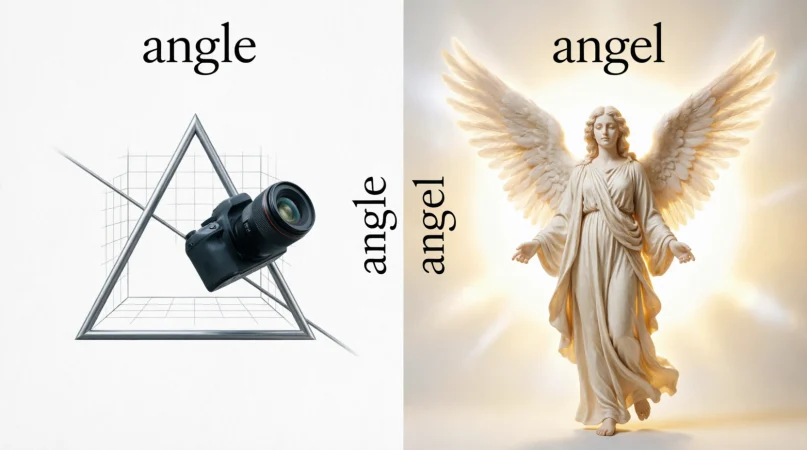
Angle and angel are both correct words, but they have completely different meanings. Angle refers to the space or direction formed where two lines meet, or a particular way of looking at something. Angel refers to a spiritual being, often described as a messenger or heavenly figure. Because they sound similar, they are easy to confuse in writing.
Have you ever wondered whether you should write angle or angel? These two words are pronounced differently and have completely different meanings, but their similar spelling can cause confusion. Knowing the difference is especially important because using one in place of the other can change the entire meaning of your sentence.
This guide explains angle and angel in simple, beginner friendly language, covering their meanings, pronunciation, spelling, grammar, and everyday examples. Whether you’re writing about geometry, photography, perspectives, or spiritual beings, understanding the distinction will help you choose the correct word with confidence.
Angle vs Angel: What’s the Difference?
The simplest way to understand the difference is to remember that angle belongs mainly to geometry, position, perspective, and approach, while angel refers to a spiritual or heavenly being. Although the words look and sound similar, their meanings have no direct connection.
| Word | Part of Speech | Main Meaning | Common Context |
| Angle | Noun | Space or position formed by two lines or surfaces | Geometry, photography, design |
| Angle | Noun | A particular viewpoint or approach | Writing, journalism, discussion |
| Angle | Verb | To position or direct something at an angle | Movement, construction, photography |
| Angel | Noun | A spiritual or heavenly being | Religion, literature, culture |
| Angel | Noun | A person regarded as exceptionally kind | Informal description |
| Angel | Noun | An investor who provides money to a business | Business and finance |
Consider these examples:
The camera was placed at a different angle.
Here, angle refers to the position from which the camera captures something.
The child imagined an angel watching over her.
Here, angel refers to a spiritual being.
The spelling difference is small, but the semantic difference is enormous. One word can describe geometry or perspective, while the other can describe a supernatural being, a kind person, or a business investor.
Mini Recap
Angle relates to position, geometry, perspective, and approach.
Angel refers primarily to a spiritual or heavenly being.
Angle can also work as a verb.
Angel is generally used as a noun.
The words should never be treated as interchangeable.
Is Angle vs Angel a Grammar, Vocabulary, or Usage Issue?
The confusion between angle and angel is primarily a vocabulary and spelling issue, although grammar also matters because angle has uses that angel does not.
If you write angle when you mean a spiritual being, the problem is lexical. You have selected the wrong word. If you write angel when discussing geometry, photography, or perspective, the same problem occurs in reverse.
The words aren’t interchangeable.
Angle as a noun
As a noun, angle can describe a measurable geometric relationship.
The triangle has three angles.
It can also describe a position or viewpoint.
Try a different angle for the photograph.
In journalism and communication, angle can mean the particular perspective used to present a story.
The article takes an unusual angle on workplace culture.
Angle as a verb
Angle can also function as a verb.
She angled the mirror toward the window.
It can describe directing or positioning something.
Angel as a noun
Angel is a noun referring to a supernatural or spiritual being.
The painting shows an angel with wings.
The word can also describe someone exceptionally kind.
My neighbor was an angel when she helped us move.
In business, angel can refer to an individual who invests money in an early stage company.
The entrepreneur received funding from an angel investor.
Formal and informal usage
Both words occur in formal and informal English, but their contexts differ.
Angle is common in technical, academic, professional, and everyday language. You may encounter it in mathematics, engineering, photography, journalism, business, and ordinary conversation.
Angel appears in religious, literary, cultural, personal, and financial contexts.
Neither word is inherently more formal than the other. The important point is choosing the word that matches the intended meaning.
Academic versus casual usage
Academic writing frequently uses angle when discussing geometry, perspective, research approaches, or analytical viewpoints.
The researchers examined the issue from a historical angle.
Angel may appear in academic writing when the subject concerns religion, mythology, art, literature, anthropology, or cultural studies.
The study examines representations of angels in medieval art.
The distinction therefore depends on subject matter rather than formality alone.
Using Angle Correctly
Angle has several meanings, which explains why it appears in so many different kinds of writing.
Angle in geometry
The most familiar technical meaning concerns the space formed by two lines, rays, or surfaces that meet.
The two lines form a right angle.
Common mathematical expressions include acute angle, obtuse angle, right angle, straight angle, interior angle, and exterior angle.
Students often encounter angle when studying triangles, polygons, circles, and trigonometry.
Angle in photography
In photography, angle describes the position or direction from which a subject is viewed.
The photographer changed the angle to capture the entire building.
A low angle can make a subject appear larger or more imposing. A high angle can provide a broader view from above.
Angle in writing and journalism
Writers often use angle to describe the particular perspective through which a topic is presented.
The reporter approached the story from a consumer angle.
Two writers can discuss the same event while choosing different angles. One might focus on financial consequences, another on personal experiences.
Angle in business
Businesses may discuss a sales angle, marketing angle, or strategic angle.
The marketing team found a new angle for the campaign.
Here, angle means a particular approach that may make an idea more appealing or persuasive.
Angle in technology
Technology uses the word in several practical contexts.
Adjust the viewing angle of the monitor.
The sensor measures the angle of movement.
Engineers, designers, programmers, photographers, and technicians may all use angle in different ways.
Workplace example
We need to look at the proposal from another angle before making a decision.
In this sentence, angle means perspective or approach.
Academic example
The paper analyzes the problem from an economic angle.
The word indicates a particular analytical perspective.
Technology example
Adjust the camera angle before starting the video call.
Here, angle refers to the camera’s position.
Usage Recap
Use angle when discussing geometry, position, viewpoint, direction, or approach. The word can describe both a physical position and an abstract perspective.
Using Angel Correctly
Angel has a very different semantic history and meaning.
Angel in religious contexts
In many religious traditions, angels are understood as spiritual beings associated with divine messages, protection, worship, or service.
The story describes an angel delivering a message.
The exact role and characteristics of angels vary between religious traditions and cultural interpretations.
Angel in literature
Writers frequently use angel as a symbol of innocence, goodness, protection, beauty, or supernatural intervention.
The character appeared like an angel in the final scene.
Literary uses can be literal or figurative.
Angel as a description of a person
In everyday English, someone may call another person an angel as a warm expression of appreciation.
You brought me some water? You’re an angel.
This does not normally mean the speaker literally believes the person is a supernatural being. It is an affectionate compliment.
Angel in business
The word also appears in the expression angel investor.
An angel investor is an individual who provides capital to a startup or early stage business, often in exchange for an ownership interest.
The company secured funding from an angel investor.
This meaning is completely separate from geometric angle.
Workplace example
Our angel investor agreed to support the company’s next stage of growth.
Here, angel identifies a type of investor.
Academic example
The course explores the representation of angels in religious art.
The word refers to spiritual beings and their cultural representation.
Technology example
The startup received early funding from an angel investor before launching its software.
Here, angel belongs to business vocabulary rather than technology vocabulary itself.
Usage Recap
Use angel when referring to a spiritual being, a person described as exceptionally kind, or an individual investor in the expression angel investor.
When You Should NOT Use Angle or Angel
Understanding when not to use each word is one of the easiest ways to eliminate this spelling mistake.
1. Do not use angel for geometry
Incorrect:
The triangle has three angels.
Correct:
The triangle has three angles.
The subject is geometry, so angle is required.
2. Do not use angle for a spiritual being
Incorrect:
The painting shows an angle with wings.
Correct:
The painting shows an angel with wings.
The reference is a spiritual being.
3. Do not use angel for photography position
Incorrect:
Change the angel of the camera.
Correct:
Change the angle of the camera.
The camera’s position is an angle.
4. Do not use angle for a kind person
Incorrect:
My grandmother is such an angle.
Correct:
My grandmother is such an angel.
Here, angel is a figurative compliment.
5. Do not use angel when discussing perspective
Incorrect:
Let’s examine the issue from another angel.
Correct:
Let’s examine the issue from another angle.
The intended meaning is viewpoint.
6. Do not use angle for an investor
Incorrect:
The startup contacted an angle investor.
Correct:
The startup contacted an angel investor.
The established business term is angel investor.
7. Do not use angel when describing direction
Incorrect:
The machine needs to be installed at a forty degree angel.
Correct:
The machine needs to be installed at a forty degree angle.
This is a measurement or position.
8. Do not assume similar pronunciation means similar meaning
A spelling mistake can survive unnoticed when people mostly hear a word rather than read it. Context should guide the spelling.
Common Mistakes and Decision Rules
| Correct sentence | Incorrect sentence | Explanation |
| The camera needs a wider angle. | The camera needs a wider angel. | Camera position uses angle. |
| She believes an angel protected him. | She believes an angle protected him. | A spiritual being is an angel. |
| The triangle has three angles. | The triangle has three angels. | Geometry uses angle. |
| You are an angel for helping me. | You are an angle for helping me. | A kind person can be called an angel. |
| We need a new angle on the problem. | We need a new angel on the problem. | A perspective is an angle. |
| The startup found an angel investor. | The startup found an angle investor. | Angel investor is the correct business term. |
Decision Rule Box
If you mean position, measurement, viewpoint, or approach, use angle.
If you mean a spiritual being, a very kind person, or an early stage investor, use angel.
This rule covers most everyday situations.
Angle or Angel in Modern Technology and AI Tools
Modern technology has created even more situations in which angle is common.
Cameras use viewing angles. Smartphones include camera systems designed around different fields of view. Computer graphics depend on geometric relationships, rotations, and viewing positions. Robotics also relies heavily on measurements involving angles.
Artificial intelligence systems that analyze images may identify objects from different camera angles. Computer vision models can process photographs captured from multiple viewpoints. In these contexts, angle remains a technical word describing orientation or perspective.
Angel can also appear in technology related business discussions, particularly when startups raise capital. An angel investor may provide funding before a company reaches later stages of institutional investment.
The distinction remains straightforward. Technology involving positioning, rotation, geometry, or viewpoint generally calls for angle. Startup financing may use angel when referring to an investor.
Etymology: Where Do Angle and Angel Come From?
The two words look remarkably similar, but their histories are different.
Angle ultimately traces back through French to Latin angulus, meaning a corner or angle. Its development is closely connected with geometry, corners, and positions formed by intersecting lines or surfaces.
Angel has a different history. It entered English through Old English engel, from Latin angelus, which came through Greek angelos, meaning messenger. This history reflects the traditional idea of an angel as a messenger associated with the divine.
Their similar spelling in modern English is therefore not evidence that they are related in meaning.
This distinction is useful because etymology reinforces what modern usage already shows. Angle belongs to the language of position and geometry, while angel developed from a word associated with messengers and spiritual beings.
An Expert Perspective on the Difference
A useful way to approach confusing word pairs is to focus on meaning before spelling.
“When two words look similar but carry different meanings, context should determine the word you choose.”
That principle is particularly helpful with angle and angel. Instead of trying to memorize the spelling in isolation, identify what the sentence is talking about first.
If the sentence concerns a camera, triangle, direction, viewpoint, or approach, angle will usually be the appropriate choice.
If it concerns a heavenly being, a kind person, or an investor, angel is likely the intended word.
Two Illustrative Case Studies
Case Study 1: A photography instruction
Imagine a photography student writing instructions for a class project.
The student writes:
Change the angel of the camera to capture more of the building.
The intended meaning is obvious to a human reader, but the spelling is incorrect. The student isn’t talking about a supernatural being. The correct sentence is:
Change the angle of the camera to capture more of the building.
The correction changes only one letter, but it restores the technical meaning and makes the instruction suitable for professional or academic writing.
Case Study 2: A personal message
Now imagine someone sending a thank you message after receiving unexpected help.
They write:
You were such an angle for helping me.
The intended compliment is clear, but the spelling produces the wrong word. The corrected version is:
You were such an angel for helping me.
In this case, angel is a figurative expression meaning that the person was exceptionally kind or helpful.
These examples demonstrate why spelling accuracy matters even when context allows readers to guess the intended meaning.
Error Prevention Checklist
Always use angle when
- You mean a geometric measurement.
- You mean the position of an object.
- You mean a camera viewpoint.
- You mean a direction or orientation.
- You mean a perspective on an issue.
- You mean a particular approach to a problem.
- You are discussing lines, shapes, or rotation.
Never use angel when
- You are describing a camera position.
- You are discussing a geometric measurement.
- You are describing a viewpoint.
- You mean an approach to a topic.
- You are describing the orientation of an object.
Always use angel when
- You mean a spiritual or heavenly being.
- You describe someone as exceptionally kind.
- You use the expression angel investor.
- You discuss angels in religion, literature, art, or culture.
Related Grammar Confusions You Should Master
Angle and angel belong to a larger group of English words that become confusing because of similar pronunciation or spelling.
Here are several related distinctions worth learning:
- Accept or except: Accept is generally a verb meaning receive or agree, while except commonly indicates exclusion.
- Affect or effect: Affect commonly functions as a verb, while effect commonly functions as a noun, although both words have additional uses.
- Advice or advise: Advice is a noun, while advise is a verb.
- Compliment or complement: Compliment expresses praise, while complement refers to something that completes or enhances another thing.
- Principal or principle: Principal can refer to a person or something primary, while principle means a fundamental rule or belief.
- Stationary or stationery: Stationary means remaining still, while stationery refers to writing materials.
- Dessert or desert: Dessert is a sweet course, while desert commonly refers to a dry region or, as a verb, abandonment.
- Lose or loose: Lose means to fail to keep or win something, while loose means not tightly fixed.
- Advice or advise: The ending changes the word’s grammatical function and pronunciation.
- Their or there: Their expresses possession, while there generally refers to a place or introduces an idea.
Learning these pairs builds a stronger instinct for choosing words from context rather than relying only on how they sound.
FAQs
What is the difference between angle and angel?
Angle refers to a geometric measurement, viewpoint, direction, or approach. Angel usually refers to a spiritual being, a kind person, or a startup investor.
Is it angle or angel for a camera?
The correct word is angle. A camera angle describes the position or viewpoint from which a photograph or video is captured.
Is it angle or angel in geometry?
The correct word is angle. Geometry uses angle to describe the space or relationship formed by intersecting lines, rays, or surfaces.
Is it angel or angle investor?
The correct expression is angel investor. An angel investor is an individual who provides capital to an early stage business.
Is an angel a person?
An angel can refer to a spiritual being. In informal English, people can also call someone an angel as a compliment when that person has been especially kind or helpful.
How do you remember angle versus angel?
Remember angle for geometry, positions, and viewpoints, while angel relates to wings, spiritual beings, kindness, or investors.
Can angle be used as a verb?
Yes. Angle can function as a verb meaning to position, direct, or move something at an angle. For example, you can angle a mirror toward a window.
Why do angle and angel get confused?
They differ by one letter and may sound similar, making their spellings easy to confuse when writing.
Which is correct, a different angle or a different angel?
The correct phrase is a different angle when you mean a different viewpoint, position, direction, or approach.
Which spelling is correct for a heavenly being?
The correct spelling is angel, meaning a spiritual being or, figuratively, a very kind person.
Conclusion:
The difference between angle and angel becomes easy once you focus on meaning rather than appearance. Angle relates to geometry, position, direction, perspective, photography, and approaches to problems. Angel refers to a spiritual being and can also describe a very kind person or an early stage business investor.
Remember the central distinction: angle is about position or perspective, while angel is about a spiritual being, kindness, or investment.
If you’re describing a triangle, camera, viewpoint, direction, or strategy, choose angle. If you’re describing a heavenly being, thanking someone warmly, or discussing an angel investor, choose angel.
The spelling difference is tiny, but the meanings are completely different. Learning that connection will help you avoid one of the most common look alike word mistakes in everyday and professional English.
Author Bio: Written by a language and SEO content specialist focused on practical English usage, spelling clarification, and search friendly educational content.