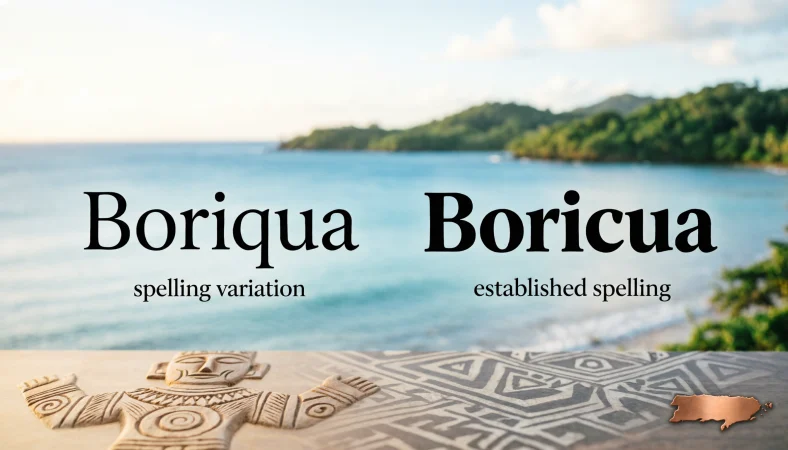
Boriqua or Boricua is a common spelling question involving a term associated with Puerto Rican identity and culture. Boricua is the standard spelling and is widely used to describe a person from Puerto Rico or someone of Puerto Rican heritage. Boriqua is generally considered a nonstandard spelling, although it appears in informal writing and pronunciation based spellings.
If you have seen the words boriqua and boricua, you may wonder whether they are two accepted spellings of the same word. They look almost identical, and the difference comes down to just one letter. However, that small spelling difference matters when you’re writing about Puerto Rican identity, culture, history, or heritage.
Boricua is the established spelling used by Puerto Ricans and by writers discussing Puerto Rican culture. The word functions primarily as a noun or adjective. A person may describe themselves as Boricua, while the term can also describe something connected with Puerto Rico or Puerto Rican culture.
Boriqua, by contrast, is generally treated as a nonstandard spelling. It can appear in informal communication, especially when people write words according to how they believe they sound. This creates confusion because the pronunciation can make the spelling seem reasonable.
The distinction becomes especially important in formal writing. A spelling mistake in a casual message may go unnoticed, but the wrong form can look careless in an article, academic paper, cultural discussion, business document, or publication about Puerto Rican communities.
Understanding the history, meaning, pronunciation, and usage of Boricua makes the choice much easier. Once you know which form is established, there is little reason to hesitate.
Boriqua or Boricua: What’s the Difference?
The central distinction is simple. Boricua is the standard and widely recognized spelling. Boriqua is a nonstandard variant that can occur in informal writing.
The word Boricua can work as a noun when referring to a person and as an adjective when describing something associated with Puerto Rican identity or culture.
Quick recap
Boricua is the spelling to use in standard writing.
Boriqua commonly represents a spelling variation based on pronunciation.
The two forms usually refer to the same intended concept.
For formal, academic, professional, and edited writing, Boricua is the safer and established choice.
Is Boriqua or Boricua a Grammar, Vocabulary, or Usage Issue?
This is primarily a spelling and usage issue, rather than a grammar problem.
Grammar determines how words function in sentences. Spelling determines how those words are written. In this case, the main question is whether the established term should be written with a c or a qu.
The difference can also be described as a vocabulary issue because Boricua is a culturally specific term with a particular meaning. However, people who already know the word usually understand the question as one of spelling.
The two forms are not equally appropriate in every context. Boricua is the established form and is suitable for formal writing, journalism, academic work, cultural discussions, and professional communication.
Boriqua may appear in informal messages or personal writing. Someone may use it because the spelling seems to reflect the pronunciation. That does not make it the preferred standard spelling.
In academic writing, consistency and accuracy matter. If you are discussing Puerto Rican history, literature, identity, music, art, or culture, using the established spelling helps make the writing appear knowledgeable and respectful.
Casual communication can be more flexible. People often experiment with spelling online, use phonetic forms, or adopt personal variations. Even so, recognizing the standard form allows you to make an informed choice.
When to Use Boricua
Use Boricua when you are referring to a Puerto Rican person, Puerto Rican identity, or something culturally associated with Puerto Rico.
The word carries cultural significance beyond simply identifying a geographic location. It can express connection to Puerto Rican heritage and identity.
Workplace example
Imagine writing a company profile about an employee who has Puerto Rican heritage:
She is a Boricua entrepreneur who has built a business inspired by her cultural heritage.
Here, Boricua works as a noun describing the person.
Another example could describe a cultural business:
The restaurant celebrates Boricua traditions through its food and music.
Here, Boricua functions adjectivally because it describes traditions associated with Puerto Rican culture.
Academic example
An academic discussion might say:
The novel explores Boricua identity through language, family history, and migration.
The term works naturally in a discussion of culture and identity.
Technology example
Technology can also involve the term when discussing digital communities:
The platform connects Boricua creators with audiences around the world.
Again, the established spelling communicates the intended cultural connection clearly.
Usage recap
Use Boricua in formal and informal writing when the context involves Puerto Rican people, heritage, culture, or identity. It is the established form and the spelling readers are most likely to recognize.
When to Use Boriqua
There is a much narrower reason to encounter Boriqua. It may appear when someone uses an informal or nonstandard spelling based on pronunciation.
For example, a person writing casually online might type:
I am proud to be Boriqua.
The intended meaning is usually clear, particularly to readers familiar with Puerto Rican identity terms. However, the spelling does not have the same standard status as Boricua.
This distinction is important because understanding a nonstandard spelling is different from recommending it for general use.
In workplace communication, formal publications, educational materials, and edited content, choosing the established form avoids unnecessary confusion.
In personal communication, someone may intentionally use an alternative spelling as part of an individual style or informal expression. Also In that situation, the context matters.
The important point is that Boriqua should not automatically be treated as an equally standard alternative simply because readers can understand it.
Usage recap
Boriqua may appear in informal writing.
It generally represents the same intended term as Boricua.
It is not the preferred spelling for standard edited writing.
When You Should NOT Use Boriqua or Boricua
The two forms should not be used casually when you are unsure what the surrounding context means.
Here are several situations where writers commonly make mistakes.
1. Do not use Boriqua simply because it sounds natural
English speakers sometimes choose spelling based on pronunciation. That approach does not always produce the established spelling.
2. Do not treat Boriqua and Boricua as equally standard
They may communicate the same intended meaning, but their spelling status is not identical.
3. Do not change the spelling inside a formal quotation
If a historical or contemporary source intentionally uses a particular spelling, preserve the wording when quoting it.
4. Do not use the term when a geographic description is more appropriate
Puerto Rican, Puerto Rico, or another precise description may be more suitable depending on what you are actually discussing.
5. Do not assume every Puerto Rican person uses the term
Identity terms can be personal. A writer should avoid assuming that every individual prefers the same label.
6. Do not use the term as a substitute for every Puerto Rican cultural concept
Boricua can describe identity and cultural connection, but the surrounding sentence still needs to communicate the specific idea accurately.
7. Do not let spelling variations enter formal content accidentally
An informal spelling can survive unnoticed during drafting. Always proofread culturally specific terms carefully.
8. Do not confuse pronunciation with spelling
Knowing how a word sounds can help you recognize it, but pronunciation alone does not determine the standard written form.
Common Mistakes and Decision Rules
The most frequent error is writing Boriqua when the intended standard form is Boricua.
Decision Rule
If you mean the established term associated with Puerto Rican identity or culture, use Boricua.
If you encounter Boriqua in informal writing, understand it as a nonstandard spelling variation rather than the preferred standard form.
This rule handles most everyday spelling questions involving these two forms.
Boriqua or Boricua in Modern Technology and AI Tools
Modern technology has made spelling variations more visible than ever.
Search engines, social media platforms, messaging applications, autocorrect systems, and AI writing tools encounter enormous amounts of informal language. Users may type words phonetically, omit accents, shorten expressions, or create alternative spellings.
As a result, a nonstandard form such as Boriqua can appear online even when Boricua is the established spelling.
AI tools can also encounter both forms in training data or user generated content. If an AI system produces an unfamiliar variant, that does not automatically mean the variant has the same standard status as the established form.
For content creators, the practical lesson is straightforward. When producing polished content, use the recognized spelling Boricua unless you are deliberately discussing or reproducing a particular informal spelling.
This is particularly important for SEO content. Search behavior can include spelling variations, but optimizing an article does not require treating every variation as equally correct. A strong article can acknowledge the alternative while clearly explaining the standard form.
The Etymology and Cultural Background of Boricua
Boricua is connected to the Taíno name associated with Puerto Rico, commonly represented in historical forms such as Borinquen and related spellings.
The word has developed into an important marker of Puerto Rican identity. It can express cultural belonging, heritage, and connection to Puerto Rico.
This background explains why the spelling deserves care. It is not simply a random vocabulary item with two interchangeable spellings. It has cultural and historical significance.
A useful way to understand the word is to think of it as a self identification term that has become strongly associated with Puerto Rican people and culture.
Because identity language can carry personal meaning, context remains important. A dictionary style definition can explain the basic usage, but real world identity language often has deeper social and cultural dimensions.
An expert style perspective
“The established spelling matters because culturally significant identity terms carry meaning beyond their individual letters.”
The practical lesson is that spelling accuracy and cultural awareness work together. Writers should not treat culturally meaningful terms as ordinary spelling puzzles without considering their context.
Two Practical Case Studies
Case Study 1: A formal cultural article
Imagine an editor is preparing an article about Puerto Rican literature. During proofreading, the draft repeatedly uses Boriqua literature.
The writer clearly understands the intended meaning, but the spelling does not follow the established form. The editor changes the wording to Boricua literature throughout the article.
The concrete result is greater consistency, clearer terminology, and a more appropriate tone for an edited publication.
The problem was not sentence grammar. The issue was standard spelling and terminology.
Case Study 2: An informal social media post
A social media user writes:
Proud to be Boriqua.
Readers familiar with the term can usually understand the intended meaning. In a casual environment, the spelling may not prevent communication.
However, if the same sentence appears in a university publication or professional article, an editor would normally use Boricua.
The result illustrates an important distinction between comprehensibility and standard usage. A reader can understand a nonstandard form without that form becoming the preferred spelling.
Error Prevention Checklist
Always use Boricua when
- You are writing formal or edited content.
- You are discussing Puerto Rican identity.
- You are describing Puerto Rican culture or heritage.
- You are writing an academic paper.
- You are preparing professional content.
- You want the established spelling.
Never use Boriqua when
- You are trying to reproduce the standard spelling.
- You are preparing formal educational content.
- You are writing polished SEO content.
- You are editing an academic publication.
- You are unsure whether the spelling is standard.
Instead, use Boricua unless a specific informal spelling needs to be preserved for a clear reason.
Related Grammar and Spelling Confusions You Should Master
Writers who frequently research spelling differences may encounter many similar questions. Learning the patterns behind these mistakes can make proofreading easier.
- Puerto Rican or Puerto-Rican
The preferred form depends on grammatical position and style.
- Latino or Latina
These terms can involve grammatical and identity considerations that vary by context.
- Hispanic or Latino
These terms are related but are not automatically interchangeable.
- Taíno or Taino
Accent marks can affect written presentation even when pronunciation remains recognizable.
- Borinquen or Borinquen
Historical names can appear in multiple forms across sources.
- Cultural identity terms
Identity language often requires more attention to context than ordinary vocabulary.
- Ethnicity and nationality terms
Nationality and cultural identity are not always identical concepts.
- Capitalization of cultural terms
Proper names and cultural identifiers can follow different capitalization patterns depending on usage.
- Accent marks in Spanish
Spanish orthography can differ from English writing conventions.
- Standard versus informal spelling
Online communication frequently creates variants that are understandable without becoming standard forms.
FAQs.
What is the correct spelling, Boriqua or Boricua?
Boricua is the established spelling. Boriqua can appear as a nonstandard spelling variation, particularly in informal writing, but Boricua is the preferred form for standard written English.
What does Boricua mean?
Boricua is a term associated with Puerto Rican identity. It can refer to a Puerto Rican person and can also describe something connected with Puerto Rican culture, heritage, or identity.
Is Boriqua a correct spelling?
Boriqua is understandable and can be found in informal usage, but it is generally considered a nonstandard spelling. When writing formally, use Boricua.
Is Boricua only used as a noun?
No. Boricua can function as a noun when referring to a person and as an adjective when describing something associated with Puerto Rican identity or culture.
Why do people spell Boricua as Boriqua?
Pronunciation based spelling and informal online writing can contribute to alternative spellings, as people often write words based on how they sound.
Is Boricua a Spanish word?
Boricua is used within Spanish and English discussions of Puerto Rican identity and has historical connections to the Taíno name associated with Puerto Rico.
Can I use Boricua in academic writing?
Yes. Boricua is appropriate in academic writing about Puerto Rican identity, culture, history, or literature, as long as the established spelling is used consistently.
Is Boricua the same as Puerto Rican?
Puerto Rican refers to nationality or geographic identity, while Boricua often carries a stronger cultural or identity based meaning. The terms can overlap but are not always interchangeable.
Should I use Boriqua for SEO keywords?
If a search query uses Boriqua, you can mention the spelling variation, but the main content should identify Boricua as the established spelling rather than treating both as equally standard.
Why is Boricua spelled with C instead of QU?
The established spelling is Boricua, reflecting the term’s historical development rather than simple English pronunciation rules. Using this form helps avoid confusion.
Conclusion:
The difference between Boriqua and Boricua is mainly a matter of standard spelling and usage. Boricua is the established form associated with Puerto Rican identity, culture, and heritage. Boriqua may appear in informal writing, but it should not normally replace the standard spelling in polished content.
For academic papers, professional articles, educational material, journalism, and SEO content, choosing the established form keeps your writing accurate and consistent.
When in doubt, remember the simplest rule: Boricua is the standard spelling.