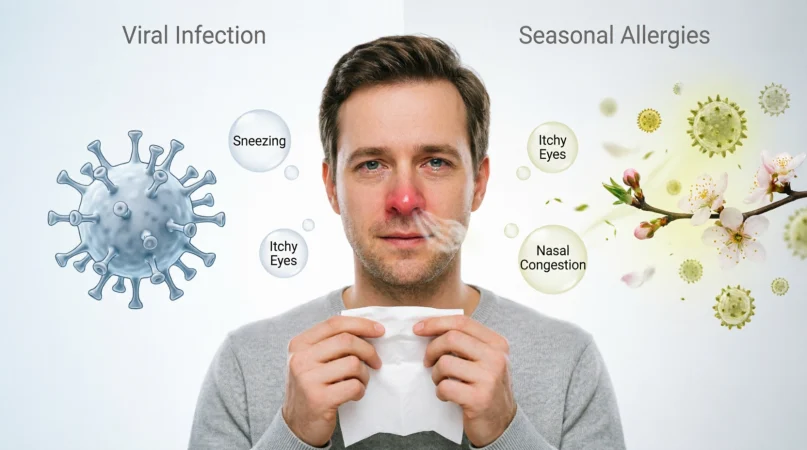
COVID and allergies can cause overlapping symptoms such as a runny or stuffy nose, cough, fatigue, headache, and sore throat. Allergies commonly cause sneezing and itchy or watery eyes, while COVID can cause fever, chills, body aches, and gastrointestinal symptoms. Because symptoms overlap, testing may be needed to distinguish COVID from another illness.
When people search for covid or allergies, they usually want to know whether their symptoms are more consistent with an infectious respiratory illness or an allergic reaction. COVID is an illness caused by infection with SARS CoV 2, while allergies occur when the immune system reacts to substances that are usually harmless, such as pollen, dust mites, mold, or pet allergens.
The confusion matters because the two conditions can look surprisingly similar at first. Both can involve congestion, a runny nose, coughing, fatigue, headache, and throat irritation. Yet COVID is contagious, whereas seasonal allergic rhinitis is not an infection. Treating every respiratory symptom as an allergy could therefore overlook an infection that warrants testing or additional precautions.
The reverse can also happen. A person with familiar seasonal allergies may mistake recurring allergy symptoms for an infectious illness. Looking at the pattern, accompanying symptoms, timing, known triggers, and appropriate testing can provide useful clues, although symptoms alone cannot always establish the cause.
COVID vs Allergies: What’s the Difference?
COVID and allergies are fundamentally different conditions even though several symptoms overlap.
As COVID is a contagious respiratory illness caused by SARS CoV 2. Its symptoms can range from mild to severe, and the CDC lists fever or chills, cough, shortness of breath, sore throat, congestion, runny nose, fatigue, headache, body aches, nausea, vomiting, diarrhea, and changes in taste or smell among possible symptoms.
Allergies are immune responses to allergens. Allergic rhinitis can cause sneezing, nasal congestion, a runny nose, and itching in the nose, throat, mouth, or eyes. Watery eyes are also common. Seasonal symptoms often correspond with exposure to airborne pollen, while indoor allergens can produce symptoms throughout the year.
| Feature | COVID | Allergies |
| Basic cause | Viral infection | Immune response to an allergen |
| Contagious | Yes | No |
| Fever | Can occur | Not typical of allergic rhinitis |
| Sneezing | Can occur | Common |
| Itchy eyes | Possible | Common |
| Watery eyes | Possible | Common |
| Runny nose | Possible | Common |
| Nasal congestion | Possible | Common |
| Cough | Common possible symptom | Can occur, especially with postnasal drainage or asthma |
| Body aches | Can occur | Not typical |
| Fatigue | Can occur | Can occur |
| Loss of taste or smell | Can occur | Can occur with nasal congestion, but sudden changes can warrant attention |
| Diarrhea or vomiting | Can occur | Not typical of ordinary seasonal allergies |
| Testing | Viral testing can help identify infection | Allergy evaluation may identify triggers |
The table provides useful clues, but it should not be treated as a diagnostic test. COVID symptoms can vary considerably, and not everyone with COVID develops fever. Likewise, allergies can vary depending on the person and the allergen involved.
Mini Recap
COVID is caused by a virus.
Allergies are immune reactions to allergens.
Itchy eyes and repeated sneezing are especially characteristic of allergic rhinitis.
Fever, chills, body aches, and gastrointestinal symptoms are more suggestive of an infection than ordinary allergies.
Symptoms can overlap, so testing or medical evaluation may sometimes be necessary.
Is COVID vs Allergies a Medical Diagnosis or Symptom Comparison Issue?
Unlike a spelling question, the difference here cannot be settled by choosing one word. COVID and allergies are separate medical conditions that can produce overlapping symptoms.
The most useful approach is to examine the overall pattern rather than relying on one symptom.
Are COVID and Allergies Interchangeable?
No.
COVID is an infectious disease. Allergic rhinitis is an immune response to allergens. One condition can spread between people, while ordinary seasonal allergies cannot.
However, their symptoms can overlap enough that a person may not immediately know which one is responsible.
The CDC specifically notes that COVID symptoms vary and can overlap with other respiratory illnesses. Current clinical guidance also recognizes that COVID can range from asymptomatic infection to severe disease.
What About Formal and Informal Language?
In medical writing, precise terminology matters.
A healthcare professional may refer to COVID as an infection caused by SARS CoV 2 and to allergies as allergic rhinitis, allergic conjunctivitis, or another specific allergic condition.
In everyday conversation, someone might simply say:
I think my allergies are acting up.
Or:
I think I might have COVID.
Both statements are understandable, but they do not establish a diagnosis.
Why Symptoms Alone Can Mislead
A runny nose does not automatically mean allergies.
A cough does not automatically mean COVID.
A headache does not automatically identify either condition.
The CDC states that COVID symptoms can include congestion, runny nose, cough, headache, fatigue, and sore throat. Allergy organizations likewise identify congestion, runny nose, sneezing, and watery or itchy eyes as common allergic symptoms.
That overlap explains why symptom comparison should be used for orientation, not self diagnosis.
How COVID Symptoms Typically Appear
COVID symptoms can differ substantially from one person to another. Some people have no symptoms, while others develop a range of respiratory or systemic symptoms. The CDC notes that symptoms can appear two to fourteen days after exposure and may begin mildly before becoming more serious.
Workplace Example
Imagine an employee develops a new cough, fatigue, sore throat, and fever.
It would be risky to assume that these symptoms are simply seasonal allergies, particularly if there has been a recent exposure to someone with a respiratory infection.
Testing can help determine whether SARS CoV 2 infection is present and can help guide decisions about protecting other people.
Academic Example
A student who develops congestion and fatigue during an allergy season might reasonably consider allergies as one possibility.
However, if the student also develops fever, chills, significant body aches, or other symptoms associated with respiratory infection, COVID or another infection should also be considered.
The presence of a known allergy history does not automatically rule out an infection.
Technology Example
Modern at home respiratory tests can help people investigate possible infections. COVID antigen tests can produce results quickly, while molecular tests such as NAATs can be more sensitive. A negative antigen result does not always rule out infection, particularly when testing occurs at an unfavorable point in the illness.
Usage Recap
COVID can produce respiratory symptoms plus systemic symptoms such as fever, chills, body aches, fatigue, and gastrointestinal symptoms.
Symptoms vary considerably.
Testing can provide information that symptoms alone cannot.
How Allergy Symptoms Typically Appear
Allergic rhinitis occurs when the immune system reacts to an allergen. Common triggers include pollen, pet allergens, mold, and dust mite particles. Seasonal allergic rhinitis often becomes more noticeable during periods when relevant pollen is present.
The symptom pattern can be particularly useful.
Sneezing, an itchy nose, itchy eyes, watery eyes, and clear nasal drainage are classic features of allergic rhinitis. AAAAI also notes that symptoms may involve the throat, ears, skin, and roof of the mouth.
Workplace Example
Someone may enter an office with dust exposure and begin sneezing repeatedly while developing itchy, watery eyes.
If the symptoms repeatedly appear around a particular allergen and improve when exposure decreases, that pattern may fit an allergic response.
Still, recurring symptoms should not automatically be self diagnosed as allergies.
Academic Example
A student may experience sneezing, nasal congestion, and itchy eyes every spring.
A seasonal pattern can be an important clue because pollen is a common trigger of seasonal allergic rhinitis.
Technology Example
Digital health records and symptom tracking tools can help people record when symptoms appear, what exposures occurred, and whether symptoms follow a recurring pattern.
These tools can organize information, but they do not replace professional diagnosis.
Usage Recap
Allergies often produce itching, sneezing, congestion, and watery eyes.
Seasonal patterns can provide useful clues.
Allergies are not contagious.
When You Should NOT Assume It Is COVID or Allergies
Several common assumptions can create problems.
1. Do Not Assume Every Runny Nose Is an Allergy
A runny nose can occur with allergies, COVID, a common cold, influenza, and other conditions.
2. Do Not Assume Every Cough Is COVID
Coughing has many possible causes. Allergies, asthma, respiratory infections, irritation, and other conditions can all produce coughing.
3. Do Not Assume a Fever Is From Allergies
Fever is not a typical symptom of allergic rhinitis. An infection becomes more important to consider when fever accompanies respiratory symptoms.
4. Do Not Assume Allergy History Rules Out COVID
Someone can have allergies and also develop COVID.
5. Do Not Assume No Fever Means No COVID
Not every person with COVID develops fever. The CDC describes a broad range of possible presentations.
6. Do Not Rely on One Symptom
One symptom rarely provides enough information to distinguish these conditions.
7. Do Not Ignore Breathing Problems
Difficulty breathing can require urgent medical attention regardless of whether the underlying cause is suspected to be COVID, asthma, allergy related complications, or another condition.
8. Do Not Use a Symptom Chart as a Diagnosis
Comparison charts are educational tools. They cannot determine the cause of an individual’s symptoms.
Common Mistakes and Decision Rules
| Correct approach | Incorrect assumption | Explanation |
| Consider testing when COVID is possible. | A stuffy nose means it is definitely allergies. | Congestion can occur with COVID and allergies. |
| Look for an overall symptom pattern. | One symptom proves the diagnosis. | Symptoms overlap. |
| Consider allergy triggers. | Seasonal symptoms automatically rule out infection. | Allergies and infections can occur at the same time. |
| Seek medical advice for concerning symptoms. | A symptom chart can provide a diagnosis. | Clinical assessment may be necessary. |
| Repeat or confirm testing when appropriate. | One negative rapid test always rules out COVID. | Antigen tests can miss infection. |
Decision Rule
If symptoms strongly resemble your usual allergy pattern, consider allergy triggers, but if infection is possible, use appropriate testing and monitor for worsening symptoms.
The important distinction is not simply whether one symptom belongs to one condition. It is whether the overall situation warrants allergy management, respiratory virus testing, medical evaluation, or urgent care.
COVID and Allergies in Modern Technology and AI Tools
Digital health technology has changed how people research symptoms. Search engines, symptom checkers, wearable devices, telehealth platforms, and AI tools can help organize information.
However, these tools should be used carefully.
An AI system can explain that itchy eyes and repeated sneezing commonly occur with allergic rhinitis. It can also explain that COVID may produce fever, cough, fatigue, congestion, sore throat, body aches, and other symptoms.
What it cannot safely do from a short description is establish a definitive diagnosis.
Testing remains important when COVID is a realistic possibility. The CDC states that viral testing can help people make decisions about treatment and reducing transmission.
Technology is therefore most useful as an information and organization tool rather than a substitute for clinical evaluation.
The Science Behind COVID and Allergies
COVID and allergies involve very different biological mechanisms.
COVID results from infection with SARS CoV 2. The virus enters the body and can produce an immune response that affects multiple systems. Symptoms can range from absent or mild to severe.
Allergic rhinitis involves an immune reaction to an allergen. AAAAI explains that the immune system responds to normally harmless substances by releasing histamine and other chemical mediators, producing symptoms in areas such as the nose, throat, eyes, and skin.
This difference explains why the conditions behave differently.
COVID can spread from person to person.
An ordinary pollen allergy cannot spread from one person to another.
The similar symptoms are therefore a consequence of overlapping effects on the respiratory system rather than evidence that the two conditions are the same.
An Expert Style Perspective
A useful clinical principle is:
“Overlapping symptoms require context, not assumptions.”
That principle is particularly relevant here.
A symptom such as congestion provides limited information by itself. A complete picture includes symptom timing, exposure history, allergy triggers, accompanying symptoms, previous patterns, and testing when appropriate.
The CDC likewise emphasizes that symptoms alone may not distinguish respiratory illnesses reliably and that testing can provide information about infection.
Two Practical Case Studies
Case Study 1: Seasonal Allergy Pattern
Consider a person who develops sneezing, itchy eyes, clear nasal drainage, and congestion every spring.
The symptoms appear during periods of heavy pollen exposure and improve when the person is away from the trigger.
That pattern is compatible with seasonal allergic rhinitis because pollen is a common cause of seasonal allergy symptoms.
The important result is not that one symptom proves an allergy. Instead, the repeated timing and symptom pattern provide useful context.
Case Study 2: Respiratory Infection Pattern
Consider another person who develops cough, sore throat, fatigue, fever, and body aches after a recent respiratory exposure.
Those symptoms can occur with COVID, among other respiratory illnesses. A viral test can help determine whether SARS CoV 2 infection is present.
If the person is at higher risk for severe illness, timely medical contact can also matter because COVID treatment may need to begin soon after symptoms appear.
The concrete result is that testing can transform an uncertain symptom comparison into useful information for next steps.
Error Prevention Checklist
Always consider allergies when
- ✓ Symptoms include prominent sneezing.
- ✓ The eyes are itchy or watery.
- ✓ Symptoms follow a familiar seasonal pattern.
- ✓ Symptoms appear after exposure to a known allergen.
- ✓ There is no typical infectious pattern.
Consider COVID testing when
- ✓ You develop new respiratory symptoms.
- ✓ You have had a relevant exposure.
- ✓ Symptoms include fever or chills.
- ✓ You develop new fatigue, body aches, or other systemic symptoms.
- ✓ You need information to protect higher risk people around you.
- ✓ Your healthcare provider recommends testing.
Never assume
- ✓ A runny nose automatically means allergies.
- ✓ A cough automatically means COVID.
- ✓ A lack of fever automatically rules out COVID.
- ✓ A history of allergies rules out infection.
- ✓ One negative rapid test always excludes infection.
Related Health Confusions You Should Understand
People researching COVID and allergies often encounter several other respiratory symptom comparisons.
- COVID or common cold
- COVID or flu
- Allergies or common cold
- Allergies or sinus infection
- Allergic rhinitis or nonallergic rhinitis
- Asthma or allergies
- Sinus infection or allergies
- Flu or allergies
- COVID or asthma
- Respiratory infection or seasonal allergies
These comparisons share one important lesson: symptoms overlap. The cause cannot always be identified from a symptom list alone.
FAQs
How can I tell if my symptoms are COVID or allergies?
Look at the overall pattern. Sneezing and itchy or watery eyes are common with allergic rhinitis, while fever, chills, body aches, and gastrointestinal symptoms can occur with COVID. However, symptoms overlap, so testing may be needed when infection is possible.
Can allergies cause a cough like COVID?
Yes. Allergies can contribute to coughing, particularly through postnasal drainage or associated respiratory conditions such as asthma. A cough alone cannot distinguish allergies from COVID.
Can COVID cause itchy or watery eyes?
COVID can involve the eyes in some cases, although itchy and watery eyes are particularly associated with allergic conditions. Because symptoms vary, eye symptoms alone cannot establish the cause.
Do allergies cause fever?
Fever is not a typical symptom of allergic rhinitis. If fever accompanies respiratory symptoms, an infection should be considered rather than automatically attributing the symptoms to allergies.
Can you have COVID and allergies at the same time?
Yes. Having allergies does not prevent someone from developing a viral infection. A person can experience allergy symptoms while also having COVID or another respiratory infection.
Is sneezing more common with COVID or allergies?
Sneezing is a common feature of allergic rhinitis, while COVID can also involve upper respiratory symptoms. Sneezing alone cannot determine whether someone has an infection.
Can a runny nose mean COVID?
Yes. Runny nose and congestion are among the possible COVID symptoms listed by the CDC. They are also common allergy symptoms, so a runny nose does not identify the cause by itself.
Should I take a COVID test if I think I have allergies?
If COVID is reasonably possible because of your symptoms, exposure, or circumstances, testing can provide useful information. The appropriate testing approach depends on the situation, and a single negative antigen test does not always rule out infection.
When should I seek emergency care for respiratory symptoms?
Seek emergency medical attention for warning signs such as difficulty breathing, persistent chest pain or pressure, new confusion, inability to wake or stay awake, or other severe symptoms.
Final Thoughts:
The difference between COVID and allergies comes down to their causes. COVID is a contagious viral infection caused by SARS CoV 2, while allergies are immune reactions to allergens such as pollen, mold, dust mites, or pet allergens.
Allergies commonly produce sneezing, congestion, runny nose, and itchy or watery eyes. COVID can produce many of those same respiratory symptoms but may also cause fever, chills, body aches, fatigue, gastrointestinal symptoms, or changes in taste or smell.
The most important point is that symptoms overlap. A symptom comparison can provide useful clues, but it cannot reliably diagnose the cause.
If COVID is possible, appropriate viral testing can provide information that symptoms alone cannot. If symptoms are severe, worsening, or concerning, medical evaluation is appropriate.
Understanding covid or allergies therefore means looking beyond one symptom. Consider the complete pattern, possible triggers, exposure history, and testing when appropriate. That approach is more reliable than assuming every cough is COVID or every runny nose is an allergy.