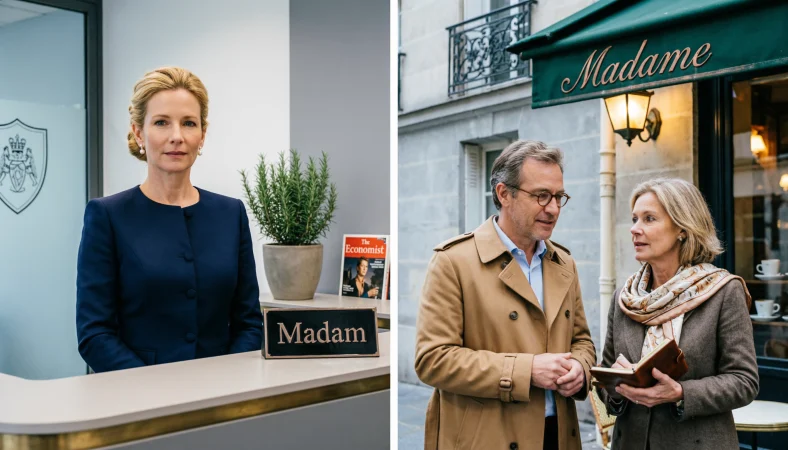
Madam and madame are both respectful forms of address for a woman, but they are not used in exactly the same way. Madam is the standard English form, especially in formal speech and writing, while madame is the French form and is often retained in English for French contexts, titles, names, or expressions.
The question of madam or madame often looks like a simple spelling choice, but the difference is actually connected to language, culture, pronunciation, and context. Both words refer to a respectful way of addressing a woman, and both ultimately come from the same historical source. However, English and French use them differently.
In modern English, madam is the normal formal term. You might hear it when speaking to a customer, addressing a woman in a formal setting, or writing a highly respectful letter. Madame, by contrast, is the French form and is usually associated with French language or culture. It can also appear in English when a French title, name, institution, or established expression is being preserved.
Choosing the wrong form can make writing sound unnecessarily foreign, overly formal, or culturally inaccurate. Understanding the distinction helps you select the word that fits the audience and situation rather than treating the two spellings as interchangeable.
Madam vs Madame: What’s the Difference?
The simplest distinction is that madam is the ordinary English form, while madame is the French form.
| Word | Part of speech | Primary language | Basic meaning | Typical use |
| Madam | Noun and form of address | English | A respectful way to address a woman | Formal English |
| Madame | Noun and form of address | French | A respectful way to address a woman | French and French influenced contexts |
The two words share the same historical origin. Both are related to the French expression ma dame, meaning essentially “my lady.”
In English, madam has developed as a natural English word. It appears in formal conversations, letters, customer service, legal settings, and other situations where respectful address is appropriate.
Madame remains strongly connected with French. In English writing, it may be used when referring to a French woman by title, preserving a French form of address, or using an established expression such as Madame Bovary.
A quick recap
Madam is the normal English spelling.
Madame is the French spelling.
They have the same historical roots but different modern usage patterns.
Context matters more than pronunciation alone.
Is Madam vs Madame a Grammar, Vocabulary, or Usage Issue?
The difference is primarily a vocabulary and usage issue, rather than a grammatical rule.
There is nothing grammatically wrong with either word by itself. The important question is whether the word belongs naturally in the language and context you are using.
If you are writing an English business email, for example, Dear Madam may be appropriate in certain formal situations. Writing Dear Madame without a French reason can make the message sound unusual or artificially French.
On the other hand, if you are writing about a French person or using a French title, Madame may be exactly right.
Are they interchangeable?
Not completely.
An English speaker could understand both words, but that doesn’t mean they are equally natural in every sentence. Language choices depend on convention. Native English usage generally favors madam, whereas French usage favors madame.
Formal versus informal usage
Both terms are associated with respect and formality, although their contexts differ.
In English, madam is formal and sometimes very formal. It can sound polished in customer service but may sound stiff in ordinary conversation.
In French, madame is an ordinary polite form of address. It does not necessarily carry the same unusually formal feeling that madam can carry in English.
Academic versus casual usage
Academic English generally uses madam only when the word is relevant to the subject or appears in direct address.
For example:
The letter begins, “Dear Madam.”
A literature paper discussing a French novel might use Madame because the original title requires it.
Casual English normally avoids both terms unless the social situation specifically calls for formal address.
How to Use Madam Correctly
Madam is the better choice when you are writing or speaking standard English and want to address a woman respectfully.
It is especially common in formal correspondence, customer service, official communication, and traditional expressions.
Workplace example
A receptionist might say:
“Good morning, madam. How may I help you?”
A formal letter might begin:
“Dear Madam, I am writing regarding your recent inquiry.”
That said, modern workplaces often prefer a person’s name when it is known. Addressing someone by name usually feels warmer and more natural than repeatedly saying madam.
Academic example
In an academic or historical context, you might encounter:
“Dear Madam, I respectfully request access to the archives.”
Here, madam functions as a formal form of direct address.
It can also appear in historical quotations, legal documents, or discussions of traditional correspondence.
Technology example
Digital customer service systems sometimes use formal language such as:
“Thank you for contacting us, madam.”
Although grammatically acceptable, this may sound old fashioned in modern conversational technology. Many contemporary interfaces use a person’s name instead because it feels more natural.
Usage recap
Use madam when standard English calls for a respectful formal address.
It works particularly well in official or traditional contexts.
In casual conversation, using the person’s name is often more natural.
How to Use Madame Correctly
Madame is appropriate when French language or culture is genuinely part of the context.
For example:
“Madame Dupont will meet us at noon.”
This reflects French naming and address conventions.
The word can also remain unchanged in English when it forms part of a proper name or established title.
Workplace example
Suppose an English speaking employee is communicating with a French client who is addressed as Madame Martin. Preserving Madame can be appropriate because it reflects the person’s preferred or culturally appropriate title.
Academic example
A history student might write:
“Madame de Staël played an important role in European intellectual history.”
Here, Madame is appropriate because it is part of the established name by which the historical figure is known.
Similarly, literary analysis may refer to Madame Bovary, not Madam Bovary, because the French title is being retained.
Technology example
A language learning application teaching French would naturally introduce:
“Bonjour, Madame.”
Here, using madame is essential because the learner is practicing French rather than English.
Usage recap
Use madame when French is the relevant language or cultural context.
Keep it in established French names and titles.
Don’t automatically substitute madame for madam in ordinary English.
When You Should NOT Use Madam or Madame
Understanding when not to use these terms is just as important as knowing when they are correct.
1. Don’t use madame simply because it looks more sophisticated
A common mistake is assuming that madame is a more elegant version of madam. It isn’t. It is the French form.
2. Don’t use madam in ordinary casual conversation without a reason
Saying “Excuse me, madam” can sound excessively formal depending on the situation. “Excuse me” or using the person’s name may be more natural.
3. Don’t replace French titles with English ones automatically
When discussing an established French name, changing Madame to Madam can make the name inaccurate.
4. Don’t use madame in ordinary English business writing without context
A sentence such as “Dear Madame” may look unusual if the correspondence is entirely in English and there is no French connection.
5. Don’t assume both spellings have identical pronunciation
Their pronunciation differs according to language and accent. French madame is not simply English madam with an extra letter.
6. Don’t use either term when a person’s name is clearly preferred
Modern professional communication often favors direct, personalized address.
7. Don’t treat madam and Madame as interchangeable titles
A French title should remain appropriate to its cultural and linguistic setting.
8. Don’t confuse respectful address with a person’s official title
Not every woman should be addressed as madam or madame. Context, preference, profession, and culture all matter.
Common Mistakes and Decision Rules
| Correct sentence | Incorrect or less suitable sentence | Explanation |
| “Good afternoon, madam.” | “Good afternoon, madame.” | English normally uses madam. |
| “Madame Bovary is a famous novel.” | “Madam Bovary is a famous novel.” | The French title is traditionally retained. |
| “Dear Madam, I am writing to you.” | “Dear Madame, I am writing to you.” | Madam is the standard English form. |
| “Bonjour, Madame.” | “Bonjour, Madam.” | French uses madame. |
| “Madame Curie won the Nobel Prize.” | “Madam Curie won the Nobel Prize.” | The established French title is Madame. |
| “Thank you, madam.” | “Thank you, madame.” | English generally favors madam in this context. |
Decision Rule Box
If you are writing standard English, use madam for formal female address.
If you are writing or speaking French, or preserving a French title or name, use madame.
This rule handles most everyday cases.
Madam or Madame in Modern Technology and AI Tools
Digital communication has changed how often these terms appear.
Modern chatbots, virtual assistants, customer support systems, and automated email platforms can generate formal language instantly. As a result, words such as madam sometimes appear in machine generated customer service responses.
However, natural communication is not simply about grammatical correctness. Tone matters.
A chatbot that repeatedly says “madam” may sound formal or outdated, especially when users expect friendly conversational language. A system that uses the person’s name can often sound more personal.
AI language tools also need to distinguish between language translation and English composition. If the intended output is French, madame is generally appropriate. If the intended output is standard English, madam is normally the correct choice in formal direct address.
This distinction is important for localization. Translation isn’t merely replacing one word with another. It requires understanding the conventions of the target language.
The Etymology of Madam and Madame
The history of these words explains why their meanings are so closely related.
Both ultimately trace back to an expression meaning “my lady.” Over time, the French form became madame, while English developed the shorter form madam.
English borrowed a large number of words and expressions from French throughout its history. Madam is one example of how a borrowed expression can become naturalized in English.
The difference between the two spellings therefore isn’t evidence that they have completely separate origins. Instead, it reflects how related forms developed within different linguistic systems.
The historical connection is useful because it explains why English speakers can recognize madame even when they don’t speak French.
An Expert Perspective on the Difference
A useful way to think about the distinction is this:
“The safest spelling is determined by the language and context, not by which form sounds more formal.”
That principle applies to many borrowed terms. A word may be perfectly recognizable in English while still belonging primarily to another language.
The goal isn’t to choose the version that appears more sophisticated. The goal is to choose the form that a fluent speaker would naturally expect in that particular setting.
Two Practical Case Studies
Case Study 1: Formal English customer service
Imagine an English speaking hotel receptionist addressing a guest.
The receptionist says:
“Good evening, madam. Your room is ready.”
The word madam is grammatically appropriate and culturally understandable. However, whether it sounds natural depends on the region, industry, and speaker. In some environments, “Good evening, Ms. Smith” may sound more personal.
The lesson is that correctness and naturalness are related but not identical. Madam can be correct while still being less conversational than using a name.
Case Study 2: French historical writing
Consider an academic article about Marie Curie.
A writer would normally refer to her as Madame Curie when retaining the traditional French form. Changing it to Madam Curie would make the title look anglicized and inconsistent with established usage.
The lesson is straightforward: when a French title is part of a recognized name, preserve the culturally established form.
Error Prevention Checklist
Always use madam when:
- You are writing standard English.
- You need a formal English form of address.
- You are writing traditional formal correspondence.
- You are quoting or reproducing an English expression that uses madam.
- You are addressing a woman respectfully in a formal English setting.
Always use madame when:
- You are writing in French.
- You are referring to a French title.
- You are preserving an established French name or expression.
- You are discussing French language or culture.
Never use madame when:
You are simply trying to make English sound more elegant.
There is no French connection and ordinary English is intended.
Never use madam when:
The established French name specifically requires Madame.
You are writing French and need the normal French form.
The context clearly calls for a person’s preferred title or name instead.
Why Pronunciation Can Cause Confusion
Spelling isn’t the only source of uncertainty.
English madam is generally pronounced in an English way, while French madame follows French pronunciation. When English speakers encounter madame in names, literature, or popular culture, pronunciation can vary depending on whether the speaker is preserving the French pronunciation or adapting the word to English.
This is another reason context matters.
A learner shouldn’t memorize the spelling without learning where each form belongs. Understanding the language behind the word makes the distinction much easier to remember.
Related Grammar Confusions You Should Master
If you often search for spelling and usage differences, several related pairs are worth learning:
- advisor or adviser
- practice or practise
- licence or license
- color or colour
- center or centre
- theater or theatre
- catalog or catalogue
- program or programme
- gray or grey
- honor or honour
These examples demonstrate an important principle: spelling differences can arise from regional English, historical development, borrowed vocabulary, or differences between languages.
FAQs
Is madam or madame correct?
Both are correct, but they belong to different linguistic contexts. Madam is the standard English form, while madame is the French form. The appropriate choice depends on the language, cultural setting, and whether a recognized French title or name is being preserved.
Is madame more formal than madam?
Not necessarily. In English, madam can sound highly formal. In French, madame is a normal polite form of address and does not necessarily have an unusually formal tone. The apparent difference in formality comes largely from language and cultural context.
Should I write Madam or Madame in a formal letter?
If the letter is written in standard English, madam is generally the appropriate form or If the letter is written in French, use madame. If you know the recipient’s name, using an appropriate personal title and surname is often preferable.
Is Madam the English version of Madame?
Yes, broadly speaking. The two forms are historically related, and madam is the established English form. Madame remains the French form and is also preserved in many French names and expressions used in English.
Why is Madame used before French women’s names?
Madame is the conventional French title corresponding broadly to a respectful form of address for a woman. English often preserves it when referring to well known French figures, literary characters, institutions, or culturally established names.
Can I use madame in English?
Yes, but the context matters. English can use madame when referring to French language or culture, preserving a French title, or discussing a French name. In ordinary formal English address, however, madam is normally the better choice.
Is Madam still used in modern English?
Yes. It remains a recognized formal term, especially in customer service, official communication, legal settings, traditional correspondence, and expressions such as “Dear Madam.” However, modern speakers often prefer a person’s name in everyday professional communication.
Is Madame always French?
Primarily, yes. Madame is the French form. English may borrow and use it in particular cultural, historical, literary, or institutional contexts, but its linguistic identity remains strongly French.
Should I say Madam or Ma’am?
In English, madam is generally more formal, while ma’am is a contracted spoken form that can sound more conversational. Regional attitudes toward both terms vary, so the relationship between speaker and listener matters.
Which is correct, Madam or Madame?
Neither spelling is universally better. Use madam for standard English formal address and madame for French language contexts or established French titles and names. Context determines the correct choice.
Conclusion:
The distinction between madam or madame becomes easy once you stop treating the words as competing spellings of exactly the same English term. Madam is the standard English form used for respectful formal address, while madame is the French form and is commonly retained when French language, culture, names, or titles are involved.
The best rule is simple: use the form that belongs naturally to your language and context. If you’re writing ordinary formal English, choose madam. If you’re writing French or preserving a recognized French title, choose madame. When a person’s name is known, however, a personalized form of address will often sound more natural than either word.