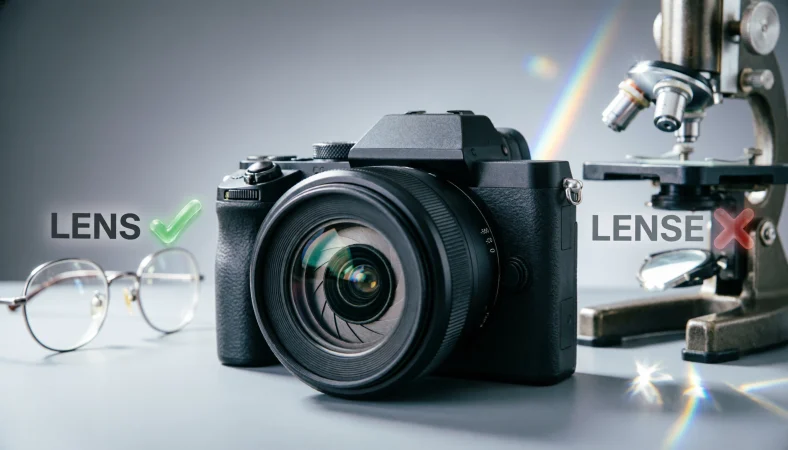
The correct spelling is lens. It is a noun that refers to a curved piece of glass or another transparent material that focuses or redirects light, or more broadly to a way of viewing something. Lense is generally a misspelling in modern standard English and should not be used in formal, academic, professional, or technical writing.
The confusion between lens or lense is understandable because English contains many nouns that form plurals by adding a final letter or changing their spelling. However, lens does not become lense in standard English. The correct singular form is lens, and its plural is lenses.
That small spelling difference matters more than it may seem. A person searching for information about a camera, eyeglasses, photography, contact lenses, microscopes, or optical equipment may encounter both spellings online. Informal websites, user generated content, product listings, and typing mistakes can make lense appear legitimate.
It isn’t the standard spelling, though.
If you’re writing an article, school assignment, product description, technical document, email, or professional message, use lens.
Lens vs Lense: What’s the Difference?
The difference is primarily one of spelling and standard usage.
Lens is the correct standard English noun. It can refer to an optical device or component that bends and focuses light. It can also have a figurative meaning, as in a particular perspective or way of examining an issue.
Lense is generally considered a misspelling of lens. It sometimes appears because writers incorrectly assume that the word needs a final letter to match other English spelling patterns.
| Word | Part of speech | Standard English | Meaning | Example |
| Lens | Noun | Yes | An optical element or perspective | The camera lens is dirty. |
| Lense | Noun | No in standard modern English | Usually an incorrect spelling of lens | The correct spelling is lens. |
| Lenses | Noun | Yes | Plural form of lens | The store sells camera lenses. |
| Lens’s | Possessive form | Yes | Something belonging to one lens | The lens’s surface was scratched. |
| Lenses’ | Plural possessive | Yes | Something belonging to multiple lenses | The lenses’ coatings were tested. |
What Does Lens Mean?
A lens is commonly an optical component designed to transmit and manipulate light.
In photography, the lens is one of the most important parts of a camera system. Different lenses provide different fields of view, focal lengths, magnification levels, and visual characteristics.
In eyeglasses, lenses help correct vision by changing how light enters the eye.
In a microscope, lenses help magnify objects that would otherwise be difficult or impossible to see clearly.
The word also has a figurative meaning.
For example:
We should examine the problem through a historical lens.
Here, lens doesn’t refer to glass. It means a particular perspective or framework for understanding something.
What Does Lense Mean?
Lense is normally an incorrect spelling of lens.
You may encounter it in online searches, comments, social media posts, informal messages, or user generated content. Its appearance doesn’t make it a standard alternative spelling.
For normal English writing, replace lense with lens.
What Is the Plural of Lens?
The plural of lens is lenses.
For example:
This camera has interchangeable lenses.
Not:
This camera has interchangeable lense.
The spelling changes from lens to lenses, with the final syllable pronounced appropriately in the plural.
Quick Recap
Lens is the correct singular spelling.
Lense is generally a spelling error.
The plural of lens is lenses.
The word can describe an optical object or a figurative perspective.
Is Lens vs Lense a Grammar, Vocabulary, or Usage Issue?
The lens or lense question is primarily a spelling and usage issue rather than a complicated grammar issue.
Both forms may look like nouns, but only lens is the standard spelling used in modern English.
This distinction is important because spelling and grammar aren’t the same thing.
Grammar concerns how words function and relate to one another in sentences. Spelling concerns how words are written.
A sentence such as:
The lens is damaged.
has correct grammar and spelling.
A sentence such as:
The lense is damaged.
has an understandable grammatical structure, but the noun has been spelled incorrectly.
Are Lens and Lense Interchangeable?
No.
They shouldn’t be treated as two accepted spellings of the same word.
In standard English, use lens.
You might encounter lense in search results because search engines index enormous amounts of user generated material. A misspelling can become surprisingly visible without becoming grammatically or lexically standard.
Formal vs Informal Usage
There is no need to use lense in informal writing simply because the conversation is casual.
For example, texting a friend doesn’t make this spelling necessary:
I need a new lense for my camera.
The correct version remains:
I need a new lens for my camera.
Informality may change punctuation, abbreviations, or sentence structure, but it doesn’t normally turn an established spelling error into a preferred spelling.
Academic vs Casual Usage
Academic writing should use lens consistently.
This applies to scientific papers, essays, research reports, textbooks, laboratory documentation, and classroom assignments.
For example:
The microscope lens was adjusted before the sample was examined.
Professional writing follows the same principle.
How to Use Lens Correctly
The easiest way to master lens is to see how naturally it fits into different contexts.
Workplace Example
Imagine a photographer discussing equipment with a client:
I use a wide angle lens when I need to capture more of the room.
The noun refers to a physical camera component.
Another workplace example might appear in an optometry setting:
The technician checked the lens before fitting the glasses.
Again, lens is the correct spelling.
Academic Example
A science student might write:
The convex lens focuses light toward a central point.
This usage is appropriate in an educational or scientific context.
The same word appears frequently in physics and optics.
Technology Example
Technology writing often discusses camera lenses, smartphone lenses, optical sensors, and augmented reality systems.
For example:
The smartphone uses multiple camera lenses to capture different perspectives.
Notice that the singular is lens and the plural is lenses.
Figurative Example
The word also works outside physical optics.
For example:
The researcher examined the issue through an economic lens.
Here, lens means a perspective or analytical framework.
Another example is:
Social media has changed the lens through which many people view news.
No physical glass is involved.
Usage Recap
- Use lens for optical equipment.
- Use lens when discussing eyeglasses and contact lenses.
- Use lens for camera equipment.
- Use lens figuratively when referring to a perspective or analytical framework.
How Lense Is Commonly Misused
The spelling lense usually appears because writers add an unnecessary final letter.
This can happen for several reasons.
A writer may associate the word with words that end in a similar sound. Another possibility is simple typing error. Search engines and online platforms can also reinforce the mistake because users sometimes see the incorrect form repeated.
Consider this sentence:
I bought a new lense for my camera.
The intended meaning is perfectly clear, but the spelling is incorrect.
The corrected sentence is:
I bought a new lens for my camera.
The mistake doesn’t change the reader’s understanding in most situations, but it can make writing appear less polished.
This matters particularly when the word appears in a professional context.
When You Should NOT Use Lense
There are several situations where choosing lense can create an avoidable spelling error.
1. Don’t use lense in academic writing
Research papers and school assignments should use the standard spelling lens.
2. Don’t use lense in technical documentation
Optics, photography, engineering, and scientific documents should use lens.
3. Don’t use lense in product descriptions
A camera product description should say camera lens, not camera lense.
4. Don’t use lense in professional communication
Emails, reports, presentations, and business documents should use the standard form.
5. Don’t use lense because you saw it online
Online frequency doesn’t automatically establish a word as correct.
6. Don’t assume lense is the singular form of lenses
The singular is lens.
The plural is lenses.
7. Don’t use lense as a stylistic alternative
There is no normal formal distinction where lens is reserved for one meaning and lense is reserved for another.
8. Don’t use lense simply because it looks more natural
English spelling doesn’t always follow visual expectations.
Common Mistakes and Decision Rules
| Correct sentence | Incorrect sentence | Explanation |
| I cleaned the camera lens. | I cleaned the camera lense. | Lens is the standard singular spelling. |
| This lens produces sharp images. | This lense produces sharp images. | Lense is an incorrect spelling here. |
| The shop sells camera lenses. | The shop sells camera lens. | Lenses is the correct plural form. |
| The microscope lens needs adjustment. | The microscope lense needs adjustment. | Use lens for the singular noun. |
| She replaced the damaged lens. | She replaced the damaged lense. | The correct spelling is lens. |
| The photographer owns several lenses. | The photographer owns several lens. | The plural of lens is lenses. |
| We examined the issue through a different lens. | We examined the issue through a different lense. | The figurative use also requires lens. |
Decision Rule Box
If you mean the optical object or a particular perspective, use lens.
If you need the plural, use lenses.
Do not use lense as a standard alternative spelling.
This rule covers virtually every ordinary use of the word.
Lens or Lense in Modern Technology and AI Tools
Modern technology has made the word lens even more common.
Smartphones use camera lenses. Digital cameras use interchangeable lenses. Microscopes rely on optical lenses. Virtual reality devices and augmented reality systems can incorporate optical components that manipulate light.
Technology products also use the word in software and branding contexts.
For example, a camera application might allow users to select different visual effects through what it calls a lens.
AI systems also encounter the term frequently because computer vision, image processing, photography, and optical technologies generate enormous amounts of text involving lenses.
If an AI writing tool produces lense, the output should be checked rather than automatically accepted.
AI can reproduce patterns found in training data, including common spelling errors. A word appearing in generated text isn’t proof that it is standard English.
For editors and publishers, this creates a useful quality control rule:
Always verify unusual spellings against established English usage rather than judging correctness by frequency alone.
Lens Etymology: Where Does the Word Come From?
The word lens has an interesting connection to the physical appearance of certain optical objects.
English borrowed the word from Latin lens, meaning a lentil. The connection comes from the shape of a lentil seed, which resembles the rounded form of a traditional convex lens.
The optical meaning developed because early lenses had a shape that could be compared with a lentil.
This history also helps explain why the standard English spelling is lens, not lense.
The word entered English as lens and has retained that spelling.
Its scientific use expanded as the study of optics developed. Today, the term appears across photography, physics, medicine, engineering, astronomy, microscopy, vision science, and everyday technology.
Why People Write Lense Instead of Lens
Understanding the source of a spelling mistake can make it easier to avoid.
One reason is pronunciation.
Because lens is pronounced with a final sound that may seem to invite another letter, some writers incorrectly create lense.
Another reason is analogy.
English has many words with unusual plural and spelling patterns. Writers sometimes unconsciously apply a familiar pattern to an unfamiliar word.
Search behavior can reinforce this mistake.
If someone types lense into a search engine and sees results containing the same spelling, they may assume that it is an accepted alternative.
This is an important lesson about online language:
Common does not always mean correct.
A misspelling can appear thousands of times across the internet while remaining a misspelling.
Lens in Photography, Vision, and Science
The word has several important technical applications.
Photography
A camera lens controls how light enters the camera and influences characteristics such as focal length, field of view, magnification, and image appearance.
Photographers may discuss wide angle lenses, telephoto lenses, macro lenses, portrait lenses, and standard lenses.
Vision Correction
Eyeglasses contain lenses designed to correct refractive errors.
Contact lenses serve a similar general purpose while sitting directly on the surface of the eye.
Microscopy
Microscopes use optical systems containing lenses to magnify and resolve tiny objects.
Astronomy
Telescopes can use lenses to gather and focus light, although many modern telescopes use mirrors as their primary light gathering elements.
Figurative Analysis
Outside science, lens can describe a conceptual viewpoint.
A historian may use a cultural lens.
An economist may use an economic lens.
A sociologist may use a social lens.
A journalist may examine an event through a political lens.
The spelling remains lens in every one of these contexts.
Case Study 1: Correcting a Photography Product Description
Consider a hypothetical online photography store preparing a product page for a camera accessory.
The initial draft contains the phrase:
Professional camera lense for low light photography.
An editor changes it to:
Professional camera lens for low light photography.
The correction improves the page because the standard spelling is now used consistently.
Suppose the page contains the word ten times. Correcting all ten instances removes ten visible spelling errors from the same piece of content.
The concrete result is straightforward: the product page uses the standard spelling throughout, making it more suitable for professional publication.
This is an illustrative editorial case study rather than a report of measured search traffic.
Case Study 2: Correcting an Academic Science Assignment
Imagine a student writing a laboratory report about optical refraction.
The student repeatedly writes lense while describing a convex optical component.
An instructor corrects the spelling and explains that lens is the standard singular form and lenses is the plural.
The student then changes every occurrence.
If the report originally contained eight instances of lense, the revision removes eight spelling errors without changing the scientific argument itself.
The concrete result is improved spelling consistency and greater technical accuracy.
Again, this is an illustrative educational example rather than a claim about a specific student’s documented result.
Expert Style Explanation: Why the Correct Form Matters
A useful way to remember the distinction is:
“Lens is the established singular form, while lenses is its standard plural. Lense should normally be treated as a spelling error.”
The important point isn’t simply memorizing one spelling.
It’s recognizing the word family.
Lens is singular.
Lenses is plural.
There is no standard modern usage in which lense replaces lens.
Error Prevention Checklist
Always use lens when:
- You mean one optical lens.
- You are discussing a camera lens.
- You are referring to an eyeglass lens.
- You are describing a microscope lens.
- You are using lens figuratively to mean perspective.
- You are writing academic or technical material.
- You are preparing professional content.
Always use lenses when:
- You mean more than one lens.
- You are discussing multiple camera lenses.
- You are referring to multiple optical components.
- You are describing several eyeglass lenses.
Never use lense when:
- You mean the standard singular noun.
- You are writing formal English.
- You are preparing technical content.
- You are publishing an article or product description.
- You are writing an academic assignment.
Related Grammar Confusions You Should Master
Learning spelling distinctions like lens or lense can make it easier to recognize other commonly confused forms.
1. Advice or Advise
Advice is a noun, while advise is a verb.
2. Device or Devise
Device is a noun referring to an object or system. Devise is a verb meaning to create or plan.
3. Practice or Practise
Practice is the standard noun in English, while practise is used as a verb in British English.
4. License or Licence
American English generally uses license for both noun and verb, while British English commonly distinguishes license as a noun and licence as a noun.
5. Sense or Since
Sense relates to perception, meaning, or judgment. Since can refer to time or causation.
6. Lose or Loose
Lose means to misplace or fail to win. Loose generally means not tight or securely fixed.
7. Then or Than
Then commonly relates to time or sequence. Than is used in comparisons.
8. Affect or Effect
Affect is commonly a verb meaning to influence. Effect is commonly a noun meaning a result, although both words have additional uses.
9. Its or It’s
Its is possessive. It’s is a contraction of it is or it has.
10. Everyday or Every Day
Everyday is an adjective meaning ordinary. Every day is an expression referring to each day.
FAQs
Is lens or lense correct?
Lens is correct in standard modern English. Lense is generally a misspelling and should not be used as an alternative spelling in formal or professional writing.
Is lense a real word?
You may find lense in online content, user generated writing, or informal text, but it isn’t the standard spelling of the common English noun. In ordinary modern usage, the correct form is lens.
What is the plural of lens?
The plural of lens is lenses.
For example:
The photographer owns three lenses.
How do you spell lens correctly?
The standard spelling is lens, with four letters. It does not require a final e.
Why do people spell lens as lense?
The error may result from pronunciation, analogy with other English words, typing mistakes, or exposure to incorrect online usage. Seeing the spelling frequently doesn’t make it standard.
Is lense an acceptable spelling in British English?
No. British English does not normally use lense as an alternative spelling of the standard noun lens. The correct form remains lens.
What is the difference between lens and lenses?
Lens is singular, meaning one optical component or one figurative perspective. Lenses is plural, meaning two or more.
For example:
This lens is expensive.
These lenses are expensive.
Is lens only used for cameras?
No. Lens can refer to optical components used in cameras, eyeglasses, microscopes, telescopes, and other systems. It can also describe a conceptual perspective, as in “through a historical lens.”
Is lens a noun or a verb?
Lens is primarily used as a noun in standard English. In specialized or informal contexts, it can also appear in derived or technical expressions, but its most familiar use is as a noun referring to an optical component or perspective.
Should I use lense in informal texting?
No. Even in casual writing, lens is the normal spelling. Informal communication doesn’t require replacing the standard spelling with lense.
Conclusion:
When choosing between lens or lense, the answer is straightforward: use lens.
A lens can be an optical component that focuses or redirects light, such as a camera lens, eyeglass lens, or microscope lens. It can also have a figurative meaning, referring to a perspective or analytical framework.
Lense is generally a misspelling rather than an accepted alternative.
Remember the simplest rule:
One lens. Two or more lenses. Never lense.
This distinction remains the same in casual conversation, academic writing, professional communication, technical documentation, photography content, and online publishing.
If you’re unsure, check the word family rather than relying on how the word sounds. The standard forms are lens for singular and lenses for plural.
Once you remember that pattern, the spelling becomes much easier to get right.