Lice or dandruff can look similar at first, but they are very different scalp problems. Head lice are tiny parasitic insects that live on the scalp and attach their eggs to individual hairs, while dandruff causes loose flakes of dead skin to shed from the scalp. Knowing the difference matters because each problem requires a different approach.
Many people notice itching, white material, or irritation and immediately wonder whether they have lice or dandruff. The confusion is understandable because both conditions can make the scalp uncomfortable. However, a closer look at where the flakes or eggs appear, how they behave when touched, and what the scalp feels like can provide useful clues.
This guide explains how to recognize the difference, what causes each condition, how transmission works, which treatments are appropriate, and when professional advice may be useful.
Lice or Dandruff: What’s the Difference?
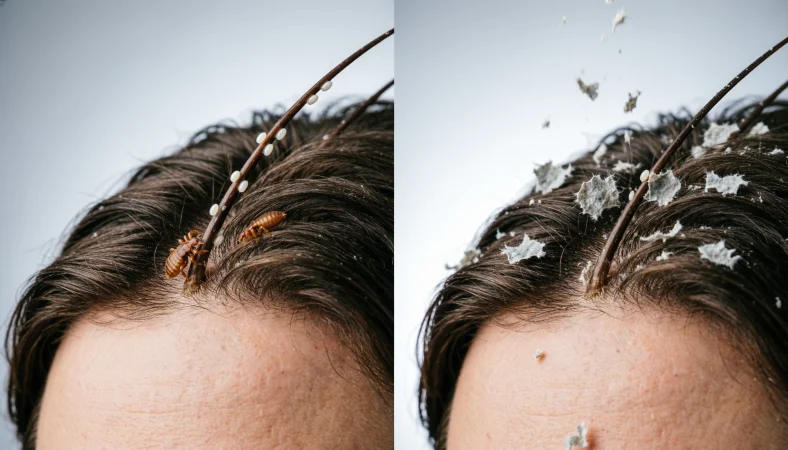
The easiest way to distinguish lice from dandruff is to examine the material attached to the hair and observe how easily it moves.
Head lice are small insects that feed on human blood and live close to the scalp. Adult lice are usually difficult to spot because they move quickly and avoid light. Their eggs, commonly called nits, attach firmly to individual hairs.
Dandruff, by contrast, involves flaking of the scalp. The flakes consist mainly of shed skin and may appear white, grayish, or yellowish depending on the individual and the condition of the scalp.
The two can cause itching, but itching alone doesn’t tell you which problem is present.
| Feature | Head lice | Dandruff |
| What it is | Parasitic insect infestation | Scalp flaking condition |
| Main cause | Head lice infestation | Scalp skin shedding and irritation |
| Appearance | Tiny insects and firmly attached nits | Loose flakes |
| Location | Close to the scalp and attached to hair | Scalp and loose hair |
| Movement | Lice can crawl | Flakes do not move independently |
| Attachment | Nits stick firmly to hair | Flakes usually fall away easily |
| Contagious | Yes | No |
| Typical concern | Infestation and spread | Scalp irritation and flaking |
A useful memory trick is simple: nits cling, while dandruff flakes.
If white material slides or brushes away easily, dandruff becomes more likely. If a small object remains firmly attached to a hair shaft near the scalp, a nit becomes more likely.
Still, visual inspection isn’t always enough. Hair products, dry scalp, skin conditions, and other debris can resemble either one.
The quick distinction
Lice are living parasites.
Nits are lice eggs attached to hair.
Dandruff consists of loose scalp flakes.
Lice can spread from person to person.
Dandruff isn’t an infectious condition.
Is Lice or Dandruff a Medical, Skin, or Hygiene Issue?
The distinction isn’t simply about cleanliness. Both problems can occur in people who maintain good personal hygiene.
Head lice are an infestation caused by a specific parasite. They spread primarily through direct hair to hair contact. They aren’t evidence that someone has poor hygiene.
Dandruff is associated with the way the scalp sheds skin and can involve several factors, including scalp sensitivity, oil production, irritation, and a naturally occurring yeast called Malassezia. Some people develop persistent flaking even when they wash their hair regularly.
This difference is important because people sometimes respond to either condition by washing their hair excessively. That may not solve the underlying problem.
Are they interchangeable?
No. Lice and dandruff describe different conditions and shouldn’t be treated as interchangeable terms.
Someone with dandruff doesn’t need lice treatment simply because their scalp itches. Likewise, someone with head lice shouldn’t assume that ordinary anti dandruff shampoo will eliminate an infestation.
Formal and everyday usage
In everyday conversation, people may describe anything white in their hair as dandruff. This is understandable but can lead to mistakes.
In health education and professional settings, the distinction matters. Lice refers to the parasitic insects, while dandruff refers to scalp flaking.
Academic and casual contexts
Academic or educational writing should distinguish between lice, nits, and dandruff. Casual conversation often uses broader descriptions such as flakes, bugs, or scalp irritation.
Using precise terminology makes it easier to understand what is actually happening and choose an appropriate response.
Understanding Head Lice
Head lice are small insects adapted to living on the human scalp. They feed on blood and spend most of their life close to the scalp, where they can move through the hair.
A female louse can lay eggs that become attached to individual hair shafts. These eggs are commonly called nits. Their firm attachment is one of the most useful clues when distinguishing an infestation from ordinary scalp flakes.
Head lice don’t fly or jump. They move by crawling. Transmission most commonly occurs when hair comes into direct contact with infested hair.
Children are frequently affected because close physical contact is common during play, school activities, sports, and other social situations. Adults can also get head lice.
Workplace example
Imagine an employee notices persistent scalp itching after spending time with a family member who recently had head lice. Rather than assuming the problem is dry skin, they inspect the hair close to the scalp.
If live crawling insects or firmly attached nits are found, the situation should be treated as a lice infestation rather than ordinary dandruff.
Academic example
A health education lesson might explain that head lice are parasitic insects rather than a form of scalp dermatitis. This distinction helps students understand why treatment for lice differs from treatment for flaky skin.
Technology example
Digital health applications and image recognition systems may attempt to identify scalp conditions from photographs. However, a photograph alone may not reliably distinguish lice, nits, dandruff, dry skin, or cosmetic residue.
A person should therefore avoid treating an automated image suggestion as a definitive diagnosis.
Usage recap
Head lice are parasites.
Nits are their eggs.
The insects crawl rather than fly or jump.
Nits tend to remain firmly attached to individual hairs.
An infestation can spread between people through close hair contact.
Understanding Dandruff
Dandruff is a common scalp condition characterized by visible flakes and varying degrees of itching or irritation.
It isn’t caused by head lice, and it isn’t contagious.
Dandruff can appear as small white flakes on dark clothing or around the shoulders. Some people experience only mild flaking, while others develop noticeable itching, redness, or larger areas of scaling.
Several factors can contribute to dandruff. Changes in oil production, individual sensitivity to scalp microorganisms, environmental conditions, stress, and certain skin disorders may influence symptoms.
Workplace example
Someone may notice white flakes falling onto a dark shirt during a meeting. If the material comes away easily when the hair is touched, dandruff is more plausible than nits.
Academic example
A student studying skin health may learn that dandruff involves scalp scaling rather than an insect infestation. The distinction demonstrates why identifying the underlying cause matters before selecting treatment.
Technology example
Search engines and health applications frequently provide information about dandruff because it is a common concern. However, digital tools can’t always determine whether an individual has simple dandruff or another scalp condition.
Persistent redness, severe scaling, sores, or significant inflammation may indicate that professional evaluation is appropriate.
Usage recap
Dandruff produces loose scalp flakes.
- It doesn’t crawl or move independently.
- It isn’t contagious.
- It can cause itching and irritation.
Treatment generally focuses on scalp care and controlling flaking rather than eliminating parasites.
How to Tell Lice and Dandruff Apart
When you’re trying to determine whether scalp debris represents lice or dandruff, focus on several characteristics rather than one symptom.
Look at how firmly it is attached
Dandruff flakes generally detach from the scalp or hair relatively easily.
Nits are different. They are attached to individual hairs and can be difficult to remove with ordinary brushing.
Look at where it appears
Nits are commonly found close to the scalp because the eggs need an appropriate environment for development.
Dandruff can occur across the scalp and may become visible on clothing, bedding, brushes, or hair.
Check whether it moves
Live lice crawl.
Dandruff flakes don’t crawl.
This is one of the clearest distinctions when a person can observe the material directly.
Consider the itching pattern
Both conditions can itch, so itching alone isn’t enough to distinguish them.
With lice, itching can result from sensitivity to bites and may become particularly noticeable around areas such as the scalp, behind the ears, and near the neck.
Dandruff related itching is more closely associated with scalp irritation and flaking.
Examine the hair carefully
Good lighting can make inspection easier. A fine toothed comb can also help when checking for lice.
If you’re uncertain about what you’re seeing, repeatedly scratching the scalp isn’t useful. It can irritate the skin and make the situation harder to assess.
When You Should NOT Assume Lice or Dandruff
Not every itchy or flaky scalp problem fits neatly into one of these two categories.
There are several situations where assuming the cause can lead to the wrong response.
Don’t assume every white particle is a nit
Hair spray, styling products, dust, dry skin, and other debris can become attached to hair.
Don’t assume every itchy scalp has lice
Itching can result from dandruff, irritation, allergic reactions, dry skin, or other scalp conditions.
Don’t assume frequent washing prevents lice
Head lice aren’t simply a consequence of poor hygiene.
Don’t use lice treatment just because flakes are visible
Lice treatments are intended for an actual infestation, not ordinary scalp flaking.
Don’t treat persistent scalp inflammation as simple dandruff indefinitely
If symptoms are severe or don’t improve with appropriate care, another scalp condition may be involved.
Don’t rely entirely on an online photograph
Images can help people learn what lice and dandruff look like, but they don’t replace direct examination.
Don’t confuse nits with live lice
Finding something attached to a hair doesn’t automatically prove that live lice are present. Careful inspection is important.
Don’t ignore repeated infestations
If lice repeatedly return after treatment, reinfestation or incomplete treatment may need to be considered.
Common Mistakes When Comparing Lice and Dandruff
| Correct sentence | Incorrect sentence | Explanation |
| The flakes brush away easily, so dandruff is possible. | The flakes move, so they must be lice. | Loose flakes don’t indicate a parasite. |
| Nits are firmly attached to individual hairs. | Nits fall freely from the hair. | Nits typically cling to hair shafts. |
| Head lice are contagious. | Dandruff is contagious. | Dandruff isn’t an infectious infestation. |
| Lice crawl through the hair. | Lice jump from one person to another. | Head lice move by crawling. |
| Itching can occur with both conditions. | Itching proves someone has lice. | Itching has many possible causes. |
| Dandruff produces scalp flakes. | Dandruff is caused by insects. | Dandruff isn’t a lice infestation. |
Decision Rule
If the material is loose and flakes away easily, dandruff is more likely. If a small object is firmly attached to an individual hair and live crawling insects are present, lice becomes more likely.
This rule isn’t a substitute for professional assessment, but it provides a practical starting point.
Lice or Dandruff: What Causes Each Condition?
The causes are fundamentally different.
Head lice result from infestation with human head lice. Transmission commonly happens through close hair to hair contact. Sharing personal objects that touch the hair may also play a role in some circumstances, although direct contact is the primary route.
Dandruff doesn’t result from an infestation. It reflects scalp scaling and irritation. A naturally occurring microorganism on the skin, particularly Malassezia, can contribute to dandruff in susceptible individuals.
Other factors can influence how noticeable dandruff becomes. These may include changes in scalp oil, weather conditions, stress, skin sensitivity, and the use of irritating hair products.
The important point is that these conditions require different approaches. Treating the wrong problem can waste time and may irritate the scalp.
Lice or Dandruff in Modern Technology and AI Tools
Modern technology can make health information easier to access, but scalp conditions demonstrate why automated identification has limits.
An AI system may analyze a photograph and recognize patterns that resemble flakes, eggs, or irritation. Yet lighting, image quality, hair color, camera resolution, styling products, and skin texture can dramatically affect what appears in a photograph.
AI can therefore serve as an educational aid, but it shouldn’t be treated as a definitive diagnostic tool.
For example, an image containing small white particles might be classified as dandruff when the particles are actually cosmetic residue. Conversely, a photograph of firmly attached material might be mistaken for nits without enough evidence.
The best use of technology is to support observation and education while leaving uncertain or persistent cases to qualified professionals.
The Etymology of Lice and Dandruff
The words themselves have long histories in English.
Louse, the singular form of lice, comes from Old English and related Germanic forms. The word has been used for centuries to describe the small parasitic insect.
Dandruff is also an old English word associated with scalp scaling or flaking. Its historical development reflects the long recognition of visible scalp flakes as a distinct condition.
Modern medical terminology has become much more precise, but these everyday words remain widely used because they describe familiar problems in accessible language.
Understanding the vocabulary helps prevent another common mistake: treating two visually similar things as though they belong to the same category.
An expert perspective
A useful principle in scalp care is simple: appearance should guide inspection, not replace it.
That principle applies especially well when people are trying to distinguish parasites from ordinary skin flakes. A careful examination of attachment, movement, location, and associated symptoms is more informative than focusing on itching alone.
Two Practical Case Examples
Case example one: The removable flakes
Consider a person who notices white particles on a dark shirt. Their scalp feels mildly itchy, and they initially worry about head lice.
Under good lighting, the particles are seen throughout the hair and fall away when the hair is brushed. No crawling insects are found, and nothing appears firmly attached to individual hair shafts.
The result is a pattern more consistent with dandruff than an active lice infestation.
The practical lesson is that loose material shouldn’t automatically be interpreted as nits.
Case example two: The firmly attached particles
Now consider a child with persistent itching around the scalp and behind the ears. During a careful inspection, several small oval particles are found firmly attached to individual hairs close to the scalp. Further examination identifies live crawling insects.
This pattern is much more consistent with head lice.
The practical result is a change in management: the household should focus on appropriate lice treatment and measures designed to prevent continued transmission or reinfestation.
These examples are educational scenarios rather than individual medical diagnoses. Their purpose is to demonstrate why the physical characteristics of the material matter.
Error Prevention Checklist
Always consider these clues when identifying dandruff
- Check whether flakes are loose.
- Look for visible scalp scaling.
- Notice whether particles fall away during brushing.
- Consider whether scalp dryness or irritation is present.
- Remember that dandruff isn’t contagious.
Always consider these clues when checking for lice
- Inspect individual hair shafts.
- Look for firmly attached nits.
- Check close to the scalp.
- Look carefully around the ears and neck.
- Look for live crawling insects.
- Consider recent close hair contact with someone who had lice.
Never assume dandruff when
- Material remains firmly attached to individual hairs.
- Live crawling insects are visible.
- Several household members develop similar symptoms after close contact.
- The itching is persistent and accompanied by evidence of infestation.
Never assume lice when
- The material falls away easily.
- Only generalized scalp flaking is present.
- No insects or firmly attached nits can be found.
- The symptoms fit ordinary scalp irritation more closely.
When Should You Seek Professional Advice?
Many cases can be identified through careful inspection, but professional guidance becomes especially useful when the situation is unclear.
Consider seeking medical advice if the scalp develops significant redness, swelling, sores, bleeding, severe irritation, or persistent symptoms.
Professional assessment can also help when an apparent lice infestation doesn’t improve after appropriate treatment, when repeated infestations occur, or when you’re uncertain whether the material in the hair represents lice, nits, dandruff, or another skin condition.
Children with persistent scalp symptoms may also benefit from professional evaluation rather than repeated experimentation with different products.
The goal isn’t simply to remove whatever is visible. It’s to identify the underlying cause and use an appropriate response.
Related Grammar and Health Confusions You Should Master
The distinction between similar terms appears throughout everyday health language. Learning related differences can make health information easier to understand.
- Dry scalp or dandruff
- Lice or nits
- Rash or allergy
- Eczema or psoriasis
- Cold or flu
- Bacterial infection or viral infection
- Acne or skin irritation
- Sunburn or heat rash
- Allergy or intolerance
- Infection or inflammation
These comparisons demonstrate an important communication principle: similar symptoms don’t necessarily mean identical causes.
FAQs
How can I tell if I have lice or dandruff?
Look at whether the material is loose or firmly attached. Dandruff usually flakes away relatively easily, while nits remain attached to individual hairs. Finding live crawling insects provides stronger evidence of a lice infestation.
Can dandruff look like lice eggs?
Yes. Dandruff, dry skin, hair products, and other debris can sometimes resemble nits. The main clue is attachment. Nits are generally difficult to slide off the hair, whereas dandruff tends to loosen more readily.
Do lice cause dandruff?
Lice don’t cause ordinary dandruff. However, an infestation can irritate the scalp and cause scratching or skin debris, which may sometimes look similar to flaking.
Is dandruff contagious like head lice?
No. Dandruff isn’t a contagious infestation. Head lice, however, can spread through close hair to hair contact.
Can lice jump from one person to another?
No. Head lice don’t jump or fly. They crawl from hair to hair, which is why close contact is an important factor in transmission.
What do lice eggs look like compared with dandruff?
Lice eggs are small and firmly attached to individual hairs, usually relatively close to the scalp. Dandruff consists of loose flakes that can detach from the scalp and hair more easily.
Can you have lice and dandruff at the same time?
Yes. A person can have dandruff while also developing a head lice infestation. One condition doesn’t automatically prevent the other.
Does washing your hair get rid of head lice?
Ordinary shampooing alone isn’t considered a reliable treatment for head lice. An actual infestation generally requires an appropriate lice treatment approach and careful follow up.
Should I use dandruff shampoo if I think I have lice?
Dandruff shampoo is designed to address scalp flaking rather than eliminate a head lice infestation. If lice are suspected, the first priority is confirming whether an infestation is actually present.
Conclusion:
The difference between lice or dandruff becomes much easier to understand when you focus on the physical clues. Dandruff produces loose scalp flakes, while head lice are parasites that live close to the scalp and produce eggs that attach firmly to individual hairs.
Itching can occur with both conditions, so it shouldn’t be used as the only deciding factor. Instead, examine whether the material moves, how firmly it attaches to the hair, where it appears, and whether live crawling insects are present.
The most important takeaway is that lice and dandruff aren’t interchangeable problems. Correct identification helps prevent unnecessary treatment and makes it easier to choose the appropriate next step.