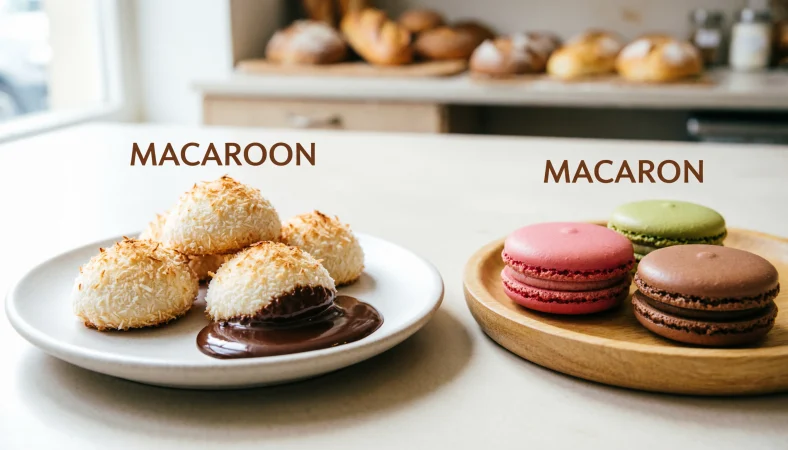
Macaroon and macaron are both correct words, but they refer to two different types of cookies. A macaron is a delicate French sandwich cookie made with almond flour, egg whites, and sugar, typically filled with ganache, buttercream, or jam.
A macaroon is usually a dense, chewy cookie made with shredded coconut, egg whites, and sugar. Understanding the difference between macaroon or macaron helps you identify the right dessert and use the correct spelling when discussing recipes or ordering sweets.
Have you ever wondered whether the colorful French cookie is called a macaroon or macaron? These names look and sound similar, so people often mix them up when discussing desserts, baking recipes, or bakery menus.
However, the two treats differ in ingredients, texture, shape, and appearance. Macarons typically feature smooth shells and creamy fillings, while coconut macaroons are known for their rough texture and chewy centers.
In this guide, you will learn the difference between macaroon and macaron, explore their ingredients and defining characteristics, and discover when to use each word correctly. With clear explanations and practical examples, you will understand how to distinguish these popular treats and avoid confusion when reading recipes, writing about desserts, or choosing something sweet at a bakery.
Macaroon vs Macaron: What’s the Difference?
Although macaroon and macaron look and sound similar, they describe distinct desserts. Both are nouns, and both can refer to sweet baked treats, but their ingredients, preparation methods, and finished appearance are usually quite different.
What Is a Macaroon?
A macaroon is a small, sweet cookie commonly made with shredded coconut, egg whites, and sugar. Many recipes also include condensed milk, vanilla extract, or a coating of chocolate.
Macaroons usually have a rough, irregular surface and a moist, chewy center. Depending on the recipe, they may look golden brown on the outside and soft inside. Some versions are dipped or drizzled with chocolate.
Coconut macaroons are especially popular in North America and are often served at bakeries, holiday gatherings, and family celebrations.
Examples:
- She brought a box of chocolate dipped macaroons to the party.
- Coconut macaroons are easy to make with a few basic ingredients.
- The bakery sells freshly baked macaroons with crisp, golden edges.
The word macaroon is commonly associated with coconut cookies, although recipes and regional traditions can vary.
What Is a Macaron?
A macaron is a French confection made from almond flour, egg whites, and sugar. Bakers combine these ingredients to create a delicate shell, then sandwich two shells around a filling such as buttercream, ganache, or jam.
A well made macaron typically has a smooth, rounded top, a slightly crisp outer shell, a soft interior, and a characteristic ruffled edge known as the foot.
Macarons come in a wide range of colors and flavors, including pistachio, raspberry, chocolate, lemon, vanilla, and salted caramel. Their appearance and carefully balanced textures make them popular in French patisseries and specialty bakeries.
Examples:
- She chose a raspberry macaron from the pastry display.
- The chef filled the chocolate macarons with dark chocolate ganache.
- French macarons require careful mixing and controlled baking conditions.
Unlike the typical coconut macaroon, a traditional French macaron uses almond flour as its main nut based ingredient.
Macaroon vs Macaron Comparison Table
| Feature | Macaroon | Macaron |
| Part of speech | Noun | Noun |
| Common origin associated with the modern style | Various European and North American traditions | French pastry tradition |
| Main ingredient | Usually shredded coconut | Usually almond flour |
| Texture | Moist and chewy | Delicate shell with a soft interior |
| Appearance | Rough, irregular mound | Smooth, rounded sandwich cookie |
| Typical filling | Often none, though chocolate coatings are common | Buttercream, ganache, jam, or similar filling |
| Common flavors | Coconut, chocolate, vanilla | Pistachio, raspberry, chocolate, lemon, vanilla |
| Preparation | Often relatively simple | Requires careful technique and precise mixing |
| Typical presentation | Individual mound shaped cookies | Two shells joined by a filling |
| Common spelling | Macaroon | Macaron |
Quick recap: A macaroon is usually a chewy coconut cookie. A macaron is a French sandwich cookie made with almond flour and a filling. Their similar names can cause confusion, but their ingredients and appearance make them easy to distinguish. If you see colorful, smooth cookies with ruffled edges, they are probably macarons.
Is Macaroon vs Macaron a Grammar, Vocabulary, or Usage Issue?
The difference between macaroon and macaron is primarily a vocabulary and spelling issue. Both spellings are correct, but they refer to different desserts in common contemporary usage.
Are Macaroons and Macarons Interchangeable?
No. Although the words are related historically, they are not generally interchangeable when identifying the two modern cookie styles.
If a recipe calls for shredded coconut and condensed milk, it is probably describing a macaroon. If it calls for almond flour, whipped egg whites, and a filling between two shells, it is likely describing a macaron.
Using the wrong term may not prevent someone from understanding the general idea, but it can create practical confusion when ordering pastries, following recipes, or describing ingredients to someone with a food allergy.
Formal vs Informal Usage
Both words are standard terms in food writing, restaurant menus, recipes, and everyday conversation.
A professional bakery menu should use macaron for the French almond sandwich cookie and macaroon for the coconut cookie. The distinction is especially useful when customers expect a particular dessert.
In casual conversation, someone may use the terms incorrectly because the spellings differ by only a few letters. However, the distinction matters when the type of cookie affects a purchase or recipe.
Academic vs Casual Usage
In culinary education, food history, and recipe development, accurate terminology helps readers understand the ingredients and preparation methods involved.
A student writing about French pastry techniques should use macaron when discussing the French sandwich cookie. A report about coconut based confections should use macaroon when that is the dessert being examined.
In casual conversation, context may clarify the intended meaning. In professional or educational writing, using the correct name avoids ambiguity.
How to Use Macaroon Correctly
Use macaroon when referring to the cookie commonly made with shredded coconut, sugar, and egg whites. Some recipes use sweetened condensed milk or other ingredients to create a moist, chewy texture.
Macaroons are often easier for beginner bakers because many recipes involve mixing the ingredients, shaping small mounds, and baking them until the edges turn golden.
Workplace Example
Imagine a bakery preparing its daily product list. The staff member needs to distinguish coconut cookies from French pastries.
A suitable product description would be:
Our freshly baked coconut macaroons have a chewy center and a lightly toasted exterior.
This wording tells customers what to expect from the cookie.
Academic Example
A student writing a culinary report might explain:
Coconut macaroons combine shredded coconut, sugar, and a binding ingredient to produce a moist, chewy cookie.
The term accurately identifies the type of confection being studied.
Technology Example
Recipe applications, digital bakery inventories, and online food ordering systems use product names to organize recipes and menu items.
For example:
The recipe app categorizes coconut macaroons under simple baked desserts.
In a digital inventory, the word macaroon helps distinguish coconut cookies from almond based French pastries.
Additional Examples
- The baker sprinkled toasted coconut over the macaroons.
- Chocolate dipped macaroons make a popular dessert gift.
- My grandmother’s macaroon recipe uses condensed milk.
- The bakery offers coconut macaroons during the holiday season.
- These macaroons stay chewy in the center after baking.
Usage recap: Choose macaroon when the dessert is the familiar coconut based cookie. If the recipe describes smooth almond shells joined by a filling, macaron is the more appropriate word.
How to Use Macaron Correctly
Use macaron when referring to the French style confection made from almond flour, egg whites, and sugar, with a filling placed between two shells.
Macarons require more precise preparation than many basic cookie recipes. Bakers need to manage the texture of the batter, the formation of the shells, and the baking conditions to achieve the characteristic smooth tops and ruffled feet.
Workplace Example
A pastry chef preparing a display for a bakery might write:
The pastry team arranged pistachio and raspberry macarons in separate rows.
The sentence uses macaron correctly because the products are French style filled cookies.
Academic Example
A culinary student might describe the preparation process as follows:
French macarons rely on carefully prepared meringue and almond flour to create a delicate shell.
The wording identifies both the dessert and a defining part of its preparation.
Technology Example
A baking website or recipe application might recommend macaron recipes based on the ingredients available to the user.
For example:
The baking app recommends a chocolate macaron recipe that uses almond flour and ganache.
The term tells readers that the recipe concerns French sandwich cookies rather than coconut macaroons.
Additional Examples
- The pastry chef filled the macarons with vanilla buttercream.
- Raspberry macarons add color to a dessert platter.
- The shells developed small ruffled feet during baking.
- She ordered six macarons in different flavors.
- The chocolate macarons were arranged in a gift box.
Usage recap: Use macaron for the French sandwich cookie with almond based shells and a filling. When describing its smooth surface, delicate texture, or colorful presentation, this is generally the correct term.
When You Should NOT Use Macaroon or Macaron
The two terms are easy to confuse, but several common situations make the distinction important.
When Describing a Coconut Cookie
Do not use macaron if you mean a traditional coconut macaroon.
Incorrect: The bakery sells chocolate dipped coconut macarons.
Correct: The bakery sells chocolate dipped coconut macaroons.
The corrected sentence uses the common name for the coconut cookie.
When Describing a French Sandwich Cookie
Do not use macaroon simply because the dessert is small and sweet.
Incorrect: She bought three raspberry macaroons with buttercream filling.
Correct: She bought three raspberry macarons with buttercream filling.
The second sentence identifies the French style confection.
When Following a Recipe
Do not substitute one word for the other without checking the ingredients. A recipe for coconut macaroons will not produce the same dessert as a recipe for French macarons.
When Ordering at a Bakery
If you want a French pastry with two almond shells and a filling, ask for a macaron. If you want a chewy coconut cookie, ask for a macaroon.
When Writing a Food Menu
Avoid using the spellings interchangeably in a menu. Customers may expect a specific texture, flavor, or ingredient profile.
When Discussing Food Allergies
Do not assume either dessert is safe for someone with a particular allergy based only on its name. Macarons commonly contain almonds, while macaroons often contain coconut. Recipes may include other allergens, and ingredients can vary. Always check the ingredient list and any cross contamination information.
When Describing Appearance
A smooth, colorful cookie with a filling between two shells is usually a macaron. A rough, coconut covered mound is usually a macaroon. Use the word that matches the actual product.
When Writing a Culinary Assignment
Do not treat the spellings as simple variants of the same word. If the assignment compares recipes, explain the differences in ingredients and technique.
Common Mistakes and Decision Rules
A simple way to distinguish the words is to connect each one with its best known ingredient and appearance.
| Correct sentence | Incorrect sentence | Explanation |
| She baked coconut macaroons. | She baked coconut macarons. | The sentence describes the common coconut cookie. |
| The chef filled the macarons with ganache. | The chef filled the macaroons with ganache. | The sentence describes French sandwich cookies. |
| The bakery sells almond flour macarons. | The bakery sells almond flour macaroons. | Almond flour is a defining ingredient in traditional French macarons. |
| He dipped the macaroons in melted chocolate. | He dipped the macarons in melted chocolate. | The intended product is a coconut based cookie. |
| The raspberry macarons had smooth shells. | The raspberry macaroons had smooth shells. | Smooth shells and fillings are characteristic of French macarons. |
| The coconut macaroons had a chewy texture. | The coconut macarons had a chewy texture. | The sentence describes the familiar chewy coconut confection. |
The Simple Decision Rule
If you mean a chewy cookie made mainly with coconut, use macaroon.
If you mean a French sandwich cookie made with almond flour and a filling, use macaron.
Remember: macaroon usually means coconut cookie, while macaron usually means French pastry.
This rule covers the most common modern uses. Some recipes and historical traditions vary, so ingredients and preparation remain the best way to identify a dessert precisely.
Macaroon and Macaron in Modern Technology and AI Tools
Digital recipe platforms, online bakeries, food delivery services, and AI powered cooking assistants all rely on clear ingredient and product descriptions.
When someone searches for macaroon recipes, they often want a coconut based cookie. A search for macaron recipes commonly points to French almond sandwich cookies. Confusing the terms can lead users to recipes that require entirely different ingredients and techniques.
AI writing tools can suggest spellings based on context, but they may not always distinguish between the desserts. A sentence about shredded coconut, condensed milk, and chewy cookies strongly suggests macaroon. A sentence about almond flour, meringue, ganache, and smooth shells usually suggests macaron.
Recipe developers and food businesses should also provide clear ingredient lists and product descriptions. This is more useful than relying on the name alone, particularly when customers need information about allergens or dietary restrictions.
Technology can help organize recipes and products, but the writer must still confirm which dessert the text describes.
The Etymology of Macaroon and Macaron
The two words are historically related. Both developed from names for almond based confections, with roots in Italian terminology associated with maccarone and related forms. Their histories reflect the movement of recipes and culinary traditions across Europe.
Over time, different versions of the confection developed in different regions. The French macaron became associated with the delicate almond based pastry that is often filled and presented as two joined shells. The English word macaroon became widely associated with the coconut cookie, particularly in North America.
The historical relationship helps explain why the words look similar. However, their modern culinary meanings have become distinct enough that most recipes and menus use the two spellings to identify different desserts.
Although the history is shared, the most reliable way to choose the correct word today is to consider the recipe, ingredients, and finished appearance.
An Expert Perspective on Choosing the Correct Word
A useful editorial principle for food writing is:
The most accurate name for a dish is the one that helps readers identify what they will actually eat.
This principle applies directly to macaroon and macaron. The words share a history, but modern readers generally expect different desserts when they encounter them.
A bakery should identify a coconut cookie as a macaroon and a traditional French almond sandwich cookie as a macaron. A recipe writer should also describe the ingredients and preparation method, especially when the distinction affects allergies or baking results.
Correct terminology makes recipes easier to follow, menus easier to understand, and food descriptions more trustworthy.
Case Study One: Correcting a Bakery Menu
The following is an illustrative editing scenario.
A bakery prepares a menu for a seasonal dessert selection. One item is a chewy cookie made with shredded coconut and dipped in chocolate. The draft menu calls it a “chocolate coconut macaron.”
The editor checks the recipe and revises the name to:
Chocolate dipped coconut macaroon.
The revised description matches the dessert’s ingredients and common name. Customers looking for coconut cookies can identify the product more easily, and staff can distinguish it from the bakery’s French pastries.
Result: The menu uses consistent terminology, reducing the chance of customers ordering a different dessert than they expected.
The key lesson is to name a food according to the product being sold rather than choosing a spelling based on how familiar it looks.
Case Study Two: Improving a Baking Recipe
This illustrative scenario concerns a recipe website.
An editor reviews an article that uses macaroon throughout, even though the recipe calls for almond flour, whipped egg whites, and a ganache filling. The finished cookies have smooth shells and characteristic ruffled feet.
The editor changes the terminology to macaron and checks the title, ingredient notes, and preparation instructions for consistency.
Result: The article now accurately describes the French sandwich cookie and is less likely to confuse readers who are searching for a coconut macaroon recipe.
The lesson is that a correct keyword is not enough on its own. The recipe’s ingredients, method, and description must support the term being used.
Error Prevention Checklist
Use this checklist when proofreading the two spellings.
Always Use Macaroon When
- You mean a cookie commonly made with shredded coconut.
- The recipe describes a chewy coconut based confection.
- You are discussing a coconut cookie that may be dipped in chocolate.
- The ingredients and appearance match the familiar macaroon style.
Always Use Macaron When
- You mean the French style sandwich cookie.
- The shells are commonly made with almond flour, egg whites, and sugar.
- The finished dessert has two shells joined by buttercream, ganache, or jam.
- You are discussing traditional French pastry techniques for this confection.
Never Confuse Them When
- Writing bakery menus or product labels.
- Publishing recipes and ingredient lists.
- Explaining pastry techniques in a culinary assignment.
- Responding to food allergy questions.
- Organizing recipes in a digital application or online store.
The easiest memory aid is to associate macaroon with coconut and macaron with French filled pastry.
Related Grammar Confusions You Should Master
These commonly confused words are useful to study alongside macaroon and macaron:
- Bailer or baler: A liquid removal tool or legal role compared with a machine that compresses materials into bales.
- Desert or dessert: A dry region or the sweet course served after a meal.
- Flour or flower: A baking ingredient compared with the bloom of a plant.
- Chili or chilly: A spicy pepper or dish compared with a word describing cold conditions.
- Compliment or complement: Praise compared with something that completes or enhances another thing.
- Principal or principle: A person in authority compared with a rule or belief.
- Stationary or stationery: Being still compared with writing materials.
- Palette or palate: A range of colors compared with the sense of taste or a person’s taste preferences.
- Advice or advise: A noun referring to guidance compared with a verb meaning to give guidance.
- Affect or effect: A verb often meaning to influence compared with a noun often meaning a result.
These examples reinforce an important writing skill: similar spelling or pronunciation does not guarantee the same meaning. Always check the context before choosing a word.
FAQs
What is the difference between a macaroon and a macaron?
Macaroons are usually chewy coconut cookies, while macarons are French almond meringue cookies with two shells joined by a filling.
Is it spelled macaroon or macaron?
Both spellings are correct. Macaroon usually refers to a coconut based cookie, while macaron refers to the French almond based sandwich cookie. The correct spelling depends on which dessert you mean.
Are macarons made with coconut?
French macarons are typically made with almond flour, egg whites, and sugar, though some recipes may include coconut or other ingredients.
Are macaroons made with almonds?
Macaroons usually refer to coconut cookies in North America, although some traditional and regional versions use ground nuts instead.
Why are macarons so expensive?
Macarons often cost more than regular cookies because they require precise preparation, careful baking, individual assembly, and sometimes specialty ingredients or decorative finishes.
Which is easier to make, macarons or macaroons?
Coconut macaroons are easier for beginners, while French macarons require more precise mixing, drying, and baking techniques.
Are macarons and macaroons gluten free?
Traditional recipes for both desserts may be gluten free, but always check ingredients and packaging because recipes and cross contact risks can vary.
How do you pronounce macaron and macaroon?
“Macaron” typically ends with an “on” sound, while “macaroon” ends with an “oon” sound. Pronunciation may vary by accent.
Is a coconut macaron the same as a coconut macaroon?
A coconut macaroon is a chewy cookie made with shredded coconut, while a macaron is typically a French sandwich cookie. Check the ingredients and appearance to identify special variations.
Conclusion:
When deciding between macaroon or macaron, consider the ingredients and the finished dessert. A macaroon is usually a chewy coconut cookie, while a macaron is a French sandwich cookie made with almond flour, meringue, and a filling.
Both spellings are correct, but they describe different treats in common modern usage. Using the right term helps readers follow recipes, understand bakery menus, and identify the dessert they want.
Remember the simplest rule: macaroon usually means coconut cookie, while macaron usually means French filled pastry.