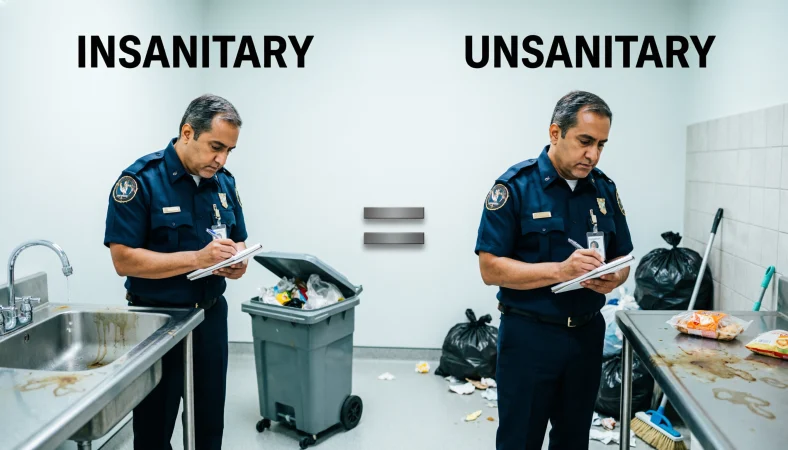
Unsanitary and insanitary are both correct spellings, and they have the same meaning: unclean or likely to harm health because of poor hygiene or sanitation. Unsanitary is more common in American English, while insanitary is more frequently associated with British English and formal contexts.
For example, “The restaurant was closed because of unsanitary conditions.” Choose the spelling that best matches your audience and maintain consistency throughout your writing.
Have you ever wondered whether to use insanitary or unsanitary when describing an unclean environment? Both words refer to conditions that may threaten health because of inadequate cleanliness, hygiene, or sanitation.
Although their meanings are essentially the same, their usage can vary by region and context. Understanding this difference helps you choose appropriate wording when discussing public health, workplace hygiene, food safety, or household cleanliness.
In this guide, you will learn the meanings of insanitary and unsanitary, explore their spelling and regional usage, and discover how to use each word correctly in sentences.
With clear definitions and practical examples, you will understand which form suits your audience and communicate more accurately in everyday, academic, and professional writing.
Insanitary vs Unsanitary: What’s the Difference?
The difference between insanitary and unsanitary is mainly a matter of word choice and usage, rather than meaning. Both adjectives describe conditions that fail to meet acceptable standards of cleanliness or sanitation.
What Does Insanitary Mean?
Insanitary is an adjective that describes a place, condition, or practice that is unhygienic or potentially harmful to health because of poor sanitation.
It is commonly associated with environments that lack proper waste disposal, clean water, adequate drainage, or suitable facilities for maintaining hygiene. Although the word is correct, it appears less frequently in everyday English than unsanitary.
Examples:
- The inspector found insanitary conditions in the abandoned building.
- Workers complained about the insanitary facilities at the construction site.
- The report identified insanitary practices in the food preparation area.
In these examples, insanitary emphasizes conditions that may threaten health or fail to meet acceptable hygiene standards.
The word is particularly suitable for formal descriptions, inspection reports, and discussions about public health. However, writers should consider their audience because some readers may find unsanitary more familiar.
What Does Unsanitary Mean?
Unsanitary is an adjective that describes something that is not sufficiently clean or hygienic and may pose a health risk.
It is widely used in everyday conversation, workplace policies, healthcare communication, food safety guidance, and public health discussions.
Examples:
- The restaurant was warned about unsanitary kitchen conditions.
- Leaving uncovered food on a dirty counter can create an unsanitary environment.
- The school replaced its damaged sinks to address unsanitary bathroom conditions.
The word can describe a physical environment, a method of handling food, a cleaning practice, or another situation in which hygiene is inadequate.
For most general audiences, unsanitary is the clearest and most familiar choice.
Insanitary vs Unsanitary Comparison Table
| Feature | Insanitary | Unsanitary |
| Part of speech | Adjective | Adjective |
| Meaning | Unhygienic or harmful to health because of poor sanitation | Unhygienic or harmful to health because of poor sanitation |
| Correct spelling | Yes | Yes |
| Common usage | Less common | More common |
| Formal writing | Acceptable | Acceptable |
| Everyday conversation | Less familiar to many readers | Widely understood |
| Typical contexts | Inspection reports, formal descriptions, public health writing | Everyday use, workplace rules, food safety, healthcare |
| Example | Insanitary living conditions | Unsanitary living conditions |
Quick recap: Both words describe poor hygiene or inadequate sanitation. Insanitary is correct but less common in modern general English. Unsanitary is usually the more familiar choice for everyday and professional communication. In most contexts, you can use either word without changing the intended meaning.
Is Insanitary vs Unsanitary a Grammar, Vocabulary, or Usage Issue?
The difference between insanitary and unsanitary is primarily a vocabulary and usage issue. Both words are adjectives, both are grammatically correct, and both describe conditions that lack adequate sanitation.
Are Insanitary and Unsanitary Interchangeable?
Generally, yes. In ordinary contexts, the words communicate the same central idea.
For example:
- The inspector documented insanitary conditions in the kitchen.
- The inspector documented unsanitary conditions in the kitchen.
Both sentences describe a kitchen that does not meet appropriate hygiene standards.
The difference is not a strict grammatical distinction. Instead, it concerns familiarity, frequency, and the tone of the writing.
However, if a regulation, organization, or technical document defines a particular term, follow that document’s terminology rather than assuming every word has a legally identical meaning.
Formal vs Informal Usage
Both terms are suitable for formal writing, but unsanitary is generally the more accessible option for a broad audience.
A public notice might say:
The building has unsanitary conditions that require immediate attention.
A formal inspection report could use either term:
The inspection identified insanitary conditions in the storage area.
The second sentence is correct, but the less familiar word may sound more technical or formal to some readers. That effect is a matter of style rather than a strict rule.
Academic vs Casual Usage
In academic writing, consistency and precision matter more than choosing the less common synonym. If a public health paper uses unsanitary conditions throughout, there is usually no reason to switch to insanitary simply to vary the vocabulary.
In casual conversation, unsanitary is often the more natural choice:
That kitchen looks unsanitary.
You could also say:
That kitchen looks insanitary.
The second sentence is grammatically acceptable, but some listeners may find it less familiar.
For general readers, use unsanitary unless the context gives you a specific reason to choose insanitary.
How to Use Insanitary Correctly
Use insanitary when describing a place, practice, or condition that lacks adequate hygiene or sanitation. It can be especially appropriate in formal descriptions and discussions of environmental health.
Because it is less common than unsanitary, make sure your audience will understand it easily.
Workplace Example
A workplace safety officer might write:
The inspection identified insanitary conditions in the staff washroom.
This sentence describes inadequate hygiene in a workplace facility. It may appear in a formal inspection summary or internal safety report.
A more accessible alternative would be:
The inspection identified unsanitary conditions in the staff washroom.
Both versions are grammatically correct.
Academic Example
A student researching public health might write:
Insanitary living conditions can contribute to the spread of infectious diseases when clean water, safe waste disposal, and appropriate hygiene facilities are unavailable.
The word is appropriate because the sentence concerns sanitation and health risks.
In an academic paper, the writer should support claims about disease transmission with reliable evidence and explain the specific conditions being discussed.
Technology Example
Digital inspection platforms allow property managers, environmental health officers, and workplace safety teams to record sanitation problems.
For example:
The inspection software flagged insanitary conditions after the reviewer documented overflowing waste containers and inadequate cleaning facilities.
Here, insanitary describes the conditions recorded by the inspection system. The software itself does not determine the meaning of the word; the recorded evidence establishes the context.
Additional Examples
- Residents reported insanitary conditions in the overcrowded building.
- The review documented insanitary waste disposal practices.
- The facility was criticized for insanitary food storage.
- Inspectors recommended improvements to the site’s insanitary drainage system.
- The report described insanitary conditions affecting several shared areas.
Usage recap: Insanitary is a valid adjective for conditions involving inadequate sanitation. It works in formal and technical writing, but unsanitary is often more familiar to general readers.
How to Use Unsanitary Correctly
Use unsanitary when describing conditions that are not sufficiently clean or hygienic. It is a versatile word for everyday conversation, workplace communication, health education, and professional reports.
The word can refer to places, objects, habits, or procedures that create hygiene concerns.
Workplace Example
A restaurant manager might write:
Employees must clean and sanitize food preparation surfaces to prevent unsanitary conditions.
This sentence uses the word to describe a situation that food safety procedures should prevent.
It is clear, direct, and appropriate for workplace instructions.
Academic Example
A public health student might write:
Unsanitary drinking water and inadequate waste disposal can increase the risk of certain waterborne diseases.
The adjective describes conditions that can affect public health. In research writing, the author should identify the relevant hazards and avoid implying that every hygiene problem produces the same outcome.
Technology Example
A facility management application may allow workers to submit photographs and reports about hygiene problems.
For example:
The maintenance team received an alert about unsanitary conditions in the building’s shared kitchen.
The sentence uses a familiar term that most employees can understand immediately.
Additional Examples
- The school closed the affected room because of unsanitary conditions.
- Leaving raw meat on an unclean surface can create an unsanitary food preparation area.
- The inspector asked the business to correct its unsanitary waste storage practices.
- Unsanitary medical equipment can increase the risk of infection.
- The landlord was asked to address unsanitary conditions in the property.
Usage recap: Choose unsanitary when you need a clear, widely understood word for inadequate hygiene. It is an excellent default for everyday writing, workplace notices, and general health information.
When You Should NOT Use Insanitary or Unsanitary
Although both adjectives describe poor sanitation, they are not suitable for every situation involving dirt, disorder, or discomfort. These common mistakes can make your writing less precise.
When You Only Mean Untidy
A cluttered room is not automatically insanitary or unsanitary.
Incorrect: The desk was unsanitary because papers covered it.
Better: The desk was cluttered because papers covered it.
Use a sanitation related adjective when there is a genuine hygiene concern, not simply because a space looks messy.
When You Mean Something Is Unattractive
A stained wall may look unpleasant without necessarily creating a health risk.
Incorrect: The wall looked insanitary because its paint was faded.
Better: The wall looked dirty and poorly maintained.
Choose a word that accurately describes the problem.
When You Mean a Space Is Unsafe for Any Reason
An unsafe condition may involve electrical hazards, structural damage, or fire risks rather than hygiene.
Incorrect: The exposed electrical wiring created insanitary conditions.
Better: The exposed electrical wiring created an electrical safety hazard.
Use unsanitary only when the problem relates to sanitation or hygiene.
When You Need a More Specific Description
A general statement about unsanitary conditions may be insufficient in a technical report.
Instead of writing only that an area was unsanitary, identify the problem, such as contaminated surfaces, inadequate handwashing facilities, or improper waste storage.
Specific descriptions help readers understand what needs to change.
When You Are Making an Unsupported Health Claim
Do not claim that a location caused an illness merely because you consider it unsanitary. A health risk and a confirmed cause are not the same thing.
Describe the observed condition and explain the potential risk without claiming more than the evidence supports.
When You Are Writing About a Legal Standard
Avoid assuming that insanitary and unsanitary have identical legal implications in every jurisdiction or regulation. Everyday meanings overlap, but a specific statute or policy may define its own requirements.
Use the terminology adopted by the relevant authority.
When You Mean Sterile
Unsanitary and nonsterile are not exact synonyms. A surface can be clean without being sterile, and an object can be nonsterile without looking dirty.
If a medical procedure requires sterilized equipment, use the precise term that describes the required standard.
When You Are Referring to a Person Without Context
Calling a person unsanitary may sound insulting or vague. It is usually more constructive to identify the behavior or condition involved.
For example, describe inadequate handwashing or unsafe food handling rather than making a broad personal judgment.
Common Mistakes and Decision Rules
The most common mistake is treating insanitary and unsanitary as if one is correct and the other is incorrect. Both are standard adjectives.
The better approach is to select the word that fits your audience and then describe the sanitation problem clearly.
| Correct sentence | Incorrect sentence | Explanation |
| The inspector found unsanitary conditions. | The inspector found insanitary conditions. | The second sentence is not actually incorrect. Both words are acceptable. |
| The kitchen had insanitary conditions. | The kitchen had unsanitary conditions. | Both are correct. The second is generally more familiar. |
| The room was cluttered with papers. | The room was unsanitary because papers covered the desk. | Clutter alone does not establish a sanitation problem. |
| The exposed wiring created a safety hazard. | The exposed wiring created unsanitary conditions. | Electrical danger is not a sanitation issue. |
| The report documented contaminated surfaces. | The report documented sterile surfaces. | These terms communicate different conditions. |
| The notice identified unsanitary food storage. | The notice identified unsafe food storage. | Both can be correct, but they emphasize different aspects of the problem. |
The Simple Decision Rule
If you mean inadequate cleanliness or hygiene, use either insanitary or unsanitary.
If you want the more familiar word for general readers, choose unsanitary.
Remember: the difference is mainly usage and familiarity, not a strict difference in meaning.
This rule is more accurate than assigning one word to a particular action or object. Unlike some commonly confused word pairs, insanitary and unsanitary have substantially overlapping meanings.
Insanitary and Unsanitary in Modern Technology and AI Tools
Technology increasingly helps organizations identify and document sanitation problems. Digital inspection systems, maintenance applications, food safety software, and public health dashboards can record observations about hygiene conditions.
For example, a property inspection application might classify overflowing waste bins, inadequate cleaning, and contaminated surfaces as sanitation concerns. A written report could describe these findings as unsanitary conditions.
AI writing tools can also suggest alternatives when a writer uses insanitary. However, an automated system should not replace careful judgment. The less common word is not automatically incorrect, and changing it may not improve a sentence if the original wording is appropriate for the audience.
When using AI to prepare inspection summaries or health guidance, describe the observed problem accurately. Distinguish visible dirt from contamination, sanitation deficiencies from other safety hazards, and potential health risks from confirmed causes.
Technology can help organize information, but precise language still depends on understanding what the evidence actually shows.
The Etymology of Insanitary and Unsanitary
Both words are formed from the adjective sanitary, which relates to health, hygiene, and conditions that support cleanliness.
Sanitary is connected to sanitation, a term associated with systems and practices for maintaining public health through measures such as safe waste disposal, clean water, and appropriate hygiene.
The prefix un commonly expresses negation. In unsanitary, it indicates that something does not meet appropriate sanitary standards.
The prefix in can also express negation in English. In insanitary, it similarly indicates a lack of adequate sanitation.
These formations help explain why the words overlap in meaning. Both describe conditions that are not sanitary, and neither spelling is inherently wrong.
Over time, unsanitary has become the more familiar option in much contemporary general English. Insanitary remains valid, particularly in formal descriptions and some regional or institutional contexts.
The history of the words supports the practical rule: choose based on meaning, audience, and consistency rather than assuming that one form is grammatically invalid.
An Expert Perspective on Choosing the Correct Word
A useful editorial principle is:
Clear writing describes the actual condition first and chooses the most familiar accurate word second.
This principle is particularly helpful when discussing hygiene and public health. Writers should identify whether the problem concerns contaminated surfaces, inadequate waste disposal, poor ventilation, or another specific condition.
Both insanitary and unsanitary can describe inadequate sanitation. The choice between them usually affects style and familiarity more than meaning.
For public notices, workplace instructions, and general educational content, unsanitary is often the easiest choice for readers to understand. In formal reports, insanitary may also be appropriate.
The strongest writing does more than label a condition. It explains what was observed, why it matters, and what action may be needed.
Case Study One: Revising a Workplace Inspection Report
The following is an illustrative editing scenario.
A facilities team prepares a report after inspecting a shared staff kitchen. The original sentence reads:
The inspector found insanitary conditions around the food preparation counter.
The sentence is grammatically correct. However, the intended audience includes employees who may be unfamiliar with insanitary.
The editor revises it to:
The inspector found unsanitary conditions around the food preparation counter.
The report then specifies the observed problems, such as unclean surfaces and improperly stored waste, rather than relying on the adjective alone.
Result: The wording becomes more familiar to general readers, while the additional details make the findings easier to understand and act on.
The lesson is that a valid word may still be less suitable for a particular audience. Editing should improve clarity without incorrectly labeling acceptable language as an error.
Case Study Two: Improving a Public Health Notice
This illustrative scenario concerns a public information notice about inadequate waste disposal.
The first draft states:
Residents should report insanitary conditions in shared waste collection areas.
The communications team wants a straightforward message for a broad audience. It revises the sentence to:
Residents should report unsanitary conditions in shared waste collection areas.
The notice also explains which conditions residents should report, including overflowing bins, leaking waste containers, and areas that need cleaning.
Result: The message uses familiar wording and gives readers specific examples of the problems that require attention.
The key lesson is that word choice and practical detail work together. Choosing unsanitary makes the wording accessible, while describing the actual conditions makes the notice more useful.
Error Prevention Checklist
Use this checklist when deciding between the two adjectives.
Always Use Insanitary When
- You want a valid alternative to unsanitary in a suitable formal context.
- Your document or organization consistently uses the term.
- The audience understands the word and the meaning is clear.
- You are describing a genuine lack of adequate sanitation.
Prefer Unsanitary When
- You are writing for a broad general audience.
- You are preparing everyday health advice or workplace instructions.
- You want the more familiar term for inadequate hygiene.
- You are explaining sanitation concerns in a straightforward way.
Never Assume
- That insanitary is misspelled or grammatically incorrect.
- That every dirty or cluttered place is unsanitary.
- That a sanitation concern automatically proves a particular illness was caused by it.
- That unsanitary means exactly the same thing as nonsterile in every technical context.
Related Grammar Confusions You Should Master
Learning the difference between similar words can improve spelling, vocabulary, and professional writing. These examples are useful to study next:
- Unhealthy or unsanitary: Unhealthy is broader and can describe many threats to health, while unsanitary specifically concerns inadequate hygiene or sanitation.
- Clean or sterile: Cleanliness and sterility are different standards, especially in healthcare.
- Hygienic or sanitary: Both relate to health and cleanliness, but their use can vary with context.
- Affect or effect: Affect is commonly a verb meaning to influence, while effect is commonly a noun meaning a result.
- Advice or advise: Advice is a noun, while advise is a verb.
- Principal or principle: A person in authority versus a rule or belief.
- Compliment or complement: Praise versus something that completes or enhances another thing.
- Stationary or stationery: Not moving versus writing materials.
- Everyday or every day: An adjective meaning ordinary versus a phrase referring to each day.
- Fewer or less: Often used for countable items versus amounts, with usage depending on the context.
These pairs show why context matters. The best choice is the word that communicates the intended meaning accurately, not simply the word that looks or sounds more familiar.
FAQs
Is insanitary or unsanitary correct?
Both insanitary and unsanitary are correct English adjectives. They describe conditions that lack adequate sanitation or hygiene. Unsanitary is generally more familiar to modern general readers, so it is usually the better default for everyday and professional communication.
What is the difference between insanitary and unsanitary?
There is little difference in their central meaning. Both describe unhygienic conditions that may pose health concerns. The main distinction is usage: unsanitary is more common in general English, while insanitary is a less common alternative.
Is insanitary a real word?
Yes. Insanitary is a valid English adjective meaning unhygienic or lacking adequate sanitation. It is less common than unsanitary, but it is not inherently incorrect or misspelled.
Is unsanitary more common than insanitary?
Yes, unsanitary is generally the more familiar choice in contemporary general English. It is widely understood in everyday conversation, workplace instructions, and public health communication.
Can I use insanitary in formal writing?
Yes. Insanitary is acceptable in formal writing when it accurately describes inadequate sanitation. However, writers should consider their audience and follow any terminology requirements established by a relevant organization or regulation.
What does insanitary conditions mean?
Insanitary conditions are circumstances involving inadequate hygiene or sanitation. Examples may include improper waste disposal, contaminated surfaces, or insufficient sanitation facilities. The exact concern should be explained when the term appears in a technical or public health report.
What does unsanitary mean in simple words?
Unsanitary means not clean or hygienic enough to meet appropriate sanitation standards. For example, a food preparation area with contaminated surfaces or poorly managed waste may be described as unsanitary.
Is insanitary a synonym for unhygienic?
Yes, the words can overlap in meaning. Both can describe conditions that do not meet appropriate hygiene standards. However, insanitary often emphasizes inadequate sanitation, while unhygienic may refer more broadly to practices or conditions that fail to maintain cleanliness.
Is unsanitary the opposite of sanitary?
Yes. In ordinary usage, unsanitary is the opposite of sanitary. It describes conditions that do not meet appropriate standards of cleanliness or sanitation.
Conclusion:
When choosing between insanitary or unsanitary, remember that both words are correct and have substantially the same meaning. They describe conditions that lack adequate cleanliness or sanitation and may pose health concerns.
The main difference is familiarity. Unsanitary is generally more common and accessible to modern readers, while insanitary remains an acceptable alternative in appropriate contexts.
For most everyday writing, workplace notices, and public health communication, choose unsanitary. More importantly, explain the actual hygiene problem instead of relying on a general label.