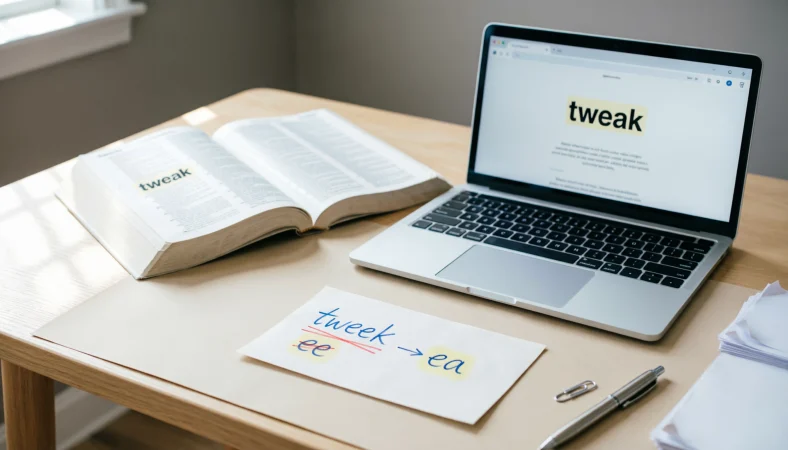
The correct spelling is tweak. It is a verb meaning to make a small adjustment or improvement, and it can also be a noun referring to a minor change. Tweek is generally considered a misspelling when intended to express this meaning. Understanding the difference helps prevent spelling errors in emails, academic writing, technical instructions, and everyday communication.
When you see tweek or tweak, the choice can seem surprisingly difficult because both spellings look plausible. English has many words in which the letters “ee” appear together, so it is easy to assume that tweek follows a familiar spelling pattern. However, standard English uses tweak, with “ea” in the middle.
The word appears frequently in workplace communication, software documentation, design discussions, gaming communities, engineering, marketing, and casual conversation. Someone might say that a report needs a small tweak, that a website needs tweaking, or that a setting should be tweaked for better performance.
The confusion matters because spelling affects credibility. A misspelled word in a casual message may be harmless, but the same mistake in a professional report, product description, application, or academic assignment can make the writing appear less polished. Learning the correct form is therefore more useful than simply memorizing which spelling looks familiar.
Tweek or Tweak: What Is the Difference?
The main difference is straightforward. Tweak is the standard spelling in contemporary English. Tweek is generally not the correct spelling when you mean a small adjustment or modification.
The word tweak functions primarily as a verb and noun.
As a verb, tweak means to adjust, modify, or improve something slightly.
Example:
We need to tweak the design before publishing it.
As a noun, tweak means a small change or adjustment.
Example:
The new version only needs a few tweaks.
The spelling tweek is normally an error rather than an alternative spelling of the same standard word. If you are writing about making a small adjustment, use tweak.
Quick recap
Tweak is the correct standard spelling.
It can describe a small change, adjustment, or improvement.
Tweek is generally a spelling error when used with this meaning.
Use tweak in professional, academic, technical, and everyday writing.
Is Tweek or Tweak a Grammar, Vocabulary, or Spelling Issue?
This is primarily a spelling issue, although understanding the vocabulary behind the word makes the distinction easier.
Grammar determines how words function within sentences. In the sentence “We should tweak the settings,” the grammar is straightforward. Tweak is a verb because it describes an action.
Vocabulary concerns the meaning of the word. To tweak something means to make a relatively small adjustment. The word can describe physical, technical, creative, or conceptual changes.
Spelling determines whether the word has been written in its accepted form. That is where the real problem appears with tweek. Although the spelling may look reasonable, standard English does not normally use tweek as the spelling of the verb meaning “adjust slightly.”
This distinction is useful because a person may understand the meaning perfectly while still spelling the word incorrectly. Someone who writes “I need to tweek the settings” clearly understands what they want to say. The issue is simply that the standard written form is tweak.
Formal and informal usage
Tweak works comfortably in both informal and formal contexts.
In casual conversation, someone might say:
I just need to tweak this recipe.
In professional communication, you could write:
We made several small tweaks to the proposal.
The word is common enough that there is no need to replace it with an unnecessarily complicated expression. However, in highly formal academic writing, words such as modify, adjust, or refine may sometimes be preferable when they better describe the exact process.
Academic versus casual writing
In academic writing, tweak is understandable and grammatically correct, but context matters. If a researcher makes a minor modification to an experimental method, adjust or modify may sound more precise.
In casual writing, tweak is natural:
I tweaked the settings until the program ran smoothly.
The important point is that changing the register does not change the spelling. Whether the sentence is casual, professional, or technical, the standard spelling remains tweak.
What Does Tweak Mean?
Tweak generally means to make a small adjustment to something. The change can improve performance, appearance, accuracy, comfort, or suitability.
The word often suggests that the original thing is already reasonably functional. A tweak is usually not a complete transformation. It is a relatively minor change.
Consider these examples:
She tweaked the recipe by adding less sugar.
The designer tweaked the layout before the final release.
We need to tweak the schedule slightly.
He tweaked the camera settings for better results.
In each example, the basic thing remains intact. The person is making a limited adjustment rather than starting over.
The noun follows the same idea:
The final design needed a few tweaks.
Here, tweaks means small modifications.
This distinction is important because tweak does not normally imply a complete reconstruction. If a company replaces an entire software system, calling that change a simple tweak would probably understate what happened.
How to Use Tweak in Everyday English
The versatility of tweak explains why it appears in so many types of communication.
Workplace example
Imagine that a marketing team has prepared an advertising campaign. The campaign is already complete, but the manager wants to make several small improvements.
A natural sentence would be:
We only need to tweak the headline before the campaign goes live.
Here, tweak communicates that the headline does not need to be completely rewritten. A small adjustment should be enough.
Another example is:
Could you tweak the wording in the introduction?
This is common workplace language because it sounds less dramatic than saying the entire introduction needs to be rewritten.
Academic example
In academic contexts, tweak can describe a minor change to a method, argument, model, or explanation.
For example:
The researcher tweaked the survey questions to make them easier to understand.
The word works grammatically, although modified might sound more formal in a highly technical research paper.
Technology example
Technology is one of the areas where tweak is especially common.
You might hear:
Try tweaking the display settings.
Or:
The developer tweaked the code to improve performance.
In software discussions, tweak often communicates a small technical adjustment rather than a major change to the underlying system.
Usage recap
- Use tweak when you mean a small adjustment.
- Use it as a verb when someone changes something slightly.
- Use it as a noun when referring to the small change itself.
Tweak as a Verb
As a verb, tweak describes the act of making a minor change.
Its basic forms are easy to remember:
Present: tweak
Third person singular: tweaks
Past tense: tweaked
Present participle: tweaking
Examples include:
I need to tweak the settings.
She tweaks the design after every review.
They tweaked the proposal yesterday.
We are tweaking the final version now.
Notice that the spelling changes naturally when the endings are added. The past tense is tweaked, not tweeked.
The present participle is tweaking, not tweeking.
This creates another useful spelling checkpoint. If you remember the base form tweak, the related forms become much easier to spell correctly.
Tweak as a Noun
Tweak can also function as a noun. In this form, it refers to a small adjustment or modification.
For example:
The software needs one final tweak.
We made several tweaks to the presentation.
That small tweak improved the user experience.
The noun is particularly common when people discuss iterative improvement. A product, design, website, application, or document may already be good, but several tweaks can make it more effective.
The noun can also be used with adjectives:
a minor tweak
a useful tweak
a final tweak
a technical tweak
These expressions are common because the word naturally suggests a limited change.
When You Should NOT Use Tweek or Tweak
There are several situations where people misuse these spellings or misunderstand the meaning.
1. Do not use tweek as an alternative spelling
If you mean “make a small adjustment,” write tweak, not tweek.
2. Do not treat the two spellings as equally acceptable
They are not simply two regional spellings like some genuine British and American variants. For the standard meaning discussed here, tweak is the established spelling.
3. Do not write tweeked
The correct past tense is tweaked.
4. Do not write tweeking
The correct present participle is tweaking.
5. Do not use tweak for a complete transformation
A major redesign is more accurately described with words such as rebuild, redesign, replace, or transform.
6. Do not assume every minor change is automatically a tweak
The word often implies a relatively small adjustment. If the change is substantial, another verb may communicate the situation more accurately.
7. Do not rely only on pronunciation
The sound of tweak does not reveal its spelling. English contains many words whose pronunciation does not make their spelling obvious.
8. Do not use informal language when precision matters
Tweak is perfectly acceptable in many professional situations, but technical or academic writers should choose adjust, modify, or refine when those words communicate the exact process more clearly.
Common Mistakes and Correct Usage
Decision rule
If you mean a small adjustment or modification, use “tweak.”
The alternative spelling tweek should not be used for this standard meaning.
Tweak in Modern Technology and AI Tools
Modern technology has made tweak even more common.
Developers regularly talk about tweaking code, settings, algorithms, interfaces, prompts, databases, and configurations. The word is useful because technology often develops through repeated small adjustments rather than one enormous change.
For example:
The developer tweaked the algorithm to improve its output.
A user might say:
I tweaked the prompt to get a more precise response.
Designers may talk about tweaking colors, spacing, typography, or interface elements.
The same idea applies to artificial intelligence. Someone may experiment with an AI system and make small changes to instructions, parameters, context, or formatting. Describing those changes as tweaks communicates that the underlying system remains substantially the same.
This is also why correct spelling matters in technology writing. Documentation, interface text, help articles, technical discussions, and professional reports often use tweak. Writing tweek can look like an obvious spelling error to readers who are familiar with the terminology.
Why Is Tweak Spelled With EA?
The spelling of tweak becomes easier to remember when you stop trying to derive it from pronunciation alone.
English spelling contains many vowel patterns that do not follow a single universal rule. The letters ea appear in numerous English words, but they can represent different sounds depending on the word.
Tweak belongs to the group in which ea produces the long “ee” sound.
Compare:
tweak
speak
weak
leak
The spelling pattern is not identical in every word, but seeing tweak alongside familiar words can help reinforce its written form.
The important lesson is that spelling memory works better when you connect a word with related forms and repeated usage rather than relying entirely on a pronunciation based guess.
The Etymology and History of Tweak
Tweak has an interesting history. The word is associated with older English forms referring to pinching, twisting, pulling, or making a small adjustment.
Over time, its meaning developed beyond a physical action. Modern English uses tweak more broadly for small modifications to ideas, designs, systems, settings, and processes.
That semantic development explains the word’s modern flexibility. A person can tweak a physical object, tweak a recipe, tweak a sentence, tweak a software configuration, or tweak a strategy.
The central idea remains similar: make a relatively small change that alters or improves the result.
This history also explains why the word has become so useful in modern English. Contemporary work often involves continuous refinement, and tweak provides a concise way to describe that process.
An Expert Style Explanation of Tweak
A useful way to understand the word is to focus on the scale of the change.
“To tweak something is generally to adjust it slightly rather than replace or rebuild it.”
That distinction helps writers choose the word accurately. If you change one sentence in a report, you can tweak the wording. Also If you rewrite the entire report from the beginning, rewrite is more precise.
If you adjust a few software settings, you can tweak the configuration. If you replace the entire software architecture, calling the change a tweak would be misleading.
Good word choice depends not only on spelling but also on meaning.
Two Practical Case Studies
Case study one: Workplace communication
Imagine a project manager reviewing a proposal. The document is fundamentally sound, but the manager wants clearer wording in two sections.
The manager writes:
Please tweak the wording in sections two and three.
That sentence communicates the intended scale of the revision. The writer does not need to create an entirely new proposal. A few targeted adjustments should address the issue.
If the manager instead writes:
Please rewrite the entire proposal.
the meaning changes considerably.
The case demonstrates why tweak is valuable in professional communication. It provides a precise way to distinguish minor revision from major revision.
Case study two: Technology settings
Consider a user who is adjusting a computer application. The application works, but the user wants better performance.
A natural instruction might be:
Tweak the settings until the application runs more smoothly.
The word tells the reader to experiment with relatively small changes rather than replace the application.
This distinction is especially useful in technical communication because the size of a change can matter. A tweak may involve one setting, several configuration values, or a small code adjustment. A complete redesign represents a fundamentally different level of intervention.
Error Prevention Checklist
Always use tweak when
- You mean a small adjustment.
- You mean a minor modification.
- You mean a slight improvement.
- You are discussing small changes to wording, design, settings, code, or strategy.
- You are using the noun for a small modification.
- You are writing the past tense as tweaked.
- You are writing the present participle as tweaking.
Never use tweek when
- You mean a small adjustment.
- You are writing professional communication.
- You are preparing academic work.
- You are creating technical documentation.
- You are writing product or software content.
- You are using the past form of tweak.
- You are using the present participle of tweak.
The easiest rule is simple: remember the spelling tweak, then build its other forms from that base.
Related Spelling Confusions You Should Master
If you often confuse tweek and tweak, you may also encounter other English spelling problems involving vowel patterns.
1. Receive or recieve
The correct spelling is receive. This is a common example of confusion involving the familiar spelling rule about “i” and “e.”
2. Separate or seperate
The correct spelling is separate. The middle vowel sequence often causes mistakes.
3. Definitely or definately
The correct spelling is definitely. Many writers accidentally insert an extra “a.”
4. Necessary or neccessary
The correct spelling is necessary. The number and position of the consonants often cause errors.
5. Occurred or occured
The correct spelling is occurred. The doubled final consonant matters in the standard past tense.
6. Beginning or begining
The correct spelling is beginning. The middle consonant is doubled.
7. Recommend or recomend
The correct spelling is recommend. The repeated consonant pattern can be easy to overlook.
8. Embarrass or embarass
The correct spelling is embarrass. Both the repeated consonants and final spelling deserve attention.
9. Privilege or privelege
The correct spelling is privilege. Pronunciation can make the spelling less obvious.
10. Maintenance or maintainance
The correct spelling is maintenance. It is related to the verb maintain, but its spelling does not simply copy the entire verb form.
Learning these patterns can improve spelling accuracy across professional and academic writing.
FAQs
Is tweak or tweek correct?
Tweak is correct when you mean to make a small adjustment or modification. Tweek is generally a misspelling of the standard word.
Is tweek a real word?
Tweek is not the standard spelling of the English word meaning a small adjustment. It may occasionally appear as a name, username, creative spelling, or other proper expression, but it should not replace tweak in ordinary English writing.
What does tweak mean?
Tweak means to make a small adjustment or modification. It can also be a noun meaning a minor change.
Is tweak a verb or noun?
Tweak can be both a verb and a noun. As a verb, it means to adjust something slightly. As a noun, it refers to the small adjustment itself.
What is the past tense of tweak?
The past tense is tweaked.
Example:
We tweaked the design yesterday.
Is it tweaking or tweeking?
The correct form is tweaking.
Example:
We are tweaking the settings.
Why do people spell tweak as tweek?
The mistake probably occurs because the pronunciation of tweak contains a long “ee” sound, and English has many words in which that sound is represented by “ee.” However, the standard spelling of this particular word uses ea.
Is tweak appropriate in professional writing?
Yes. Tweak is widely understood and can be perfectly appropriate in workplace and technical communication. In highly formal contexts, words such as modify, adjust, or refine may sometimes provide greater precision.
What is the difference between tweak and modify?
Both words describe changing something, but tweak usually suggests a relatively small adjustment. Modify is broader and can describe changes ranging from minor adjustments to more substantial alterations.
How can I remember the spelling of tweak?
Remember the phrase tweak with EA. Connecting the word to familiar words such as weak and speak can also help reinforce the spelling.
Conclusion:
When deciding between tweek or tweak, choose tweak when you mean a small adjustment, modification, or improvement. The word can function as both a verb and a noun, and it is common in everyday English, workplace communication, technology, design, and software discussions.
The spelling tweek may look logical because the word contains a long “ee” sound, but pronunciation does not determine English spelling in every case. Standard written English uses tweak, with the letters “ea.”
Remember the related forms as well: tweak, tweaked, and tweaking. Once that pattern becomes familiar, this spelling confusion becomes much easier to avoid. Whether you’re describing a minor change to a sentence, a software setting, a design, or a strategy, tweak is the form to use.