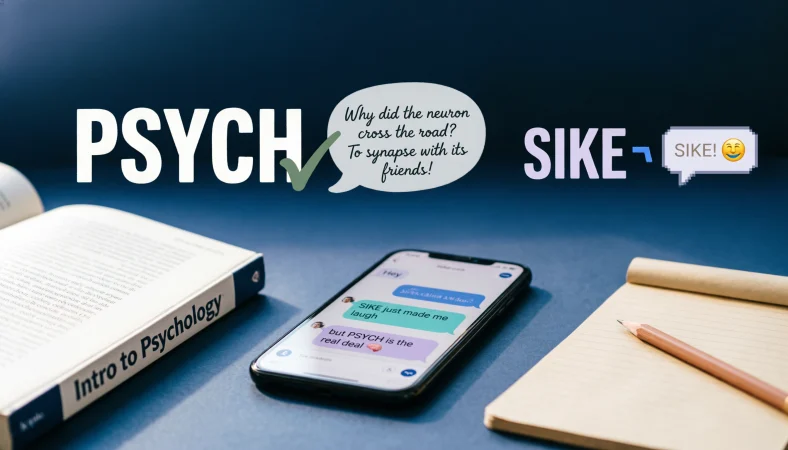
Sike and psych are both used informally in English, but their usage differs. Psych is the more established spelling of an expression used to reveal that a statement was a joke or trick, as in “I said I won the lottery, psych!” Sike is a popular informal variant, especially in casual conversations and online messages.
However, psych also has other meanings related to psychology or mental preparation, depending on the context. For standard writing, choose the word that fits your intended meaning.
Have you ever wondered whether to write sike or psych when joking with friends or sending a playful message? Both spellings appear in informal communication, particularly when someone wants to reveal that a previous statement was meant to trick or surprise another person. Although sike is common in texting and internet slang, psych is the more established spelling of this expression and can also carry meanings related to psychology.
In this guide, you will learn the difference between sike and psych, explore how people use these expressions in conversations and online messages, and discover which spelling is more appropriate in different contexts. With clear explanations and practical examples, you will understand the meaning behind each form and avoid confusion when using informal English.
Sike vs Psych: What’s the Difference?
The difference between sike and psych depends on whether you mean an informal slang expression or a word connected to psychology and mental processes. Although people sometimes use them interchangeably in jokes, they are not equally appropriate in every context.
What Does Sike Mean?
Sike is an informal slang spelling commonly used to signal that someone was joking, teasing, or deliberately misleading another person. It often appears after a statement that the speaker immediately takes back.
For example:
- I got you a new phone. Sike!
- I’m never talking to you again. Sike, I’m kidding.
- You actually believed that? Sike!
In these examples, sike signals that the preceding statement was not meant to be taken seriously. The speaker reveals the joke or trick, often to surprise a friend.
The spelling is especially common in texting, social media comments, memes, and casual conversations. It is not generally recommended for formal essays, professional reports, or academic writing.
What Does Psych Mean?
Psych is a recognized English word, often used as an informal exclamation to reveal a joke or trick. It is also a shortened form of psychology and appears in words related to psychological processes.
For example:
- I bought you concert tickets. Psych!
- Don’t believe him. He’s trying to psych you out.
- She studies psych at university.
In the first example, psych! reveals that the speaker was joking. In the second, psych out means to unsettle, intimidate, or confuse someone psychologically. In the third, psych is an informal abbreviation for psychology.
The standard spelling is psych, even though the initial letters may not sound the way an unfamiliar reader expects.
Sike vs Psych Comparison Table
| Feature | Sike | Psych |
| Word type | Informal slang spelling | Recognized word and informal exclamation |
| Common meaning | Signals a joke or trick | Signals a joke or relates to psychology |
| Standard spelling | Nonstandard in general writing | Standard |
| Common setting | Texts, memes, casual conversations | Casual speech, writing, and psychology related contexts |
| Example | You thought I was serious? Sike! | You thought I was serious? Psych! |
| Formal writing | Usually avoid as a slang spelling | Use according to its meaning and context |
| Related expression | Informal variant of “psych!” | “Psych out,” “psychology,” “psychological” |
Quick recap: Psych is the established spelling, including when used as a teasing exclamation.
Sike is a popular informal spelling that represents how some people pronounce the expression.
Both may communicate the same joke in casual conversation, but psych is the safer choice when correct standard spelling matters.
Is Sike vs Psych a Grammar, Vocabulary, or Usage Issue?
The difference between sike and psych is mainly a spelling and usage issue. The words are often used to express the same slang meaning, but they do not have identical status in standard English.
Are Sike and Psych Interchangeable?
In casual slang, they can serve the same purpose. Someone might write either form after making a playful statement and then revealing that it was a joke.
For example:
- I saved you the last slice of cake. Psych!
- I saved you the last slice of cake. Sike!
Both versions can communicate teasing or playful deception. However, psych is the established spelling of the exclamation, while sike is a nonstandard spelling used by some speakers and writers.
The words are not interchangeable in every situation. You can write “She studies psych” to mean psychology, but “She studies sike” would not communicate that meaning in standard English.
Formal vs Informal Usage
In informal settings, sike may fit the tone of a meme, a text between friends, or a playful social media post. It communicates an exaggerated, joking reaction.
In professional or academic writing, however, neither spelling should be inserted casually unless the context specifically calls for slang or a direct quotation.
For example:
Casual: You thought I forgot your birthday? Psych!
Formal: The speaker initially misled the audience before revealing that the statement was a joke.
The formal version communicates the same basic idea without relying on slang.
Academic vs Casual Usage
Academic writing requires greater attention to standard spelling, clear definitions, and consistent terminology.
If you are writing about slang, you can discuss sike as an informal spelling variant and psych as the established form. If you are writing a psychology assignment, use psychology or psychological when those terms are appropriate.
In casual conversation, the priority may be humor and tone rather than formal correctness. Still, understanding the difference helps you choose a spelling that suits your audience.
How to Use Sike Correctly in Casual Conversations
Although sike is a nonstandard spelling, readers often recognize it as a slang expression that signals a joke or playful trick. Its use depends heavily on tone and context.
Workplace Example
Imagine coworkers joking during an informal conversation.
One person says:
I heard we’re all working this weekend. Sike!
The word signals that the announcement was a joke. However, this kind of teasing can cause confusion if the subject concerns real work schedules.
In a professional email or announcement, it is better to make jokes unmistakable and avoid misleading colleagues about important details.
Academic Example
A student writing a formal essay should generally avoid using sike as a substitute for a standard expression.
Instead of writing:
The character says he will leave, then says sike.
A more formal sentence would be:
The character initially claims that he will leave, then reveals that the statement was a joke.
If the essay analyzes internet slang, the student can mention the spelling sike and explain its informal use.
Technology Example
On social media, a user might post:
I deleted the game after losing one round. Sike, I’m playing again.
The spelling suits the informal, playful tone of the post. Readers familiar with internet slang can understand the intended meaning.
In professional technology documentation, however, this expression would normally be unnecessary. Instructions should be direct and unambiguous.
Additional Examples
- I was going to tell you the secret. Sike!
- You really thought I ate your lunch? Sike!
- I said I hated the song, but sike, it’s my favorite.
- You believed I was moving away? Sike, I’m staying.
Usage recap: Sike is mainly an informal slang spelling. It may work in jokes, memes, and friendly messages, but psych is the established spelling to use when standard written English matters.
How to Use Psych Correctly
Use psych when writing the established exclamation that reveals a joke or when referring to psychology and related expressions. The surrounding sentence tells readers which meaning you intend.
Workplace Example
In a casual conversation, a colleague might say:
You thought I was taking the last donut? Psych!
The exclamation reveals the joke. In formal workplace communication, a clearer statement is usually more appropriate.
The word also appears in the expression psych out, as in:
The competitor tried to psych out the opposing team.
Here, psych out means to unsettle or intimidate someone mentally.
Academic Example
A student might write:
Psychology examines human behavior, thought, and mental processes.
If the student is discussing a university subject informally, they might say:
I’m studying psych this semester.
The shortened form is common in casual contexts, but the full term psychology is usually more appropriate in formal academic writing.
Technology Example
In an online game, a player might type:
You thought I was out of lives? Psych!
This use creates a playful surprise. In gaming communities, the word may appear in chat messages, reaction posts, and memes.
A digital learning platform could also use psych informally when referring to a psychology course, although formal course titles should follow the institution’s official wording.
Additional Examples
- Psych! I was only pretending.
- He tried to psych himself up before the competition.
- She is taking a psych course.
- The coach did not want the opponent to psych out the players.
- The psychology department offers several introductory courses.
Usage recap: Psych is the established spelling. Use it for the teasing exclamation, the informal abbreviation of psychology, and expressions such as psych out or psych up, according to the intended meaning.
When You Should NOT Use Sike or Psych
Knowing when to avoid these expressions is just as important as understanding their meanings. Here are eight situations where choosing the right form improves clarity.
When You Are Writing a Formal Essay
Avoid using sike as a casual substitute for a standard expression in academic writing.
Informal: The character says he is leaving, then says sike.
Better: The character reveals that his announcement was a joke.
If your essay examines slang, you can discuss the expression directly and explain its cultural or conversational role.
When You Mean Psychology as an Academic Subject
Use psychology in formal writing rather than relying on the abbreviation psych.
Informal: I am majoring in psych.
Formal: I am majoring in psychology.
The shorter form is understandable in conversation, but the full term is clearer in academic applications, research papers, and official documents.
When You Need the Standard Spelling of the Exclamation
If you want to write the established slang exclamation, choose psych rather than sike in standard edited English.
Less standard: You thought I was serious? Sike!
Standard spelling: You thought I was serious? Psych!
The nonstandard version may still be appropriate when reproducing someone’s exact words or describing online slang.
When the Joke Could Mislead Someone About Something Important
Do not use a teasing expression to create confusion about serious matters such as employment, safety, money, or urgent plans.
For example, announcing a fake workplace closure and then adding psych! could lead to genuine misunderstandings.
Use clear communication whenever the information affects another person’s decisions.
When Your Audience May Not Understand Slang
Not everyone recognizes internet slang. In a message to an unfamiliar audience, an international reader, or someone who prefers formal language, explain the joke instead of relying on a single slang word.
For example:
I was joking. There is no change to the plan.
This is more accessible than ending the message with sike or psych.
When You Mean to Influence Someone Psychologically
Use the appropriate expression rather than the exclamation.
Correct: The player tried to psych out the goalkeeper.
Incorrect: The player tried to sike out the goalkeeper.
The established expression is psych out, meaning to unsettle or intimidate someone mentally.
When You Mean a Psychology Professional
Do not confuse psych with the name of a particular profession. Depending on the context, a person may be a psychologist, psychiatrist, or another mental health professional. These titles have different meanings and qualifications.
For example, write She is a psychologist when that is the person’s profession, rather than using psych as though it were a precise professional title.
When You Are Quoting Someone Directly
If you are documenting a conversation, interview, or social media post, preserve the original spelling when accuracy requires an exact quotation. You can explain that sike is a nonstandard spelling of the slang exclamation.
If you are not quoting someone, use the spelling and wording that best fit your own writing.
Common Mistakes and Decision Rules
The most common confusion occurs when people treat sike and psych as equally standard spellings in every context. Their casual meanings may overlap, but their broader uses are different.
| Correct sentence | Incorrect or less suitable sentence | Explanation |
| You thought I was serious? Psych! | You thought I was serious? Sike! | The second is common slang, but psych is the established spelling. |
| She studies psychology at university. | She studies sike at university. | Sike does not mean psychology in standard English. |
| He tried to psych out his opponent. | He tried to sike out his opponent. | Psych out is the established expression. |
| I was joking about the surprise. | I was joking about the surprise, psych. | The exclamation may sound unnatural when added without the right conversational context. |
| The character reveals that the statement was a joke. | The character reveals that the statement was sike. | Use a clear description in formal writing. |
| I am taking a psychology course. | I am taking a sike course. | Psych may be an informal abbreviation of psychology, but sike is not the standard term. |
The Simple Decision Rule
If you mean the teasing exclamation, use psych for the established spelling.
If you mean psychology or an expression such as psych out, use psych.
Use sike only when the informal spelling itself is relevant, such as when discussing slang or reproducing someone’s wording.
A helpful test is to replace the expression with “just kidding.” If the sentence still makes sense, you probably mean the slang exclamation. If you are talking about mental processes or a psychology subject, psych has a different role.
Sike and Psych in Modern Technology and AI Tools
Social media, messaging apps, online games, and meme culture have helped spread informal spellings such as sike. In quick conversations, people often choose spellings that reflect how a word sounds to them rather than following formal spelling conventions.
For example, someone might post:
I thought my team had lost. Psych! We won.
Another user might write sike in the same situation. Readers may understand both as a playful reveal, even though psych is the established spelling.
AI writing assistants and spellcheckers can help distinguish the standard word from a nonstandard spelling. However, automatic correction depends on context. A tool may flag sike in a casual message even when the writer intentionally wants to reproduce a particular internet slang style.
For formal writing, choose psych when it expresses the established exclamation, and use the full word psychology when clarity matters. For casual online content, consider whether the audience will understand the intended tone.
Technology can help identify spelling differences, but it cannot always determine whether a joke is appropriate for the situation. Human judgment remains important.
The Etymology of Sike and Psych
The word psych is connected to psychology and other words derived from Greek roots associated with the mind or soul. In modern English, it appears in terms such as psychological, psychologist, and psych out.
As an informal exclamation, psych! is used to reveal that a preceding statement was a joke or deliberate trick. The expression has become familiar in casual conversation and popular culture.
The spelling sike is a nonstandard variant associated with the way some speakers pronounce or interpret the exclamation. Its appearance in slang does not make it the standard spelling for all meanings of psych.
The key distinction is that psych has recognized uses beyond the exclamation, while sike is mainly associated with the informal slang spelling. This is why the context of a sentence matters.
An Expert Perspective on Choosing the Correct Spelling
A useful editorial principle is:
Choose the spelling that communicates your meaning clearly and fits the expectations of your audience.
For a joke between friends, readers may understand either sike or psych. In a formal article, however, using the established spelling and explaining the slang meaning is more reliable.
Consider these two examples:
Casual message: You thought I forgot your birthday? Psych!
Formal explanation: The speaker uses “psych” to reveal that the preceding statement was a joke.
The first example uses the expression directly. The second discusses how the expression works. Both use psych consistently, but the purpose of the word differs.
Good editing involves more than correcting spelling. It also considers tone, audience, meaning, and whether the expression belongs in the particular context.
Case Study One: Choosing a Spelling for a Social Media Post
Consider an illustrative scenario involving a creator preparing a playful social media post.
The creator writes:
I just gave away all my gaming equipment. Sike!
The intended meaning is that the creator is joking. The audience may understand the message, but an editor recommends psych! because it is the established spelling of the exclamation.
The revised post reads:
I just gave away all my gaming equipment. Psych!
The creator keeps the humor while using the standard spelling. If the post specifically discusses how online communities write sike, the original form could be retained and explained.
Result: The revised version maintains the joke and follows standard spelling conventions without changing the intended meaning.
The lesson is to distinguish between using slang and discussing a nonstandard spelling.
Case Study Two: Editing a Student’s Psychology Assignment
Imagine a student writing an assignment about psychology and informal language.
The first draft includes the sentence:
The student decided to study sike because she was interested in human behavior.
The sentence is unclear because sike is not the standard abbreviation for psychology.
The student revises it to:
The student decided to study psychology because she was interested in human behavior.
Later, the assignment discusses internet slang and includes this explanation:
Some online users write “sike” as an informal spelling of the exclamation “psych!”
This revision separates the academic subject from the slang expression.
Result: The assignment uses precise terminology when discussing psychology and clearly identifies the nonstandard spelling when discussing internet slang.
The lesson is that a word’s meaning and spelling should be evaluated within the context of the sentence.
Error Prevention Checklist
Use this checklist when deciding between sike and psych.
Always Use Psych When
- You want the established spelling of the teasing exclamation.
- You mean psychology in an informal context.
- You are writing expressions such as psych out or psych up.
- You need standard spelling in an edited article or educational explanation.
Avoid Sike When
- You are writing a formal essay or professional report.
- You mean psychology or a psychological process.
- You need to use an established expression such as psych out.
- Your audience may mistake the informal spelling for an error.
Check Before Publishing
- Does the word mean “just kidding,” or does it refer to psychology?
- Is the tone casual, educational, or professional?
- Is sike intentional, or is it an accidental misspelling?
- Would a reader unfamiliar with internet slang understand the sentence?
- If you are quoting a source, do you need to preserve its original spelling?
Related Grammar Confusions You Should Master
Learning the difference between sike and psych also helps you recognize other spelling and usage distinctions.
- Your or you’re: Possession versus the contraction of “you are.”
- Their or there: Possession versus a reference to a place or existence.
- Its or it’s: Possession versus a contraction.
- Affect or effect: Influence versus result in common uses.
- Then or than: Sequence or time versus comparison.
- Definitely or defiantly: Certainty versus acting in a resistant or challenging way.
- Loose or lose: Not tight versus failing to keep or win something.
- Advice or advise: Guidance as a noun versus giving guidance as a verb.
- Compliment or complement: Praise versus something that completes or enhances another thing.
- Everyday or every day: An adjective meaning ordinary versus a phrase referring to each day.
These examples show why similar sounds, spellings, or online habits can cause confusion. Understanding a word’s role in a sentence is often the best way to select the correct form.
FAQs
Is it sike or psych?
Psych is the established spelling of the slang exclamation used to reveal a joke or trick. Sike is a nonstandard spelling that is common in some casual online conversations.
What does sike mean in texting?
In texting, sike usually signals that the writer was joking or deliberately made a statement to trick the reader playfully. It is often used after a surprising claim to reveal that the claim was not serious.
What does psych mean in slang?
In slang, psych! is an exclamation used to reveal that a preceding statement was a joke or trick. It can also appear in expressions such as psych out, which means to unsettle or intimidate someone mentally.
Why do people spell psych as sike?
Some people write sike because it reflects how they hear or pronounce the slang exclamation. Online conversations often favor playful and phonetic spellings, although psych remains the established form.
Is sike a real word or a misspelling?
Sike is widely used as an informal slang spelling, but it is not the standard spelling of the exclamation in general edited English. In formal writing, psych is the safer choice.
Can I use psych in a formal essay?
Use psych for slang or informal contexts, but prefer psychology for the academic subject and formal expressions when appropriate.
What does psych out mean?
Psych out means to make someone feel nervous, confused, or less confident, often to gain an advantage. For example, a competitor might try to psych out an opponent before an important match.
Is psych short for psychology?
Yes. Psych is commonly used as an informal abbreviation of psychology, especially in conversation about school subjects or university courses. Formal writing usually benefits from spelling out psychology.
Should I write sike or psych in a meme?
Psych is the established spelling, while sike is a nonstandard internet variant often used for jokes or informal slang.
Conclusion:
When choosing between sike or psych, remember that psych is the established spelling of the slang exclamation used to reveal a joke or playful trick. Sike is a common nonstandard spelling that appears in casual texts, memes, and social media posts.
The words can communicate the same playful meaning in informal conversations, but they are not interchangeable in every context. Use psych when discussing psychology or expressions such as psych out, and use psychology in formal writing when referring to the academic subject.
The simplest rule is to choose psych for standard spelling and reserve sike for contexts where the informal spelling itself is intentional.