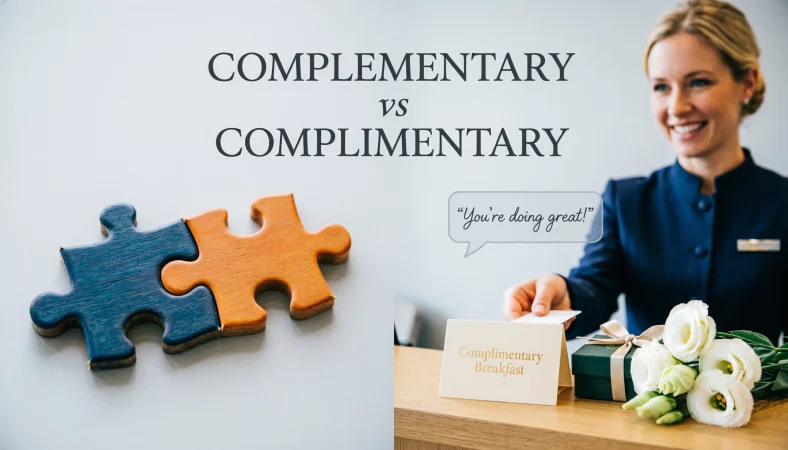
Complementary and complimentary are both correct words, but they have different meanings. Complementary means something that completes, enhances, or works well with something else, as in “The colors are complementary.” Complimentary can mean free of charge or expressing praise, as in “The hotel offers complimentary breakfast” or “She made complimentary remarks.”
Have you ever wondered whether to use complementary or complimentary? These words look and sound very similar, but their meanings are quite different. Complementary relates to things that complete or enhance each other, while complimentary commonly refers to something given for free or words that express praise.
This guide explains complementary and complimentary in simple, beginner friendly language, with clear definitions and practical examples. Understanding the difference will help you avoid one of the most common word confusions in English and choose the correct spelling based on context.
Complementary or Complimentary: What’s the Difference?
The easiest way to understand complementary and complimentary is to focus on what each word describes.
Complementary is an adjective that describes things that complete, improve, or work well with each other. The word is related to complement, which means something that completes or enhances another thing.
For example:
The two colors are complementary.
This means the colors work well together or enhance each other.
Complimentary is also an adjective, but it has two main meanings. It can describe something given free of charge, or it can describe words that express praise or approval.
For example:
The hotel offers complimentary breakfast.
Here, complimentary means the breakfast is provided without an additional charge.
In another sentence:
She made complimentary comments about his presentation.
Here, complimentary means praising or expressing approval.
| Word | Part of Speech | Main Meaning | Example |
| Complementary | Adjective | Completing, enhancing, or working well together | The colors are complementary. |
| Complimentary | Adjective | Free of charge or expressing praise | Guests received complimentary drinks. |
| Complement | Noun or verb | Something that completes or enhances | The sauce complements the meal. |
| Compliment | Noun or verb | Praise or an expression of approval | He complimented her presentation. |
The spelling difference is only one letter, but the meaning changes significantly.
Complementary usually relates to completion, balance, or compatibility.
Complimentary usually relates to free services or praise.
A useful way to remember the distinction is to connect complementary with complement and complimentary with compliment.
Is Complementary or Complimentary a Grammar, Vocabulary, or Usage Issue?
The confusion between these words is primarily a vocabulary and usage issue, although grammar also matters because both words normally function as adjectives.
They aren’t interchangeable.
If you use complementary when you mean something is free, your sentence becomes incorrect. Likewise, using complimentary when you mean two things work well together can change the intended meaning.
Consider these examples:
The hotel provides complimentary breakfast.
The breakfast is free.
The hotel provides complementary breakfast.
This could suggest that the breakfast completes or enhances something else, rather than clearly communicating that guests don’t have to pay for it.
The distinction becomes especially important in professional writing. Businesses frequently use complimentary when discussing free consultations, meals, upgrades, tickets, samples, and services.
Meanwhile, complementary often appears in writing about design, science, medicine, education, technology, and relationships between ideas or systems.
In academic writing, the distinction can be particularly important because a small vocabulary error may change the interpretation of a sentence.
In casual conversation, people may understand what you mean from context. However, professional writing doesn’t give you the same flexibility. A website, business email, academic paper, or product description should use the precise word.
The key point is simple:
Complementary describes things that complete, enhance, or work well together.
Complimentary describes something provided free of charge or something that expresses praise.
How to Use Complementary Correctly
Complementary describes two or more things that complete, balance, improve, or enhance one another.
It can refer to physical objects, colors, skills, ideas, services, systems, or approaches.
Workplace Example
Her communication skills are complementary to his technical expertise.
The sentence means the two skill sets work well together.
Another example is:
The marketing and sales teams have complementary responsibilities.
Their responsibilities differ, but they work together effectively.
Academic Example
The researchers used two complementary methods to examine the problem.
Here, the methods support each other and provide a more complete understanding.
You might also write:
The two theories offer complementary explanations.
The theories aren’t necessarily identical. Instead, each contributes something useful to the overall explanation.
Technology Example
The application uses complementary technologies to improve performance.
The technologies work together to provide a more complete system.
Another example would be:
These two software tools have complementary functions.
Each tool performs a different function, but their capabilities work well together.
Usage Recap
Use complementary when you mean something completes, balances, supports, or enhances something else.
Think about compatibility and completion.
If two things work better together than separately, complementary may be the word you need.
How to Use Complimentary Correctly
Complimentary has two important meanings, and understanding both prevents many common errors.
The first meaning is given free of charge.
The second meaning is expressing praise or approval.
Workplace Example
The company offers complimentary consultations to new clients.
The consultations are free.
Another example:
The manager gave complimentary remarks about the employee’s performance.
Here, complimentary means positive or praising.
Academic Example
The professor made complimentary comments about the student’s research.
The professor praised the research.
Notice that this meaning has nothing to do with something completing another thing.
Technology Example
The software company provides complimentary access to premium features for new users.
The features are available without an additional charge.
Another example:
The reviewer was complimentary about the application’s new interface.
Here, the reviewer expressed approval.
Usage Recap
Use complimentary when something is free or when someone is expressing praise.
A hotel may offer complimentary breakfast.
A manager may give complimentary feedback.
A reviewer may be complimentary about a product.
When You Should NOT Use Complementary or Complimentary
Several recurring situations make this distinction easier to understand.
1. Don’t use complimentary when you mean that two things work well together
Incorrect:
The two strategies are complimentary.
If you mean the strategies support each other, use complementary.
Correct:
The two strategies are complementary.
2. Don’t use complementary when something is free
Incorrect:
Guests receive complementary drinks.
This can suggest that the drinks complete or enhance something.
Correct:
Guests receive complimentary drinks.
3. Don’t use complementary when someone gives praise
Incorrect:
She was complementary about his work.
Correct:
She was complimentary about his work.
4. Don’t use complimentary when describing compatible skills
Incorrect:
Their skills are complimentary.
If the skills work well together, use complementary.
Correct:
Their skills are complementary.
5. Don’t use complementary for free samples
Incorrect:
Customers receive complementary samples.
Correct:
Customers receive complimentary samples.
6. Don’t use complimentary for balanced colors
Incorrect:
The colors are complimentary.
If the colors enhance one another, complementary is the appropriate word.
7. Don’t confuse compliment with complement
This is the underlying source of the spelling problem.
A compliment is praise.
A complement is something that completes or enhances something else.
8. Don’t rely only on pronunciation
Both words sound extremely similar in ordinary speech. When writing, focus on meaning rather than sound.
Common Mistakes and Decision Rules
| Correct sentence | Incorrect sentence | Explanation |
| The colors are complementary. | The colors are complimentary. | The colors work well together. |
| Breakfast is complimentary. | Breakfast is complementary. | Breakfast is provided free. |
| She gave him a compliment. | She gave him a complement. | A compliment is praise. |
| Their skills are complementary. | Their skills are complimentary. | The skills work well together. |
| The hotel offers complimentary parking. | The hotel offers complementary parking. | The parking is free. |
| The two approaches are complementary. | The two approaches are complimentary. | The approaches enhance each other. |
| He made a complimentary remark. | He made a complementary remark. | The remark expresses praise. |
Decision Rule Box
If you mean “completes, enhances, balances, or works well with,” use COMPLEMENTARY.
If you mean “free of charge” or “expressing praise,” use COMPLIMENTARY.
This rule works in most everyday situations.
Another useful memory trick is to look at the related nouns.
Complement → complementary
Something completes or enhances another thing.
Compliment → complimentary
Someone gives praise, or something is provided free.
Complementary and Complimentary in Modern Technology and AI Tools
Modern technology creates many situations where both words can appear naturally.
Software platforms may offer complimentary access to selected features. In this context, complimentary means users receive access without paying an additional fee.
At the same time, different technologies can have complementary functions. For example, one tool might generate information while another organizes or analyzes it. Their functions can be complementary because they contribute different capabilities to the same workflow.
AI tools also create similar examples.
A company might provide complimentary AI credits to new users. The credits cost the user nothing.
Two AI systems might have complementary capabilities when one specializes in generating text and another specializes in analyzing structured information.
The meaning comes from the relationship being described.
Free access is complimentary.
Mutually useful capabilities are complementary.
The Etymology Behind Complementary and Complimentary
The spelling becomes easier to remember when you understand where the words come from.
Complementary comes from complement, which traces back through French to Latin roots associated with filling up or completing something.
That idea of completion remains visible in modern English. A complement adds something needed to make another thing more complete.
Complimentary comes from compliment, which developed through French and ultimately relates to expressions of politeness and praise.
Although the two words now look and sound remarkably similar, their historical paths helped give them distinct meanings.
The shared beginning is therefore misleading. Their meanings developed in different directions.
An Expert Style Explanation
“Use complementary for things that complete or enhance one another, and complimentary for free offerings or expressions of praise.”
This distinction reflects the central difference between complement and compliment.
Two Practical Case Studies
Case Study 1: Hotel Website Copy
Imagine a hotel preparing promotional website text.
The original sentence says:
Guests receive complementary breakfast every morning.
The hotel actually means that guests don’t pay for breakfast.
Changing the word to complimentary produces:
Guests receive complimentary breakfast every morning.
The meaning is now immediately clear. The sentence tells readers that breakfast is provided free of charge.
The practical result is improved clarity because customers don’t have to interpret what “complementary” means in that context.
Case Study 2: Professional Skills
Consider a workplace report describing two employees.
The original sentence says:
Their skills are complimentary.
The intended meaning is that one employee has technical expertise while the other has strong communication and organizational skills. Together, those abilities form a useful combination.
The corrected sentence is:
Their skills are complementary.
The correction changes the sentence from an apparent spelling error to an accurate description of how the two skill sets work together.
These examples show why the distinction matters. The words aren’t simply different spellings of the same adjective. They communicate different relationships.
Error Prevention Checklist
Always use COMPLEMENTARY when:
- Two things enhance each other
- Two ideas complete each other
- Skills work effectively together
- Colors or designs create a balanced combination
- Methods provide useful support to each other
- Technologies perform functions that work well together
Always use COMPLIMENTARY when:
- Something is free of charge
- A business offers a free service
- A hotel provides something without an additional fee
- Someone expresses praise
- A review contains positive comments
- A person makes an approving remark
A quick final test can prevent most mistakes.
Ask yourself:
Does this mean free or praising?
If yes, choose complimentary.
Ask:
Does this mean completing, enhancing, or working well together?
If yes, choose complementary.
Related Grammar Confusions You Should Master
Learning this pair becomes even easier when you understand other commonly confused English words.
1. Affect or Effect
Affect commonly functions as a verb, while effect commonly functions as a noun. Their uses can vary in specialized contexts.
2. Advice or Advise
Advice is a noun meaning guidance, while advise is a verb meaning to give guidance.
3. Principal or Principle
A principal can refer to a person or something important, while a principle is a rule, belief, or standard.
4. Accept or Except
Accept means to receive or agree to something. Except means excluding someone or something.
5. Stationary or Stationery
Stationary describes something that isn’t moving. Stationery refers to writing materials.
6. Compliment or Complement
A compliment is praise. A complement completes or enhances something else.
7. Its or It’s
Its indicates possession. It’s is a contraction of “it is” or “it has.”
8. Then or Than
Then commonly relates to time or sequence. Than is primarily used for comparisons.
9. Advice or Advise
The spelling changes because the words perform different grammatical roles. Remembering the noun and verb distinction helps prevent errors.
10. Loose or Lose
Loose generally means not tight or not firmly attached. Lose means to misplace, fail to keep, or not win.
Understanding these pairs builds stronger vocabulary control and makes professional writing more precise.
FAQs:
What is the difference between complementary and complimentary?
Complementary means completing or enhancing something, while complimentary means free of charge or expressing praise. The correct choice depends on the meaning.
Is it complimentary breakfast or complementary breakfast?
The correct phrase is complimentary breakfast when you mean that the breakfast is provided free of charge.
Is it complementary colors or complimentary colors?
The standard phrase is complementary colors when describing colors that work together in a particular color relationship.
Does complimentary mean free?
Yes. In many business and service contexts, complimentary means something is provided without an additional charge.
Does complimentary also mean praising?
Yes. Complimentary can describe words, comments, or opinions that express praise or approval.
What does complementary mean in simple English?
Complementary means that two or more things work well together, enhance one another, or combine to make something more complete.
How do you remember complementary versus complimentary?
Connect complementary with complement, meaning something that completes or enhances. Connect complimentary with compliment, meaning praise, or with something given free.
Are complementary and complimentary interchangeable?
No. They have different meanings. Substituting one for the other can make a sentence inaccurate or confusing.
Is complimentary a positive word?
It can be. When it means expressing praise, it has a positive meaning. When it means free, it simply describes the cost of a product or service.
Final Verdict:
The difference between complementary or complimentary becomes straightforward once you connect each adjective with its root word.
Use complementary when two things complete, enhance, balance, or support each other. Use complimentary when something is free of charge or when someone expresses praise.
Remember the simplest distinction:
Complementary means completing or enhancing.
Complimentary means free or praising.
When you’re unsure, replace the word mentally with its meaning. If “free” or “praising” fits, choose complimentary. If “completing” or “enhancing” fits, choose complementary.
That small habit can prevent one of the most common spelling and vocabulary mistakes in professional English.