Formerly and formally are both correct words, but they have different meanings. Formerly means “in the past” or “previously,” as in “The building was formerly a school.” Formally means “in a formal manner” or according to established rules, as in “She was formally introduced to the team.” The correct choice depends on the intended meaning.
Have you ever wondered whether to use formerly or formally? These words look and sound similar, but they express completely different ideas. Formerly refers to something that was true or existed in the past, while formally describes something done in an official, proper, or formal way. Using the wrong word can change the meaning of your sentence.
This guide explains formerly and formally in simple, beginner friendly language, with clear definitions, grammar rules, and practical examples. Understanding the distinction will help you avoid this common word confusion and choose the correct term based on the context of your sentence.
Bronchitis vs Pneumonia: What’s the Difference?
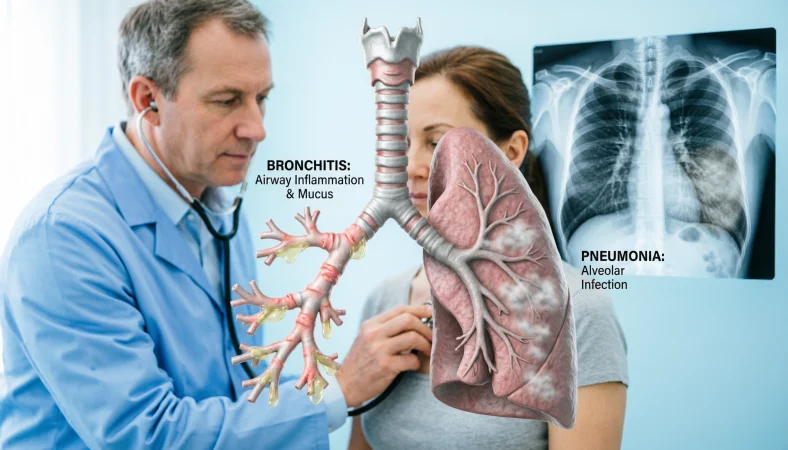
The most important difference between bronchitis and pneumonia is the part of the respiratory system primarily affected.
Bronchitis involves inflammation and swelling of the bronchial tubes, which carry air into and out of the lungs. Acute bronchitis is commonly called a chest cold and is usually caused by a virus. It often produces a persistent cough, sometimes with mucus, along with symptoms such as tiredness, congestion, sore throat, mild body aches, and occasional fever.
Pneumonia is an infection of the lungs. It can be caused by bacteria, viruses, fungi, and, less commonly, parasites. Pneumonia can cause cough, fever or chills, fatigue, shortness of breath, and chest pain that becomes noticeable when breathing or coughing.
| Feature | Bronchitis | Pneumonia |
| Main location | Bronchial airways | Lung tissue |
| Basic problem | Inflammation of the airways | Infection of the lungs |
| Common causes | Usually viruses in acute cases | Bacteria, viruses, fungi, and other organisms |
| Common symptom | Persistent cough | Cough with possible fever and breathing difficulty |
| Mucus | May occur | May occur |
| Fever | May be mild or absent | More common, although presentation varies |
| Chest discomfort | Can occur | Can occur, especially with breathing or coughing |
| Diagnosis | Often based on symptoms and examination | May require examination and sometimes chest imaging |
| Antibiotics | Usually not useful for acute viral bronchitis | May be prescribed when bacterial pneumonia is diagnosed or strongly suspected |
The table shows why symptoms alone can be misleading.
A cough does not automatically mean bronchitis.
Mucus does not automatically mean pneumonia.
Fever can occur with either illness.
Breathing difficulty can occur with either illness and should be taken seriously.
The overall pattern, physical examination, medical history, and sometimes testing help determine the cause.
Is Bronchitis vs Pneumonia a Grammar, Vocabulary, or Usage Issue?
The phrase bronchitis vs pneumonia is not a grammar issue. It is a medical terminology and health information question involving two different respiratory conditions.
The conditions are related because both can develop after respiratory infections and both can produce similar symptoms. However, they are not interchangeable diagnoses.
Bronchitis describes inflammation of the bronchial tubes. Pneumonia describes an infection involving the lungs. Because the symptoms overlap, a person cannot always determine the diagnosis simply by comparing one symptom with a checklist.
For example, coughing up mucus does not prove that someone has pneumonia. Similarly, having a fever does not automatically mean pneumonia.
Healthcare professionals consider the complete clinical picture.
Are Bronchitis and Pneumonia Interchangeable?
No.
A person can have bronchitis without having pneumonia. A person can also develop pneumonia with symptoms that initially resemble a respiratory infection or bronchitis.
Acute bronchitis is usually viral and commonly improves without antibiotics. Pneumonia has multiple possible causes, and treatment depends on the cause and severity.
Mild and Severe Presentations
Both conditions can vary considerably.
Someone with acute bronchitis may mainly experience a persistent cough and fatigue.
Someone with pneumonia may experience more pronounced breathing difficulty, fever, chills, chest pain, or weakness.
However, these patterns are not absolute. Pneumonia can sometimes have a gradual presentation, and bronchitis can cause significant coughing and discomfort.
That is why severity and symptom duration should not be used as the only way to determine the diagnosis.
Academic and Medical Usage
In medical writing, precision matters.
A healthcare professional may distinguish between:
“Acute bronchitis”
“Chronic bronchitis”
“Community acquired pneumonia”
“Viral pneumonia”
“Bacterial pneumonia”
These terms describe different clinical situations.
For general readers, simply understanding that bronchitis mainly involves the airways while pneumonia involves infection of the lungs provides a useful starting point.
How Bronchitis Usually Presents
Acute bronchitis occurs when the bronchial airways become inflamed and produce mucus. The resulting irritation commonly triggers coughing.
The cough may occur with or without mucus. Other symptoms can include fatigue, congestion, sore throat, mild body aches, and sometimes a mild fever. The illness often develops after a cold or another respiratory infection.
One confusing feature is that the cough may last much longer than the other symptoms.
A person may feel generally better while still coughing for several weeks.
That does not automatically mean the illness has become pneumonia.
Workplace Example
Imagine someone develops a cough after several days of cold symptoms.
They may feel tired and have chest discomfort while coughing, but their symptoms gradually improve.
In an uncomplicated case of acute bronchitis, rest, fluids, and symptom management may be sufficient. Antibiotics generally do not help when the cause is viral.
Academic Example
A medical education article might describe acute bronchitis as inflammation of the bronchial airways that commonly follows a respiratory infection.
This wording is more precise than simply saying that bronchitis is a chest infection.
Technology Example
Health applications and symptom checkers may ask about cough duration, fever, breathing difficulty, chest pain, and other symptoms.
However, a digital tool should not be treated as a definitive diagnostic test. A symptom pattern can suggest possibilities, but clinical diagnosis may require an examination or testing.
Usage Recap
Bronchitis mainly involves inflamed bronchial airways.
Acute bronchitis is usually caused by viruses.
A cough can remain after other symptoms improve.
Antibiotics usually do not help uncomplicated acute bronchitis caused by viruses.
How Pneumonia Usually Presents
Pneumonia is an infection of the lungs. Different organisms can cause it, including bacteria and viruses, with fungi and parasites representing less common causes.
Common symptoms include coughing, fever or chills, fatigue, shortness of breath, and chest pain associated with breathing or coughing. Some people may also experience nausea, vomiting, or diarrhea.
Pneumonia can affect people differently.
Age, overall health, underlying conditions, and the organism causing the infection can influence how the illness appears.
Workplace Example
Someone with pneumonia may find ordinary activities unusually difficult because of fatigue or shortness of breath.
Instead of assuming that the symptoms are simply a lingering cough, medical evaluation may be appropriate, particularly when breathing problems, significant fever, chest pain, or worsening symptoms occur.
Academic Example
A medical explanation may describe pneumonia as an infection of the lung tissue rather than simply an airway inflammation.
That distinction is important because it explains why pneumonia can affect oxygen movement through the lungs and may require more extensive evaluation.
Technology Example
A chest imaging system can help clinicians identify changes associated with pneumonia. A chest X ray is commonly used when pneumonia is suspected, although imaging does not necessarily identify the exact organism responsible for the infection.
Usage Recap
Pneumonia is an infection of the lungs.
It can be caused by several types of organisms.
Shortness of breath, chest pain, fever, chills, and significant worsening can be important warning signs.
Diagnosis may involve examination, oxygen measurement, chest imaging, or other tests depending on the situation.
When You Should NOT Assume It Is Just Bronchitis or Pneumonia
Symptoms can overlap, so self diagnosis can be unreliable.
1. Do Not Assume Mucus Means Bacterial Infection
Mucus can occur with acute bronchitis and other respiratory illnesses. The color of mucus by itself does not establish that a bacterial infection is present.
2. Do Not Assume Every Persistent Cough Is Pneumonia
A cough from acute bronchitis can last for weeks even as the illness improves.
3. Do Not Assume Fever Automatically Means Pneumonia
Fever can occur with multiple respiratory infections.
4. Do Not Assume Antibiotics Are Always Necessary
Most acute bronchitis cases are viral, so antibiotics generally do not provide benefit.
5. Do Not Ignore Breathing Problems
Shortness of breath or difficulty breathing deserves medical attention, particularly if it is new, severe, or worsening.
6. Do Not Rely Only on Symptom Duration
Duration can provide useful information, but it does not independently establish the diagnosis.
7. Do Not Treat Online Symptom Lists as a Diagnosis
Online information can help explain possibilities, but it cannot replace a professional assessment when symptoms are concerning.
8. Do Not Ignore Sudden Deterioration
A respiratory illness that initially improves and then becomes significantly worse should be evaluated.
Common Mistakes and Decision Rules
| Correct Statement | Incorrect Assumption | Explanation |
| Acute bronchitis often causes a persistent cough. | A persistent cough always means pneumonia. | Cough duration alone does not establish pneumonia. |
| Pneumonia can cause shortness of breath. | Shortness of breath always means pneumonia. | Several respiratory conditions can cause breathing difficulty. |
| Viral bronchitis usually does not require antibiotics. | Every chest infection needs antibiotics. | Antibiotics do not treat viral infections. |
| Pneumonia can be caused by bacteria or viruses. | Pneumonia is always bacterial. | Multiple organisms can cause pneumonia. |
| Mucus can occur with bronchitis. | Mucus proves a bacterial infection. | Mucus alone cannot establish the cause. |
| Chest imaging may help evaluate suspected pneumonia. | A chest X ray identifies every cause of pneumonia. | Imaging can show lung changes but does not necessarily identify the organism. |
Decision Rule Box
- If symptoms mainly involve a cough after a respiratory infection, acute bronchitis may be one possibility.
- If there are signs suggesting a deeper lung infection, pneumonia may need to be considered.
- If breathing is difficult, symptoms are severe, or the illness is worsening, seek medical evaluation rather than relying on a symptom comparison.
Bronchitis and Pneumonia in Modern Technology and AI Tools
Digital health tools can make respiratory information easier to access, but they also create a potential problem: people may interpret symptom matching as diagnosis.
An AI tool may identify that cough, fever, fatigue, and breathing difficulty can occur with pneumonia. It may also explain that acute bronchitis can produce cough, mucus, fatigue, and mild body symptoms.
That information can be useful for education.
It should not be treated as proof of a diagnosis.
Clinical assessment can involve information that an automated system cannot reliably determine from a short text description. A clinician can listen to the lungs, assess vital signs, consider risk factors, and decide whether additional testing is appropriate.
When pneumonia is suspected, a chest X ray may help determine whether pneumonia or another condition could explain the symptoms.
AI and symptom tools are therefore best used for education and preparation for a healthcare conversation rather than as replacements for professional diagnosis.
Etymology and Medical Meaning
The word bronchitis comes from terminology associated with the bronchial tubes and inflammation.
The word pneumonia has roots connected to the lungs and breathing.
The distinction between the terms reflects their medical meanings.
Bronchitis focuses on inflammation of the bronchial airways.
Pneumonia refers to infection of the lungs.
This difference is useful because it provides a simple conceptual framework even though real clinical presentations can be complicated.
A person can have overlapping respiratory symptoms, and different illnesses can affect several parts of the respiratory system at the same time.
An Expert Perspective on Bronchitis and Pneumonia
“A cough is a symptom, not a diagnosis.”
This principle is important when comparing these conditions.
A cough can occur with bronchitis, pneumonia, a common cold, influenza, asthma, allergies, and several other conditions.
The presence of one symptom should therefore not be used to assign a diagnosis.
The overall clinical picture matters.
Two Practical Case Studies
Case Study 1: Persistent Cough After a Cold
Consider an otherwise healthy adult who develops a cold followed by a persistent cough.
The person has mild fatigue, congestion, and coughing but no serious breathing difficulty. Over time, the other symptoms improve while the cough continues.
This pattern can occur with acute bronchitis, where coughing may persist after the initial respiratory illness has begun to resolve.
Concrete result: The important distinction is that continued coughing alone does not establish pneumonia. If symptoms remain concerning or continue beyond the expected period, medical evaluation is appropriate.
Case Study 2: Cough With Breathing Difficulty
Consider a person who develops cough together with fever, chills, shortness of breath, and chest pain during breathing or coughing.
Those symptoms can occur with pneumonia and warrant medical evaluation rather than assuming the illness is ordinary bronchitis.
A clinician may perform an examination and decide whether chest imaging or other tests are appropriate.
Concrete result: If pneumonia is identified, treatment is based on the cause and clinical severity. Bacterial pneumonia may require antibiotics, while treatment for other causes differs.
These are illustrative clinical scenarios, not individual patient records.
When to Seek Medical Care
Certain symptoms deserve prompt medical attention.
The CDC advises seeking medical care for acute bronchitis when there is a high or prolonged fever, bloody mucus, shortness of breath or difficulty breathing, symptoms lasting longer than three weeks, or repeated episodes of bronchitis.
Emergency respiratory warning signs can include difficulty breathing, persistent chest pain or pressure, confusion, inability to wake normally, severe weakness, or symptoms that improve and then return or worsen.
Children can have different warning signs. Fast breathing, difficulty breathing, bluish lips or face, chest pain, severe weakness, dehydration, or reduced alertness require prompt medical attention.
Anyone with significant breathing difficulty should seek urgent medical care rather than trying to determine the diagnosis from an online comparison.
Error Prevention Checklist
Always remember:
- Bronchitis mainly involves inflammation of the bronchial airways.
- Pneumonia is an infection of the lungs.
- Acute bronchitis is usually viral.
- Pneumonia can have bacterial, viral, fungal, or other causes.
- Cough alone cannot reliably distinguish the two conditions.
- Mucus color does not by itself prove bacterial infection.
- Antibiotics do not normally help uncomplicated acute bronchitis.
- Pneumonia may require medical testing and targeted treatment.
Never assume:
- Every cough is pneumonia.
- Every cough is bronchitis.
- Every fever means pneumonia.
- Mucus automatically means bacterial infection.
- Antibiotics are appropriate for every chest illness.
- An AI symptom checker can provide a definitive diagnosis.
Related Health Conditions You Should Understand
Understanding bronchitis and pneumonia becomes easier when you also recognize several related respiratory conditions.
Common Cold
A common viral respiratory illness can produce cough, congestion, sore throat, and fatigue.
Influenza
Influenza can produce fever, cough, body aches, fatigue, and other systemic symptoms and can sometimes lead to complications involving the lungs.
COVID 19
COVID 19 can affect the respiratory system and can range from mild illness to serious disease.
Asthma
Asthma involves airway narrowing and inflammation and can cause wheezing, coughing, and breathing difficulty.
Chronic Bronchitis
Chronic bronchitis is a long term condition involving persistent productive cough and is part of chronic obstructive pulmonary disease.
Bronchiolitis
Bronchiolitis affects the smaller airways and is especially important in young children.
Pleurisy
Pleurisy involves inflammation around the lungs and can produce sharp chest pain associated with breathing.
Tuberculosis
Tuberculosis is an infectious disease that can affect the lungs and may produce prolonged respiratory symptoms.
Sinus Infection
Sinus infections primarily affect the sinus passages but can produce drainage and coughing that may complicate the picture.
Whooping Cough
Pertussis can cause prolonged coughing and may require specific medical evaluation and treatment.
FAQs
What is the difference between bronchitis and pneumonia?
Bronchitis affects the bronchial airways, while pneumonia affects the lungs. Both can cause coughing and fatigue, but pneumonia may also cause fever, chills, breathing difficulty, and chest pain.
How can you tell if you have bronchitis or pneumonia?
Symptoms alone cannot always distinguish them. A healthcare professional may use your history, examination, vital signs, imaging, or other tests to identify the cause.
Can bronchitis turn into pneumonia?
Bronchitis does not always lead to pneumonia, although respiratory illnesses can become more serious. Worsening symptoms or breathing difficulty should be medically evaluated.
Is bronchitis or pneumonia worse?
Pneumonia and bronchitis are different conditions, and their severity varies. Pneumonia can be serious, but bronchitis may also cause significant symptoms.
Does bronchitis cause a fever?
Acute bronchitis can cause a mild fever, although fever is not present in every case. A high or prolonged fever should be discussed with a healthcare professional.
Does pneumonia always cause a fever?
No. Pneumonia can vary by cause and individual health. Fever and chills are common, but their absence does not rule out pneumonia.
Can you have bronchitis without mucus?
Yes. Acute bronchitis can cause coughing with or without mucus. Mucus production is common but isn’t required for the condition.
Does colored mucus mean pneumonia?
No. Colored mucus does not by itself establish pneumonia or prove that an illness is bacterial. Other clinical findings are more important when evaluating the cause of respiratory symptoms.
When should I see a doctor for bronchitis symptoms?
Seek medical advice for breathing difficulty, bloody mucus, high or prolonged fever, symptoms lasting over three weeks, repeated episodes, or worsening symptoms.
Can antibiotics treat bronchitis and pneumonia?
Antibiotics generally do not help uncomplicated acute bronchitis when it is caused by a virus. Pneumonia treatment depends on its cause, and bacterial pneumonia may require antibiotics.
Conclusion:
Understanding bronchitis or pneumonia starts with recognizing that the two conditions affect the respiratory system differently.
Bronchitis primarily involves inflammation of the bronchial airways, while pneumonia is an infection of the lungs. Both can cause coughing, fatigue, and other respiratory symptoms, which is why they can be difficult to distinguish without a proper clinical assessment.
Acute bronchitis is usually caused by viruses and commonly improves without antibiotics. Pneumonia can have several causes and may require medical testing and specific treatment depending on the underlying infection and severity.
The most important lesson is not to diagnose either condition from a single symptom. A cough does not automatically indicate pneumonia, and mucus does not automatically mean a bacterial infection.
If breathing becomes difficult, chest pain develops, symptoms become severe, or an illness improves and then gets worse again, professional medical evaluation is important.
For educational purposes, the simplest distinction is this: bronchitis mainly involves inflamed airways, while pneumonia involves infection of the lungs. The actual diagnosis depends on the complete clinical picture.