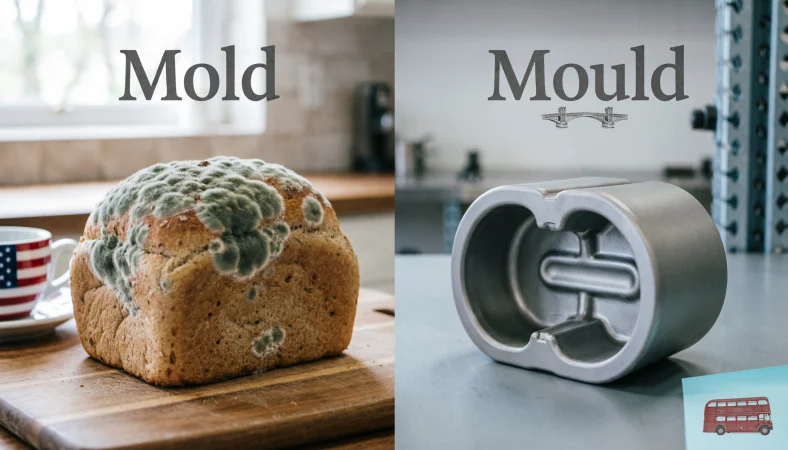
Mold and mould are both correct spellings of the same word, but their usage depends on regional English. Mold is the preferred spelling in American English, while mould is standard in British English and many other English varieties. Both words can refer to a fungus that grows in damp conditions or a container used to shape materials. Choose the spelling that matches your audience and use it consistently.
Are you confused about whether to write mold or mould? You are not alone. These two spellings often confuse writers because they look different but share the same meaning and pronunciation. The main difference is regional: American English favors mold, whereas British English typically uses mould. Understanding this distinction helps you avoid spelling inconsistencies in everyday and professional writing.
In this guide, you will learn when to use mold or mould, how each spelling works in sentences, and which version is best for your target audience. With clear definitions, practical examples, and simple spelling guidance, you can confidently choose the appropriate form for articles, emails, school assignments, and other written content.
Why Do People Write Mold or Mould?
The spelling question mold or mould often appears when writers move between American and British English. Both forms refer to the same thing, but they belong to different spelling conventions. In general, mold is the usual American spelling, while mould is the traditional British spelling.
The word can describe the fungus that grows on damp food, walls, fabric, or other surfaces. It can also refer to a container or form used to shape something, such as a cake mould or a metal mould. In both meanings, American English normally uses mold, while British English normally uses mould.
This difference can cause real mistakes when writers switch between regional forms without noticing. A British reader will usually understand mold, and an American reader will understand mould, but inconsistent spelling can make an article, report, product description, or academic paper look poorly edited.
The important point is simple. Neither spelling is inherently wrong. The choice depends on the variety of English you are using.
For example, an American writer might say:
The bread developed mold after several days.
A British writer would typically write:
The bread developed mould after several days.
The meaning remains exactly the same.
This distinction matters beyond everyday writing. Search engines, dictionaries, publishing standards, educational institutions, government documents, and professional organizations may follow a particular variety of English. If you understand the regional difference, you can choose the spelling confidently instead of treating one form as a misspelling.
The following sections explain the difference in detail, including pronunciation, meaning, grammar, regional usage, common mistakes, and practical rules for choosing the correct spelling.
Mold vs Mould: What’s the Difference?
The primary difference between mold and mould is spelling. They are not two different words with different meanings. They are regional spelling variants used in different varieties of English.
Both words can function as nouns and verbs.
As a noun, the word can describe a type of fungus or a container used to give something a particular shape.
Examples include:
“Green mold appeared on the bread.”
“The chocolate was poured into a mold.”
In British English, the equivalent sentences would normally use mould.
As a verb, the word can mean to shape or influence something.
For example:
“Heat helped mold the material into a new shape.”
“Her experiences helped mold her personality.”
British English generally writes these as:
“Heat helped mould the material into a new shape.”
“Her experiences helped mould her personality.”
The key facts are easy to remember.
Mold is the standard American spelling.
Mould is the standard British spelling.
Both forms have the same meanings.
Both forms can function as nouns or verbs.
Neither spelling is universally more correct than the other.
Is Mold vs Mould a Grammar, Vocabulary, or Usage Issue?
The difference between mold and mould is primarily a spelling and usage issue, not a grammar issue.
Grammar determines how a word functions in a sentence. Since both spellings can operate as nouns and verbs in essentially the same ways, changing the spelling does not normally change the grammatical structure.
Consider:
“The mold covered the old bread.”
“The mould covered the old bread.”
The grammar is identical. Only the regional spelling changes.
The same applies to the verb:
“Moisture can mold the material.”
“Moisture can mould the material.”
Again, the grammatical function remains unchanged.
Are Mold and Mould Interchangeable?
In meaning, yes. In regional spelling, not always.
A writer using American English should generally choose mold throughout a document. A writer following British English should generally choose mould.
The biggest problem is not choosing one form over the other. The bigger problem is mixing them unnecessarily.
For instance, an article written almost entirely in American English may suddenly contain mould because the writer encountered the spelling elsewhere. That inconsistency can make the document appear less carefully edited.
Formal and Informal Usage
Both forms are acceptable in formal writing when they match the relevant variety of English.
American academic writing uses mold.
British academic writing uses mould.
The same principle applies to business communication, journalism, technical documentation, education, and everyday conversation.
Academic and Casual Usage
Regional spelling remains relevant in both academic and casual writing. A university student writing according to American English conventions would normally use mold. A student following British English conventions would normally use mould.
The important factor is consistency.
How to Use Mold in American English
Mold is the preferred spelling in American English.
This spelling appears when discussing fungus, shaping materials, manufacturing forms, or the process of influencing development.
Workplace Example
A workplace report might state:
“Employees should report visible mold growth immediately.”
Here, mold refers to fungal growth.
Another example is:
“The technician used a plastic mold to shape the component.”
Here, mold refers to a form used to create a particular shape.
Academic Example
An American research paper might say:
“Researchers examined how environmental moisture contributes to mold growth.”
The spelling follows American English conventions.
A history paper might use the verb:
“Social experiences can mold cultural attitudes over time.”
Again, mold is the expected American form.
Technology Example
Technical writing may contain sentences such as:
“The manufacturing system uses a reusable mold for each component.”
In software and technology discussions, the word can also appear metaphorically:
“The interface can mold itself around the user’s preferences.”
The regional spelling remains mold when the document follows American English.
Usage Recap
Use mold when writing in American English.
Use it for fungal growth, a shaping form, or the act of shaping and influencing.
It works as both a noun and a verb.
How to Use Mould in British English
Mould is the traditional spelling used in British English.
It carries the same meanings as the American spelling. The extra letter is simply part of the British spelling convention.
Workplace Example
A British workplace document might say:
“Staff should report signs of mould in the building.”
Here, mould refers to fungal growth.
A manufacturing document might state:
“The component was produced using a custom mould.”
The meaning is exactly the same as the American sentence using mold.
Academic Example
A British academic article could say:
“High humidity can encourage mould growth indoors.”
The spelling follows British convention.
The verb also appears in formal writing:
“Education can mould a person’s understanding of society.”
Technology Example
British technical documentation may use:
“The device casing was created using a precision mould.”
This spelling is appropriate when the publication follows British English.
Usage Recap
Use mould when writing in British English.
It is also common in other varieties of English that follow British spelling conventions.
The meaning does not change when the spelling changes.
When You Should NOT Use Mold or Mould
There are several situations where writers can make avoidable mistakes.
1. Do Not Mix Regional Spellings Without a Reason
If your article uses American English, switching from mold to mould can create inconsistency.
If your document uses British English, suddenly writing mold can produce the same problem.
2. Do Not Assume Mould Is a Different Thing
The spelling does not indicate a different type of fungus or a different manufacturing process.
“Mold” and “mould” can refer to the same concepts.
3. Do Not Treat Mold as an American Pronunciation
The main distinction is spelling. The pronunciation is generally the same.
4. Do Not Correct Mould Automatically
If you are editing British English, changing every instance of mould to mold would introduce an American spelling rather than improve the text.
5. Do Not Correct Mold Automatically
The reverse is also true. In an American document, replacing mold with mould would move the spelling toward British usage.
6. Do Not Use One Form Randomly
Choose your regional convention before beginning a long document.
7. Do Not Assume British English Is More Formal
Neither spelling is inherently more formal. Regional convention determines the preferred form.
8. Do Not Assume American English Is More Modern
The shorter American spelling does not make it newer or more sophisticated. It is simply the standard American form.
Common Mistakes With Mold and Mould
The most common errors involve regional inconsistency rather than misunderstanding the meaning.
The important distinction is between incorrect meaning and different regional spelling. In most cases, the supposedly incorrect form is not actually wrong English. It may simply belong to another regional standard.
Decision Rule: Mold or Mould?
If you are writing for an American audience, use mold. If you are writing for a British audience, use mould. For international content, choose one regional spelling based on your editorial style and use it consistently.
This rule works for almost every ordinary spelling decision involving these two forms.
For a United States school assignment, choose mold.
For a British publication, choose mould.
For a document written according to a specific company style guide, follow that guide.
For a website serving multiple English speaking regions, consistency matters more than trying to force one spelling into every context.
Mold and Mould in Modern Technology and AI Tools
Modern technology has made regional spelling differences more visible.
Writing assistants, grammar checkers, search systems, content management systems, and AI writing tools may encounter both mold and mould. Both forms are legitimate, so an intelligent system should consider the regional context before treating one as an error.
For example, an AI generated article intended for American readers should normally use mold. The same article prepared for a British audience should normally use mould.
This is particularly important for large websites. A company may publish product descriptions for customers in several countries. If every page switches between regional spellings, the site can develop an inconsistent editorial voice.
AI tools can also identify contextual meaning. In one sentence, mold may refer to fungus. In another, it may describe a form used to shape plastic. The spelling does not determine the meaning.
Human review still matters because regional style depends on audience, publication standards, and editorial goals.
The Etymology of Mold and Mould
The history of these spellings helps explain why both forms exist.
The word has old Germanic roots and entered English through forms related to words meaning earth, soil, or ground. The fungus sense developed from the idea of growth on organic matter or material exposed to damp conditions.
The spelling mould reflects older and more traditional English spelling patterns. American English later developed a tendency toward shorter spellings in several groups of words, especially where certain letters did not strongly affect pronunciation.
This broader history helps explain why American English has forms such as mold, while British English retains mould.
The same regional pattern appears in several other spelling differences. American English often prefers shorter forms, while British English frequently preserves letters associated with older spelling traditions.
The important point is that neither form is a random misspelling. Each belongs to an established variety of English.
An Expert View on Regional Spelling
A useful editorial principle is:
“Correct spelling depends on the English variety, the audience, and the style being followed.”
That principle is especially useful for words such as mold and mould because both forms are established in standard English.
Good editing is not simply about identifying one spelling and rejecting another. It also involves understanding audience expectations and maintaining consistency across an entire document.
Two Practical Case Studies
Case Study 1: An American Home Improvement Article
Imagine an American website publishing an article about moisture problems in homes.
The editorial team chooses American English because most readers are in the United States. Throughout the article, it uses terms such as mold growth, mold removal, and mold inspection.
The concrete result is a consistent regional style. Readers encounter the spelling they expect, and the article maintains a uniform editorial voice.
If the same article repeatedly switched between mold and mould, readers might wonder whether the terms referred to different things.
Case Study 2: A British Manufacturing Guide
Now consider a manufacturing guide written for readers in the United Kingdom.
The document discusses injection moulding, custom moulds, and mould design. The editorial team follows British spelling throughout the guide.
The concrete result is regional consistency. Readers can immediately recognize that the publication follows British English conventions.
If an editor changed every occurrence of mould to mold without considering the audience, the document would adopt American spelling unnecessarily.
These examples demonstrate an important lesson. The goal is not to decide which spelling wins. The goal is to choose the appropriate variety and apply it consistently.
Error Prevention Checklist
Always use mold when
- You are writing standard American English.
- Your publication style guide specifies American spelling.
- Your target audience is primarily in the United States.
- You are writing an American academic, business, technical, or educational document.
- Your surrounding vocabulary follows American spelling conventions.
Always use mould when
- You are writing standard British English.
- Your publication style guide specifies British spelling.
- Your target audience is primarily in the United Kingdom.
- You are writing for an organization that follows British spelling conventions.
- The surrounding document consistently uses British spelling.
Never use the other form simply because
- You think it has a different meaning.
- You assume one form is a spelling mistake.
- You believe one version sounds more formal.
- You are switching between American and British English without a clear editorial reason.
- You want to vary the wording artificially.
Related Spelling Confusions You Should Master
Understanding mold or mould can help you recognize other regional spelling differences.
- Color or colour
American English generally uses color, while British English generally uses colour. - Favor or favour
American English generally uses favor, while British English generally uses favour. - Honor or honour
American English generally uses honor, while British English generally uses honour. - Center or centre
American English generally uses center, while British English generally uses centre. - Theater or theatre
Both forms are established, with regional preferences depending on the variety of English and context. - Analyze or analyse
American English generally uses analyze, while British English commonly uses analyse. - Realize or realise
American English generally uses realize, while British English commonly uses realise. - License or licence
British English commonly distinguishes between the noun licence and the verb license, while American English generally uses license for both. - Traveling or travelling
American English generally uses traveling, while British English often uses travelling. - Modeling or modelling
American English generally uses modeling, while British English commonly uses modelling.
These differences demonstrate why regional English matters. Spelling is not always governed by one universal rule.
FAQs
Is mold or mould correct?
Both are correct. Mold is the standard American spelling, while mould is the standard British spelling and is also common in several varieties influenced by British English.
Is mould British or American?
Mould is primarily associated with British English. American English normally uses mold.
Is mold the American spelling?
Yes. Mold is the standard spelling in American English for both the fungus and the form used for shaping something.
Is mould the British spelling?
Yes. Mould is the standard British spelling for the same meanings represented by mold in American English.
Does mold and mould mean the same thing?
Yes. In ordinary usage, they have the same meanings. The difference is primarily regional spelling.
How do you spell mold in British English?
In British English, the usual spelling is mould.
How do you spell mould in American English?
In American English, the usual spelling is mold.
Is mold or mould more correct?
Neither is universally more correct. The appropriate choice depends on the variety of English being used.
Should I use mold or mould in academic writing?
Use the form required by your academic institution, publication, or style guide. American academic writing normally uses mold, while British academic writing normally uses mould.
Can mold and mould be used interchangeably?
They are interchangeable in meaning, but you should not switch between them randomly within the same document. Choose the spelling that matches your regional English and remain consistent.
Conclusion:
The choice between mold and mould is straightforward once you understand regional English conventions. Both spellings are correct, both carry the same basic meanings, and both can function as nouns or verbs.
The main rule is simple: American English generally uses mold, while British English generally uses mould.
If you are writing for American readers, choose mold. If your audience follows British English, choose mould. When writing for an international audience, follow the spelling convention established by your publication or organization.
Most importantly, do not treat the two forms as different words. They are regional spelling variants. The real mistake is not choosing one over the other. It is using both forms inconsistently without a clear reason.
Once you identify your intended variety of English, the decision becomes easy. Match the spelling to your audience, follow the relevant style guide, and keep the entire document consistent.











1 thought on “Mold or Mould: Which Spelling Is Correct in English?”