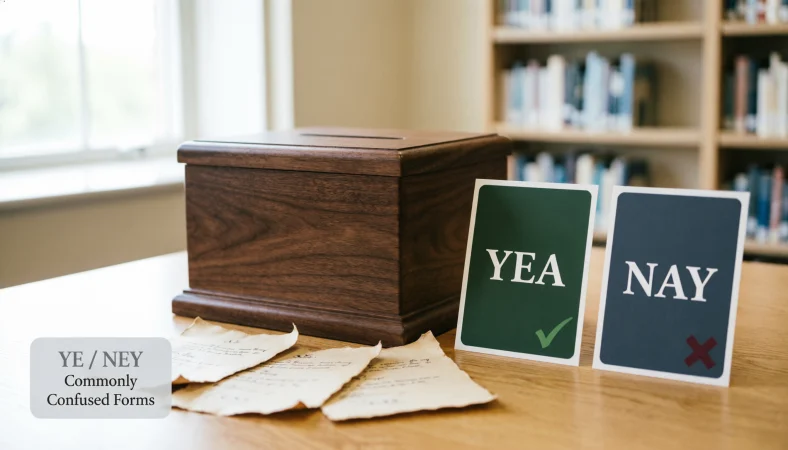
Yea and nay are established words, while ye and ney are not standard spellings for the traditional expressions meaning yes and no. Yea means “yes” or expresses an affirmative vote, while nay means “no” or expresses a negative vote.
However, ye can be an older form of “you,” and ney may appear as a variant or in specialized contexts. If you are comparing traditional ways to say yes and no, use yea or nay.
Have you ever wondered whether the correct phrase is ye or ney? These spellings can cause confusion because they resemble older English expressions and informal variations found in online writing.
The traditional phrase is yea or nay, which asks someone to express agreement or disagreement, approval or rejection. Understanding the standard forms helps you interpret the phrase correctly and avoid spelling mistakes in formal or historical contexts.
In this guide, you will learn the difference between yea and nay, explore what each word means, and discover how the phrase is used in voting, decision making, and everyday expressions.
With clear explanations and practical examples, you will understand why yea or nay is the established phrase and when these words are appropriate in modern English.
Ye vs Ney: What’s the Difference?
The phrase ye or ney is often a spelling confusion involving yea or nay, a traditional expression used to ask whether someone supports or opposes a proposal. In standard voting language, yea means yes and nay means no. The forms ye and ney do not normally serve those meanings.
What Does Ye Mean?
Ye can be a real English word, but its meaning depends on context. In older English, ye was used as a second person plural pronoun, meaning “you.” It also appears in familiar phrases such as “Ye Olde Shoppe,” where it reflects an old style of writing or a historical spelling convention.
However, ye is not the usual spelling of yea when someone means an affirmative vote. If you are answering a formal question about whether a proposal should pass, yea is the conventional word.
For example:
“Those in favor should vote yea.”
Here, yea expresses support. Writing “vote ye” would not be the standard way to express the same instruction.
What Does Ney Mean?
Ney is not the standard English spelling of nay when expressing a negative vote or answer. It may appear as a surname, a name, or a specialized term in particular contexts, but it should not normally replace nay in voting language.
Nay is the traditional word meaning “no.” It appears in formal voting, historical writing, and the familiar expression “yea or nay.”
For example:
“The committee must decide yea or nay.”
This means the committee must decide yes or no.
Ye or Ney Comparison Table
| Feature | Ye | Ney |
| Standard meaning in voting | Not the usual form for an affirmative vote | Not the standard form for a negative vote |
| Related standard word | Yea | Nay |
| Meaning of the standard word | Yes or an affirmative vote | No or a negative vote |
| Part of speech | Pronoun in historical usage, depending on context | Usually a name or specialized form when encountered |
| Formal voting usage | Use yea | Use nay |
| Common expression | Yea or nay | Yea or nay |
| Example | “The vote was yea.” | “The vote was nay.” |
Quick recap: Ye and ney are not the standard pair used to express yes and no in voting.
Use yea for an affirmative answer or vote.
Use nay for a negative answer or vote.
The established expression is “yea or nay,” not “ye or ney,” when asking for a decision.
Is Ye or Ney a Grammar, Vocabulary, or Usage Issue?
The confusion between ye or ney is primarily a spelling and vocabulary issue. The standard voting expression is yea or nay, and the words have distinct meanings. The forms ye and ney exist in other contexts, but that does not make them interchangeable with yea and nay.
Are Ye and Ney Interchangeable?
No. If you are asking whether someone agrees with a proposal, the standard pair is yea and nay. They express opposite answers.
For example:
“The chair asked members to vote yea or nay.”
This sentence asks members to vote in favor or against the proposal.
By contrast, ye may appear as a historical pronoun meaning “you,” while ney may appear as a name. Neither normally communicates an affirmative or negative vote.
Formal vs Informal Usage
In formal voting, parliamentary records, historical documents, and official meeting minutes, use yea and nay when those terms match the voting procedure.
In casual conversation, people are more likely to say “yes or no.” For example, a friend might ask, “Are you coming, yes or no?” Someone discussing an old fashioned council meeting might instead ask whether the members voted yea or nay.
The choice depends on context. Yea and nay can sound formal or traditional, while yes and no are common in everyday speech.
Academic vs Casual Usage
In academic writing about history, government, or parliamentary procedure, yea and nay may be appropriate when describing how a vote was recorded.
For example:
“The members cast their votes, with twelve voting yea and five voting nay.”
In a general school essay, however, “twelve voted yes and five voted no” may be easier for readers to understand. Both versions can communicate the same result, but the first uses traditional voting terminology.
The important point is to match the words to the subject and explain less familiar terms when your audience may not recognize them.
How to Use Ye Correctly
The word ye has legitimate historical and linguistic uses. The mistake is assuming that it is simply a shorter spelling of yea in every context.
Historical and Literary Usage
In older forms of English, ye was used as a pronoun referring to more than one person, and it appears in historical texts and literary works. Modern readers may recognize it from religious writing, traditional expressions, or deliberately archaic dialogue.
For example:
“Ye shall know the truth.”
This kind of wording imitates an older style of English. In contemporary everyday writing, the sentence would usually use “you” instead.
Workplace Example
Suppose a researcher is preparing a workplace presentation about the language of historical documents. The researcher might write:
“The word ye appears in several texts from the period.”
Here, ye is the subject of linguistic discussion. It is not being used to record a yes vote.
If the presentation concerns a modern company vote, the writer should use yea and nay only if those are the terms used in the voting system.
Academic Example
A student studying older English texts might explain:
“In this passage, ye refers to the people being addressed.”
That use is appropriate because the student is analyzing historical language. The exact meaning can depend on the text, period, and grammatical form being studied.
The student should not automatically interpret every occurrence of ye as an affirmative answer. The surrounding sentence determines its function.
Technology Example
A digital archive may preserve the spelling ye when displaying a historical document. A transcription tool should retain the original spelling if the purpose is to reproduce the source faithfully.
By contrast, a modern voting application should generally label affirmative and negative options clearly. If it uses traditional terminology, “Yea” and “Nay” are the expected labels, not “Ye” and “Ney.”
Usage recap: Use ye when the context calls for its historical or specialized meaning. If you mean an affirmative vote, choose yea.
How to Use Ney Correctly
Ney is not the standard spelling of the negative voting word nay. Before correcting it, however, consider the context. It may be a person’s name or part of a title, and proper names should not be changed simply because they resemble another word.
Workplace Example
Imagine that an employee is reviewing meeting notes containing this sentence:
“The proposal received seven ye votes and three ney votes.”
If the writer intends to record a traditional vote, the standard wording would be:
“The proposal received seven yea votes and three nay votes.”
This correction makes the meaning clear and uses the established voting terms.
If Ney were the name of a person involved in the meeting, the editor would need to preserve the name instead. Context matters.
Academic Example
A student writing about parliamentary vocabulary should use nay when describing a negative vote.
For example:
“The chair recorded the objection as a nay vote.”
Writing ney vote would generally be a spelling error in this context. The student should also distinguish between the historical spelling being analyzed and the modern standard form being used in the explanation.
Technology Example
An online poll might offer users two options: “Yea” and “Nay.” These labels are suitable when the poll imitates traditional voting language.
If a user enters “ney” into a search field, a search system may suggest “nay” based on the surrounding topic. Such a suggestion can be useful, but it should not override a verified proper name or specialized term.
When Ney Is a Name
Ney may occur as a surname or in a proper name. If you are discussing a person with that name, keep the spelling accurate.
For instance, a historical article about a person named Ney should not replace the surname with nay. The two forms may look similar, but a proper name and a voting term serve different purposes.
Usage recap: Use nay to express a negative vote. Retain Ney when it is a genuine name or a term whose spelling is established in its own context.
When You Should NOT Use Ye or Ney
The easiest way to avoid mistakes is to identify the meaning before choosing a spelling. These are the most common situations in which ye or ney should not replace yea or nay.
When You Mean Yes in a Vote
Do not write ye when you mean an affirmative vote in the traditional expression. Use yea.
Correct: “The members voted yea.”
Incorrect: “The members voted ye.”
When You Mean No in a Vote
Do not use ney as a substitute for nay.
Correct: “Five members voted nay.”
Incorrect: “Five members voted ney.”
When You Are Writing Modern Everyday English
If you are having an ordinary conversation, yes and no will usually be clearer than traditional voting terms.
For example, “Do you agree, yes or no?” is more natural in most everyday situations than “Do you agree, yea or nay?”
When You Are Quoting a Historical Text
Do not automatically modernize ye in a quotation if the original wording matters. Preserve the historical spelling when quoting faithfully, and explain it if readers may find it unfamiliar.
The same principle applies to ney if it appears in a proper name or original source.
When You Are Writing Official Meeting Minutes
Use the terminology recognized by the organization or voting procedure. If the official record uses yea and nay, do not replace those terms with nonstandard spellings.
If the organization records votes as yes and no, use those terms instead. Accuracy and consistency matter more than making a record sound traditional.
When You Are Editing a Proper Name
Do not change Ney to nay if it is someone’s actual name. Likewise, do not change a historical or literary use of ye simply because the word resembles yea.
When You Are Using Automatic Spelling Corrections
A spelling checker may suggest a familiar word, but it cannot always identify the intended meaning. Review the sentence before accepting a correction, particularly when names and historical language are involved.
Common Mistakes and Decision Rules
The most frequent error is writing ye or ney when the intended expression is yea or nay. The following examples show how to correct the wording.
Correct and incorrect examples
| Correct sentence | Incorrect sentence | Explanation |
| The committee voted yea. | The committee voted ye. | Use yea for an affirmative vote. |
| Three members voted nay. | Three members voted ney. | Use nay for a negative vote. |
| The chair asked for a yea or nay vote. | The chair asked for a ye or ney vote. | The established expression is yea or nay. |
| The historical text uses the word ye. | The historical text uses the word yea, when it actually says ye. | Preserve the spelling when accurately describing or quoting a source. |
| The speaker answered yes or no. | The speaker answered ney or ye. | Use familiar modern terms when traditional voting language is unnecessary. |
The Simple Decision Rule
- If you mean yes or an affirmative vote, use yea.
- If you mean no or a negative vote, use nay.
- If you mean the historical pronoun, use ye when it fits the source and context.
- If Ney is a person’s name, preserve that spelling.
This rule resolves most cases quickly. The key is not to treat ye and ney as a matched pair merely because they look similar.
Yea and Nay in Modern Technology and AI Tools
Modern technology can help identify the difference between ye or ney and the standard expression yea or nay. Spell checkers, search engines, and AI writing assistants may recognize the intended phrase when the surrounding sentence refers to voting or decision making.
For example, a writing assistant reviewing “The board voted ye or ney” may recommend “The board voted yea or nay.” That correction is appropriate if the writer intends to describe affirmative and negative votes.
However, automated systems may encounter historical documents, unusual names, or specialized terminology. In those cases, a correction that looks obvious may change the original meaning.
For an accurate result, writers should explain the context to the tool and review the suggested edit. In formal records, they should also verify the wording against the original minutes or voting procedure.
Technology is useful for proofreading, but context remains essential.
The Etymology of Yea, Nay, Ye, and Ney
The words yea and nay have long histories in English. They have traditionally expressed affirmative and negative responses and remain associated with formal voting and older styles of public speech.
Yea has been used to mean yes or indeed, while nay has been used to mean no. The expression yea or nay developed as a concise way to refer to an affirmative or negative choice.
The word ye has a separate history. It appears in older English as a pronoun meaning you, especially in historical texts and literary writing. Its appearance in old fashioned signs and phrases has helped keep it familiar to modern readers.
Ney, meanwhile, is not the standard spelling of the negative voting term. It can appear as a name or in other specific contexts, so its meaning must be judged from the surrounding text.
The similar appearance of these words can create confusion, but their histories and functions are not identical.
An Expert Perspective on Ye or Ney
A useful editing principle is:
Choose a word according to its meaning and grammatical role, not merely because its spelling looks familiar.
For voting language, the established pair is yea and nay. For ordinary modern conversation, yes and no are usually more direct. Also For historical writing, ye may be correct when it appears as a pronoun in the source.
This distinction is especially important in educational content. A spelling correction should improve accuracy without erasing a genuine historical form or changing a proper name.
When the context is uncertain, read the entire sentence and ask what the writer intends to communicate. That small step can prevent an unnecessary correction.
Case Study One: Correcting Meeting Minutes
Consider an illustrative example in which a committee secretary prepares minutes for a formal meeting. The first draft records the result as follows:
“Eight members voted ye, while four voted ney.”
The secretary checks the organization’s voting terminology and confirms that the minutes should use traditional voting terms. The corrected sentence reads:
“Eight members voted yea, while four voted nay.”
Result: The record now uses standard voting terminology and clearly distinguishes the affirmative votes from the negative votes. The numerical result remains unchanged.
This example shows why a small spelling difference matters in official documents. Readers should not have to guess whether an unusual word is a typo or an intentional term.
Case Study Two: Editing an Educational Article
Imagine an English language writer preparing a guide to traditional voting expressions. The draft uses ye or ney in its title and repeats the phrase throughout the article.
During editing, the writer checks the intended meaning and revises the phrase to yea or nay. The article then explains that ye can have a separate historical meaning and that Ney may appear as a proper name.
Result: The article distinguishes the standard voting expression from related forms, gives readers a clear spelling rule, and avoids incorrectly labeling every occurrence of ye or Ney as a mistake.
This is an illustrative editorial scenario, not a claim about measured search performance. Its lesson is that accurate definitions and context specific examples make educational content more useful.
Error Prevention Checklist
Use this checklist when writing about voting terminology or historical English.
Always Use Yea When
- You mean an affirmative vote in a traditional voting context.
- You are using the established expression “yea or nay.”
- You are describing a formal vote recorded as an affirmative response.
- You want to distinguish a positive vote from a negative one.
Never Use Ney When
- You mean a negative vote and intend to use standard English voting terminology.
- You are writing formal meeting minutes that call for the word nay.
- You are correcting an ordinary spelling mistake involving the phrase “yea or nay.”
Remember These Exceptions
- Use ye when it is appropriate to the historical or literary context.
- Preserve Ney when it is a person’s actual name.
- Use yes and no when they communicate the meaning more clearly.
- Check the original source before changing unfamiliar spellings in quotations.
Related Grammar Confusions You Should Master
These related word pairs and expressions can help you recognize spelling, meaning, and usage differences.
- Yea vs yay: Learn the difference between a traditional affirmative vote and an expression of excitement.
- Nay vs no: Understand when traditional voting language is appropriate and when everyday wording is clearer.
- Aye vs eye: Distinguish an affirmative response from the word for the organ used for sight.
- Yes vs yeah: Compare a standard affirmative response with a more conversational form.
- Their vs there: Distinguish possession from a reference to a place.
- Its vs it’s: Learn the difference between possession and a contraction.
- Who’s vs whose: Separate a contraction from a possessive word.
- Then vs than: Avoid confusing time or sequence with comparison.
- Allusion vs illusion: Distinguish an indirect reference from something misleading or unreal.
- Accept vs except: Learn the difference between receiving something and excluding something.
Understanding these distinctions makes proofreading easier and helps you choose words that accurately communicate your intended meaning.
FAQs
Is it ye or ney, or yea or nay?
The standard expression is yea or nay when you mean yes or no, especially in voting. Ye has a separate historical use as a pronoun, while ney is not the standard spelling of the negative voting word.
What does yea or nay mean?
Yea or nay means yes or no. It is commonly used when asking whether someone supports a proposal or when describing affirmative and negative votes in a formal decision.
Is ye a correct English word?
Yes. Ye appears in older English as a pronoun meaning you and remains in historical texts and literary language. However, it is not the standard spelling of yea when referring to an affirmative vote.
Is ney a correct spelling of nay?
No, not when you mean a negative vote. Nay is the standard spelling for that meaning. Ney may occur as a proper name or in another specialized context, so the surrounding sentence matters.
What is the difference between yea and nay?
Yea means yes or indicates an affirmative vote, while nay means no or indicates a negative vote. They are traditionally used together when describing support for or opposition to a proposal.
Should I write yea or nay in formal meeting minutes?
Use yea and nay or yes and no according to the organization’s voting terminology, prioritizing consistency and accuracy.
Is yea or nay formal or informal?
The expression yea or nay often sounds formal, traditional, or parliamentary. It is suitable for voting contexts and historical discussion. In everyday conversation, “yes or no” is usually more natural.
How do you use yea and nay in a sentence?
“The council recorded ten yea votes and three nay votes” means ten members voted in favor and three voted against.
Why do people write ye or ney instead of yea or nay?
When expressing a yes or no vote, yea or nay is the standard phrase, while confusion often arises from similar-sounding words or unfamiliarity with voting terminology.
Conclusion:
When deciding between ye or ney, first identify the meaning you want to express. If you mean an affirmative or negative vote, use yea or nay. The spelling ye has a separate historical use, and Ney may be a proper name, but neither is the standard replacement for the traditional voting pair.
For everyday questions, yes or no is often the clearest option. For formal voting records, use the terminology recognized by the organization. Understanding the context helps you avoid spelling errors while preserving legitimate historical forms and names.