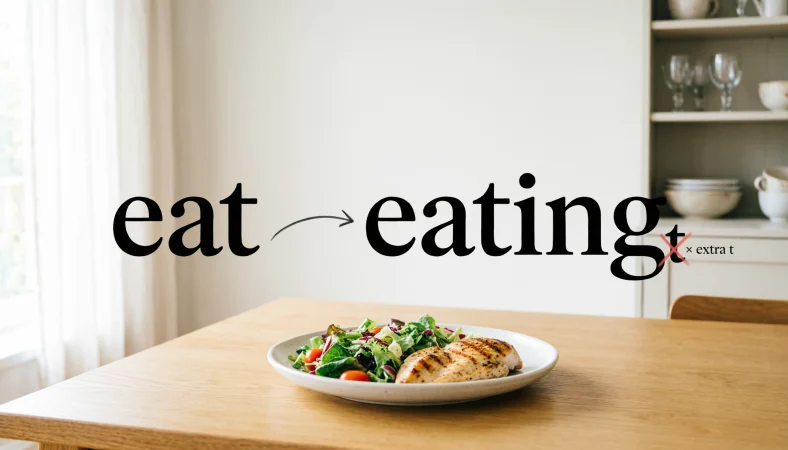
Eating is the correct spelling, while eatting is a common misspelling. Eating is the present participle of “eat,” meaning to consume food, as in “She is eating dinner.” The word is formed by adding ing to “eat” without doubling the final t, so you should always use eating in standard English.
Have you ever wondered whether the correct spelling is eatting or eating? This mistake is easy to make because many English verbs double their final consonant before adding ing, but “eat” does not follow that pattern. The correct form is eating, while “eatting” is not standard English.
This guide explains eating and eatting in simple, beginner friendly language, including the correct spelling rule, pronunciation, grammar, and practical examples. Understanding why the extra t is unnecessary will help you avoid this common spelling mistake and write with greater confidence.
Eatting or Eating: What’s the Difference?
The difference between eatting and eating is a spelling and word formation issue. Although the two forms look almost identical, only eating is the standard spelling in modern English.
The confusion usually happens because English sometimes doubles a final consonant before adding ing. For example, run becomes running, sit becomes sitting, and swim becomes swimming. Because learners recognize this pattern, they may incorrectly assume that eat should become eatting.
It does not.
The correct form is eating, with only one t.
What Does Eating Mean?
Eating is the present participle and gerund form of the verb eat.
The verb eat means to consume food or, in some contexts, to consume something in a broader sense.
Examples include:
I am eating breakfast.
She is eating an apple.
Eating slowly can make a meal more enjoyable.
The word eating can therefore function in different grammatical roles.
As part of a continuous verb phrase:
They are eating dinner.
As a gerund:
Eating before exercise may affect how you feel.
What Does Eatting Mean?
Eatting is not the standard English spelling.
It is generally a spelling mistake created by incorrectly applying the consonant doubling rule.
| Form | Status | Meaning | Example |
| Eating | Correct | Consuming food or the act of consuming food | She is eating lunch. |
| Eatting | Incorrect | Intended as a form of eat | She is eatting lunch. |
The important point is simple: eat becomes eating, not eatting.
Quick Recap
Eating is the correct spelling.
Eatting is a misspelling.
The verb eat does not double its final consonant before ing.
Use eating in formal, academic, professional, and casual writing.
Is Eatting or Eating a Grammar, Vocabulary, or Spelling Issue?
This is primarily a spelling and word formation issue, although understanding the grammar behind the word helps explain why the correct form is eating.
The underlying verb is eat. When English adds the suffix ing, the spelling changes to eating.
The two forms are not interchangeable.
Are Eatting and Eating Interchangeable?
No.
Eating is the standard English form.
Eatting should not be used in standard written English.
You may occasionally see eatting in informal online posts, comments, messages, or user generated content. Its appearance in those settings does not make it a standard spelling.
For schoolwork, professional communication, websites, applications, reports, and other edited writing, use eating.
Formal Versus Informal Usage
The correct form remains eating in both formal and informal English.
For example:
Formal: The participants were eating breakfast before the examination.
Casual: We’re eating pizza tonight.
The tone changes, but the spelling does not.
Academic Versus Casual Usage
Academic writing also uses eating.
Eating a balanced diet is an important part of maintaining overall nutritional health.
Casual writing uses the same spelling:
I’m eating right now.
The difference is the sentence style, not the spelling of the word.
How to Use Eating Correctly
The word eating appears frequently in everyday English because eating is a common human activity. It can describe something happening now, a repeated activity, or the general activity of consuming food.
Workplace Example
We were eating lunch when the meeting reminder appeared.
Here, eating forms part of the past continuous structure were eating.
Another example is:
Employees should avoid eating at their desks when company policy prohibits it.
In this sentence, eating functions as a gerund.
Academic Example
Eating a nutritious breakfast may influence energy levels during the morning.
Here, eating a nutritious breakfast functions as the subject of the sentence.
Another example:
Researchers examined eating habits among university students.
In this example, eating habits refers to patterns associated with food consumption.
Technology Example
The fitness application records information about eating habits.
Technology related writing can use eating naturally when describing health applications, food tracking systems, dietary tools, and similar software.
For example:
The app allows users to record what they are eating throughout the day.
Usage Recap
Use eating when you need the ing form of eat.
It can appear in continuous verb forms:
I am eating.
It can also function as a gerund:
Eating late may affect sleep.
It can also modify another noun:
eating habits
Why Is Eating Spelled With One T?
The most useful way to understand the spelling is to look at the structure of the base verb.
The base form is:
eat
Add ing:
eat + ing = eating
Nothing requires the final t to be doubled.
This is different from verbs such as sit.
sit + ing = sitting
Or:
run + ing = running
Why does this happen?
English spelling rules often double a final consonant when a short stressed vowel pattern appears before that consonant, particularly in certain one syllable verbs.
The verb eat does not fit that pattern.
The spelling of eat contains the vowel combination ea, which represents the long vowel sound in the standard pronunciation of the word. The final t therefore remains single when ing is added.
This is why:
eat → eating
not:
eat → eatting
Understanding the pattern is more useful than memorizing the individual word because it helps explain why some verbs double their final consonant while others do not.
When You Should NOT Use Eatting or Eating
Although eating is the correct spelling, there are several situations in which writers commonly make mistakes.
1. Do Not Write Eatting in Standard English
The most basic rule is straightforward.
Incorrect:
I am eatting dinner.
Correct:
I am eating dinner.
2. Do Not Double the T Because of Running
The fact that running has two n letters does not mean every verb ending in a consonant should double that consonant.
Compare:
run → running
with:
eat → eating
3. Do Not Use Eatting in Academic Writing
Academic writing requires standard spelling.
Incorrect:
The students were eatting before the lecture.
Correct:
The students were eating before the lecture.
4. Do Not Assume Online Usage Makes a Spelling Standard
Search engines, social platforms, comments, and informal messages may contain misspellings. Seeing eatting online does not establish it as a standard variant.
5. Do Not Confuse Pronunciation With Spelling
The pronunciation of eating may make the word feel as though it has a stronger consonant sound, but pronunciation does not justify inserting another t.
6. Do Not Change the Spelling in Different Tenses
The correct forms include:
eat
eats
ate
eaten
eating
The ing form remains eating.
7. Do Not Treat Eatting as an Alternative Variant
Unlike some spelling differences between British and American English, eatting is not a standard regional spelling variant of eating.
8. Do Not Correctly Spell the Word in One Sentence and Misspell It Elsewhere
Consistency matters in professional writing. A spelling checker may catch eatting, but writers should also recognize the correct form themselves.
Common Mistakes and Decision Rules
The following examples show how the incorrect spelling can appear in ordinary sentences.
| Correct sentence | Incorrect sentence | Explanation |
| I am eating breakfast. | I am eatting breakfast. | The correct present participle is eating. |
| She is eating an apple. | She is eatting an apple. | Eat takes ing without doubling the t. |
| They were eating dinner. | They were eatting dinner. | The past continuous uses were eating. |
| Eating vegetables can be part of a balanced diet. | Eatting vegetables can be part of a balanced diet. | Eating functions as a gerund here. |
| We enjoy eating together. | We enjoy eatting together. | The correct gerund form is eating. |
| He stopped eating when the meeting began. | He stopped eatting when the meeting began. | Eating follows stopped in this sentence. |
Decision Rule
If you need the ing form of the verb eat, use eating.
Never add a second t to create eatting in standard English.
A simple memory trick is:
Eat plus ing equals eating.
The spelling stays visually close to the original verb.
Eating in Modern Technology and AI Tools
The word eating appears frequently in modern technology because many digital products deal with food, nutrition, health, fitness, and personal tracking.
A nutrition application might include a feature called eating habits.
A fitness assistant might ask:
What are you eating today?
An AI assistant could generate:
Here are some ideas for eating a balanced breakfast.
In these contexts, the spelling remains unchanged.
AI tools can also help identify spelling errors such as eatting, but users should still understand the underlying rule. Automated correction can fix a word without explaining why it is wrong.
For educational content, that distinction matters. Knowing the rule makes it easier to avoid the mistake when writing without automated assistance.
The same principle applies to grammar checkers, word processors, mobile keyboards, and search engines. Technology can identify an error, but understanding the correct formation provides stronger long term language control.
Etymology and Word Formation
The word eat is extremely old in English.
It comes from Old English etan, a verb meaning to consume food. Its history can be traced through related forms in other Germanic languages.
Modern English retains the basic verb eat, while several related forms developed over time:
eat
eats
ate
eaten
eating
The form eating is created by adding ing to eat.
This process does not require consonant doubling.
The spelling therefore reflects the standard formation:
eat + ing = eating
rather than:
eat + ting = eatting
The historical development of the word also helps explain why eat does not behave like a verb such as run when forming its present participle.
An Expert Style Principle for Remembering the Spelling
A useful language learning principle is:
“When forming the ing form of a verb, look at the spelling pattern of the base verb rather than automatically doubling its final consonant.”
This is particularly useful because English has several consonant doubling patterns.
For example:
stop → stopping
sit → sitting
plan → planning
But:
eat → eating
The goal is not to assume that every final consonant doubles. Instead, identify the spelling pattern of the base verb and apply the appropriate formation rule.
Two Practical Case Studies
Case Study One: Student Writing
Imagine a student writing an essay about nutrition.
The student writes:
Eatting breakfast can provide energy during the morning.
The sentence contains a spelling error. The intended form is:
Eating breakfast can provide energy during the morning.
The grammatical structure is already understandable, but the spelling error can reduce the professionalism of the work.
The correction is simple because the base verb is eat and its present participle is eating.
Case Study Two: Workplace Communication
Imagine an employee sending a message:
I am eatting lunch right now, so I will call you later.
The intended meaning is completely clear, but the spelling is incorrect.
The corrected version is:
I am eating lunch right now, so I will call you later.
The practical lesson is that the same spelling rule applies whether the sentence appears in a formal report, an academic assignment, an email, or a casual message.
The context changes the tone, but it does not change the standard spelling.
Error Prevention Checklist
Always Use Eating When
- You need the present participle of eat.
- You are forming a continuous verb phrase.
- You are using eat as a gerund.
- You are describing eating habits or eating behavior.
- You are writing formal or professional English.
Never Use Eatting When
- You are writing standard English.
- You are completing an academic assignment.
- You are writing professional communication.
- You are publishing edited content.
- You mean the present participle of eat.
Quick Memory Test
If you can replace the word with another ing form of eat, the spelling should be eating.
I am eating.
She was eating.
They enjoy eating.
All three use the same spelling.
Related Grammar Confusions You Should Master
Once you understand eating, several related spelling and word formation topics become easier.
Ate vs Eaten
Ate is the simple past form of eat, while eaten is the past participle.
Eat vs Eats
Eat is used with subjects such as I, you, we, and they in the simple present. Eats is used with third person singular subjects.
Run vs Running
This is a useful comparison because run doubles its final consonant before ing.
Sit vs Sitting
Sitting demonstrates another common consonant doubling pattern.
Make vs Making
Make loses its final silent e before ing.
Write vs Writing
Write becomes writing, not writeing.
Come vs Coming
Come becomes coming because the final silent e is removed before ing.
Stop vs Stopping
Stop demonstrates consonant doubling before ing.
Plan vs Planning
Plan follows the consonant doubling pattern, unlike eat.
Read vs Reading
Reading keeps the base spelling of read while adding ing, although pronunciation changes according to tense and context.
FAQs
Is eatting or eating correct?
Eating is correct. Eatting is a misspelling and is not the standard present participle or gerund form of the verb eat.
Why is eating spelled with one t?
The verb eat does not meet the spelling conditions that require final consonant doubling before ing. Therefore, adding ing produces eating, not eatting.
Is eatting a word?
Eatting is not a standard English word. It is generally an incorrect spelling of eating.
What is the correct spelling of eat in ing form?
The correct ing form of eat is eating.
Why is running double n but eating does not double t?
Running comes from run, which follows a consonant doubling pattern when ing is added. Eat does not follow that pattern, so it becomes eating.
Is eating a verb or a noun?
Eating can function in more than one grammatical way. It can be part of a continuous verb phrase, as in “She is eating,” or function as a gerund, as in “Eating slowly can be helpful.”
How do you spell eating correctly?
Spell it eating. Start with eat and add ing without adding another t.
Is eatting an acceptable spelling in informal English?
It may appear as a typographical error in informal online writing, but it is not considered a standard spelling. Eating should be used in both formal and informal standard English.
What is the easiest way to remember eating vs eatting?
Remember the simple formation eat plus ing equals eating. The final t stays single.
Conclusion:
When choosing between eatting and eating, the correct standard form is eating. It is the present participle and gerund form of eat, and it does not require a second t.
The mistake often comes from applying consonant doubling rules too broadly. Words such as running, sitting, and stopping demonstrate valid doubling patterns, but eat follows a different spelling pattern.
For academic writing, workplace communication, websites, messages, and everyday standard English, use eating.
The easiest rule to remember is simple:
eat + ing = eating.










4 thoughts on “Eatting Or Eating: Which Spelling Is Correct In English For 2026?”