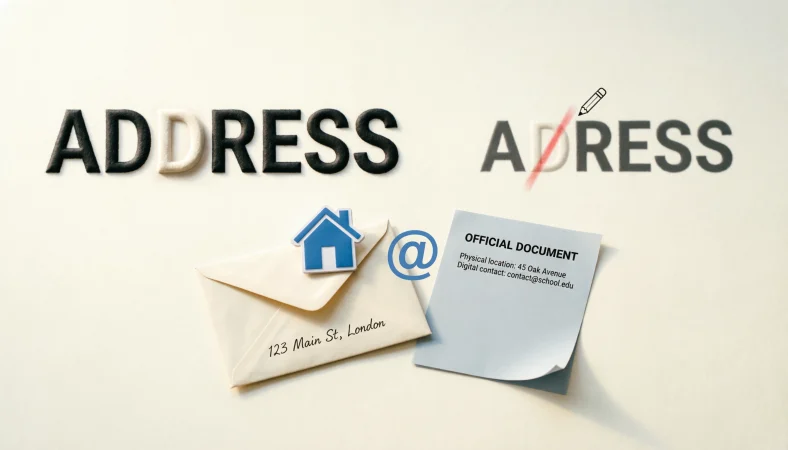
The correct spelling is address. It can refer to a location, the act of speaking to someone, or the act of dealing with an issue. Adress is a common spelling mistake and is not the standard English spelling. Remembering the double d makes the word easier to use correctly in writing.
The confusion between address or adress is common because English spelling does not always make pronunciation obvious. The word address contains two consecutive d letters, while adress contains only one. Although the incorrect form may look natural when typed quickly, it can create errors in emails, forms, academic work, business documents, and online searches.
Understanding the difference is simple once you connect the spelling with the word’s different meanings. Address can function as a noun or a verb, and its meaning changes according to context. As a noun, it can identify a place or a formal speech. As a verb, it can mean speaking to someone, writing information on something, or dealing with a problem.
Knowing this distinction helps you avoid one of the most frequent spelling errors involving a common everyday English word.
Address or Adress: What’s the Difference?
The central issue is spelling rather than meaning. Address is the standard English word, while adress is an incorrect spelling in standard modern English.
The word address has several important uses. You may use it to identify where a person lives, where a company operates, or where a particular building can be found. You can also use it as a verb when you speak directly to someone or deal with a problem.
For example:
Please send the package to my home address.
Here, address is a noun because it identifies a location.
Now consider:
We need to address the problem before the meeting.
Here, address is a verb because it means to deal with or respond to an issue.
The spelling remains the same in both cases.
| Word | Standard spelling | Part of speech | Main meaning | Example |
| address | Correct | Noun | A location or place where someone can be contacted | What is your mailing address? |
| address | Correct | Verb | To speak to, write to, or deal with something | We should address this concern. |
| adress | Incorrect | Not standard | Common spelling mistake | Please write the correct address. |
The key point is straightforward. Address is correct in standard English.
Adress is not an alternative spelling.
The double d appears in the beginning and middle of the word.
The pronunciation may make the spelling easy to forget, but the written form remains address.
Is Address or Adress a Grammar, Vocabulary, or Spelling Issue?
The difference between address and adress is primarily a spelling issue. It is not a difference between two meanings, grammatical structures, or varieties of English.
If someone writes adress when they mean address, readers can usually understand the intended meaning. However, that does not make adress correct. Standard English requires address.
This distinction matters because spelling errors can affect how polished a piece of writing appears. In casual messaging, a typo may be ignored. In a job application, academic assignment, business letter, official form, or professional email, repeated spelling mistakes can make the writing appear less careful.
Are address and adress interchangeable?
No. They are not interchangeable.
Address is the accepted spelling. Adress is generally treated as a misspelling.
You should therefore write:
What is your address?
Not:
What is your adress?
You should also write:
I will address your concerns.
Not:
I will adress your concerns.
Formal and informal usage
The spelling does not change according to formality. Address is correct in both casual and formal English.
You can use it in a text message:
Send me your address.
You can use it in professional correspondence:
Please confirm your current mailing address.
You can use it in academic writing:
The study addresses several limitations in previous research.
The form remains address in every context.
Academic and casual writing
Casual writing sometimes contains typing errors, abbreviations, or informal spellings. That does not create a separate standard spelling for address.
In academic writing, the correct spelling becomes especially important because accuracy is part of clear communication.
How to Use Address Correctly
Address is an extremely flexible word. Learning its major uses is more helpful than simply memorizing its spelling.
Address as a noun for a location
The most familiar meaning is a physical or mailing location.
Please enter your full address on the application.
The delivery driver could not find the address.
I changed my address after moving to another city.
In these examples, address identifies a place associated with a person, home, office, or organization.
Address as a noun for written or spoken communication
Address can also refer to a formal speech or presentation.
The president gave an address to the audience.
The university invited her to deliver the opening address.
This meaning is common in formal contexts.
Address as a verb meaning to speak to someone
The verb address can mean to speak directly to a person or group.
The teacher addressed the students before the examination.
She addressed the audience after the ceremony.
This use often appears in speeches, meetings, classrooms, and public communication.
Address as a verb meaning to deal with an issue
Another very common meaning is to deal with, respond to, or take action concerning something.
The company needs to address the customer’s complaint.
The report addresses several important questions.
We must address the problem quickly.
This meaning appears frequently in business, academic, technical, and professional writing.
Address as a verb for written communication
You can also address a letter, package, or envelope to someone.
She addressed the envelope to her friend.
Here, address means to write the necessary recipient information on an item being sent.
Workplace example
The manager said the company would address the scheduling problem.
Here, address means deal with or respond to.
Academic example
This research addresses the question of how language changes over time.
Here, address means examine or deal with a subject.
Technology example
The application uses an email address to identify the account.
Here, address refers to information used to identify an electronic destination.
Usage recap
Address can describe a location, a formal speech, direct communication, or the act of dealing with an issue. Its meaning depends on the sentence, but its spelling does not change.
How Adress Is Used Incorrectly
Because adress is not the standard spelling, it should not be used in standard English writing.
A person may type it accidentally because the word is pronounced quickly and the second d can be overlooked. This is especially common when someone is typing from memory rather than checking the spelling.
Consider these examples:
Incorrect: Please confirm your adress.
Correct: Please confirm your address.
Another example:
Incorrect: The manager will adress the issue.
Correct: The manager will address the issue.
The same correction applies regardless of meaning.
Workplace example
Incorrect:
Please send your current adress to Human Resources.
Correct:
Please send your current address to Human Resources.
Academic example
Incorrect:
The paper will adress the causes of language change.
Correct:
The paper will address the causes of language change.
Technology example
Incorrect:
Enter your email adress.
Correct:
Enter your email address.
Usage recap
Adress should not be treated as a variant spelling. When you see it in your writing, replace it with address.
When You Should Not Use Adress
There are several situations in which writers commonly produce the incorrect spelling.
1. When entering a mailing location
Write:
Enter your mailing address.
Not:
Enter your mailing adress.
2. When providing an email location
Write:
Please confirm your email address.
Not:
Please confirm your email adress.
3. When discussing a problem
Write:
The team needs to address the issue.
Not:
The team needs to adress the issue.
4. When referring to a formal speech
Write:
She delivered an address at the ceremony.
Not:
She delivered an adress at the ceremony.
5. When writing to a person
Write:
The letter was addressed to the director.
Not:
The letter was adressed to the director.
6. When discussing academic subjects
Write:
The article addresses an important research question.
Not:
The article adresses an important research question.
7. When writing professional correspondence
Write:
Please address your response to the department manager.
Not:
Please adress your response to the department manager.
8. When completing online forms
Write:
Home address
Not:
Home adress
Common Mistakes and Decision Rules
The most useful way to avoid this error is to recognize that address always contains two d letters.
| Correct sentence | Incorrect sentence | Explanation |
| What is your address? | What is your adress? | Address is the standard spelling. |
| Please address the problem. | Please adress the problem. | The verb also uses two d letters. |
| Enter your email address. | Enter your email adress. | The same spelling applies to electronic addresses. |
| She gave an address. | She gave an adress. | Address is also the correct noun for a formal speech. |
| The letter was addressed to him. | The letter was adressed to him. | The double d remains before the ending. |
Decision Rule Box
If you mean a location, communication directed to someone, a formal speech, or dealing with an issue, use address.
Do not use adress as an alternative spelling.
A useful memory trick is to think of the word as ad plus dress. You do not need to pronounce it that way, but the visual association can help you remember that the word contains two d letters.
Address in Modern Technology and AI Tools
The word address has become even more common because modern technology uses several kinds of addresses.
An email address identifies an electronic destination for messages. A web address identifies a location on the internet. A physical address identifies a real world location. Computer systems can also use different forms of address information to identify devices, memory locations, or network destinations.
AI tools may encounter address in several contexts as well. For example, an AI assistant might help a user format a mailing address, correct an email address, or rewrite a sentence containing the verb address.
This creates an important distinction between meaning and spelling. Technology may use address in many different ways, but the spelling remains the same.
For example:
Please update your billing address.
Here, address refers to a location.
The software uses the server address to connect to the service.
Here, address refers to a technical destination.
The report addresses the security concern.
Here, address is a verb meaning to deal with something.
AI systems can recognize these different meanings from context, but writers still need to use the standard spelling.
Why Address Has Two Different Meanings
One reason address can feel confusing is that the word developed several related meanings over time.
The noun address became associated with the manner of directing speech toward someone. From there, it developed connections with a formal speech or communication directed toward an audience.
The location meaning developed from the idea of directing something toward a particular destination. A letter or package is addressed to a particular person at a particular place. Eventually, the term address became strongly associated with the location itself.
These meanings may appear unrelated at first, but they share an underlying idea: directing something toward a particular person, place, or subject.
That connection explains why address can refer both to a physical location and to dealing with a problem.
An Expert Style Explanation
A useful way to understand the word is:
“Address changes meaning according to context, but its standard spelling remains consistent.”
This captures the main lesson. Whether address refers to a home, an email destination, a speech, a person, or a problem, the spelling does not become adress.
Good spelling depends on recognizing the stable written form even when the word has several meanings.
Two Practical Case Studies
Case Study 1: Professional email
Imagine an employee preparing a message for a customer. The employee writes:
Please confirm your email adress so we can update your account.
The meaning is understandable, but the spelling is incorrect. Changing the sentence to:
Please confirm your email address so we can update your account.
removes the spelling error without changing the meaning.
This example shows why the mistake matters in professional communication. A single missing letter may not prevent understanding, but correct spelling creates cleaner and more reliable written communication.
Case Study 2: Academic writing
Consider a student writing:
This chapter will adress the main causes of language change.
The intended meaning is clear, but the spelling is incorrect. The corrected sentence is:
This chapter will address the main causes of language change.
The correction is especially useful because address is a common academic verb. Students regularly use it when discussing research questions, problems, limitations, arguments, and topics.
The practical result is simple: recognizing address as the standard spelling prevents the same error across many different types of writing.
Error Prevention Checklist
Always use address when
- You mean a home or business location.
- You mean an email location.
- You mean a web or technical destination.
- You mean a formal speech.
- You mean speaking directly to someone.
- You mean dealing with a problem or subject.
- You mean writing recipient information on a letter or package.
Never use adress when
- You are writing formal or academic English.
- You are completing an official form.
- You are writing a professional email.
- You are describing a physical or electronic location.
- You are using address as a verb.
- You are discussing a speech or formal communication.
The simplest rule is to remember the double d in address.
Related Spelling Confusions You Should Master
If you are improving your English spelling, several other common word pairs deserve attention.
receive or recieve: Receive is the standard spelling.
separate or seperate: Separate is correct.
definitely or definately: Definitely is correct.
necessary or neccessary: Necessary is correct.
accommodation or accomodation: Accommodation is correct.
beginning or begining: Beginning uses two n letters.
occurred or occured: Occurred uses two r letters.
successful or succesful: Successful contains two c letters and two s letters.
tomorrow or tommorow: Tomorrow is the standard spelling.
embarrass or embarass: Embarrass contains two r letters and two s letters.
These examples show a broader lesson about English spelling. Pronunciation alone does not always tell you exactly how a word should be written.
FAQs
What is the correct spelling, address or adress?
The correct spelling is address. It contains two d letters. Adress is a common misspelling and is not the standard spelling used in English.
Is adress a real English word?
Adress is not the standard English spelling of the word. In ordinary modern English writing, use address instead.
Why do people spell address as adress?
The error usually happens because people type the word quickly, rely on pronunciation, or forget the second d. The pronunciation does not make the double d especially noticeable.
Is address a noun or a verb?
Address can be both a noun and a verb. As a noun, it can mean a location or a formal speech. As a verb, it can mean speaking to someone, directing something to someone, or dealing with an issue.
How do you spell address correctly?
Spell it address. A simple visual reminder is that the word contains two d letters.
Is address correct in American and British English?
Yes. Address is the standard spelling in both American and British English. The spelling does not change between these major varieties of English.
What is the difference between address and adress?
Address is the correct standard spelling. Adress is an incorrect spelling. There is no standard meaning difference between them.
How do you use address in a sentence?
You can write, “Please send the package to my address.” You can also write, “We need to address the problem.” The first example uses address as a noun, while the second uses it as a verb.
Is email address spelled with two d letters?
Yes. The correct expression is email address. The word address keeps both d letters in this expression.
Why does address have two meanings?
The meanings developed around the idea of directing something toward a particular person, place, audience, or subject. This explains its use for locations, speeches, communication, and problems.
Conclusion:
When choosing between address or adress, always use address. The standard spelling contains two d letters, whether the word refers to a physical location, an email location, a formal speech, communication with someone, or the act of dealing with an issue.
The spelling adress should be treated as an error rather than an alternative form. Once you remember the double d, the distinction becomes easy to apply.
Correct spelling matters most when the word appears in professional, academic, technical, or official writing. A quick spelling check can prevent a small error from appearing repeatedly across a document.
The most useful rule is simple: address is correct, and adress is not.











2 thoughts on “Address Or Adress: Which Spelling Is Correct In English In 2026?”