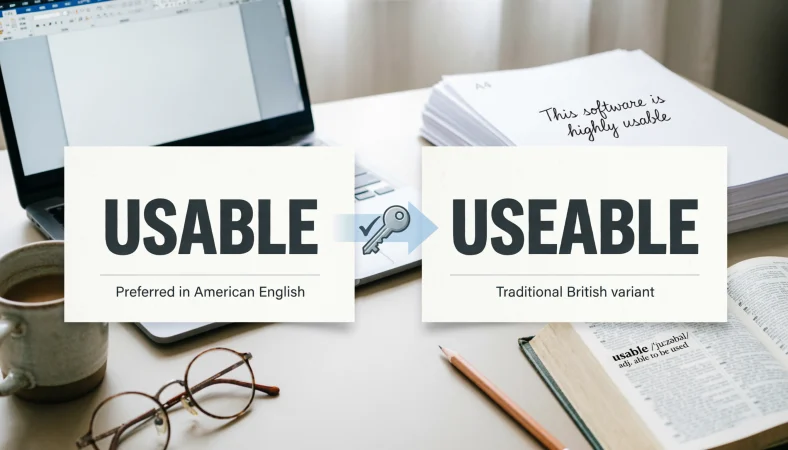
The standard spelling is useable or usable? Both forms are accepted, but usable is the more common and generally preferred spelling in modern English. Both adjectives mean suitable or practical for use. Useable is not incorrect, but it appears less frequently and can sometimes look less natural, especially in polished professional, academic, and technical writing.
The spelling useable or usable often causes confusion because both forms follow understandable spelling patterns. English speakers may expect useable because the word comes from use plus the suffix able, while usable drops the extra letter.
That small difference can make writers wonder whether one form is wrong, whether pronunciation changes, or whether one spelling belongs specifically to British or American English. In most situations, however, the distinction is mainly one of spelling preference and usage frequency rather than meaning.
Useable or Usable: What’s the Difference?
Both usable and useable are adjectives. They describe something that can be used successfully, conveniently, or practically.
The important point is that the two words do not normally express different meanings. If something is usable, it is suitable for use. If something is useable, it generally means the same thing.
| Word | Part of speech | Meaning | Commonness | Best use |
| Usable | Adjective | Suitable or practical for use | More common | General, professional, academic, and technical writing |
| Useable | Adjective | Capable of being used | Less common | Acceptable when this spelling is preferred or retained |
For most readers, usable will look more familiar and natural.
For example:
The software has a simple and usable interface.
You could also write:
The software has a simple and useable interface.
The second sentence is understandable and grammatically acceptable, but the first is generally the stronger choice for contemporary writing.
A quick recap
Usable is the preferred spelling for most situations.
Useable is also an established spelling and is not automatically wrong.
The two forms generally have the same meaning.
Professional and technical writing usually benefits from choosing usable for consistency and familiarity.
Is Useable or Usable a Grammar, Vocabulary, or Usage Issue?
The difference between useable and usable is primarily a spelling and usage issue. It is not a major grammar distinction because both words function as adjectives and can describe something that is suitable for use.
Consider these examples:
The equipment is usable.
The equipment is useable.
Both sentences communicate essentially the same idea.
The difference becomes more noticeable when you consider frequency and style. Usable has become the dominant spelling in contemporary English, particularly in fields such as software design, technology, product development, education, and business communication.
Are the two words interchangeable?
In many sentences, yes.
You can say:
We need a usable solution.
Or:
We need a useable solution.
The meaning remains substantially unchanged.
However, interchangeable does not always mean equally preferable. A word can be grammatically acceptable while still being less common or less stylistically appropriate for a particular audience.
That is the situation here. Useable is recognized English, but usable is usually the safer choice when you want the spelling most readers expect.
Formal writing
In formal writing, usable is generally preferable because it is concise, familiar, and widely established.
For example:
The report should provide usable recommendations for managers.
This sounds natural in a professional report.
The alternative is possible:
The report should provide useable recommendations for managers.
It is not necessarily incorrect, but some readers may find it visually less familiar.
Academic writing
Academic writers should normally favor usable unless a particular source, institution, publication, or style guide requires otherwise.
For example:
The researchers developed a usable framework for evaluating online learning tools.
Here, usable communicates the intended meaning clearly without drawing attention to spelling.
Casual writing
In everyday communication, either form is likely to be understood immediately. Most people, however, will encounter usable more often.
That makes usable the practical default.
What Does Usable Mean?
Usable means suitable, practical, or effective enough to be used for a particular purpose.
It comes from the verb use and the suffix able, which commonly forms adjectives describing something that can receive or support an action.
For example:
The instructions are usable.
This means the instructions are practical enough for someone to follow.
Another example is:
Is this information usable?
The question asks whether the information can actually serve a useful purpose.
The word can describe physical objects, information, systems, services, software, methods, and many other things.
Workplace example
Imagine a company receives a large spreadsheet containing customer information. The data may technically exist, but if it is badly organized, employees may struggle to work with it.
A manager might say:
The new report is much more usable than the old one.
Here, usable means the report is easier or more practical to use.
Academic example
A researcher might develop a framework that helps students evaluate sources.
The study presents a usable framework for assessing online information.
The framework is not merely theoretical. It can actually be applied.
Technology example
Technology is one of the areas where usable appears particularly often.
For example:
The application has a clean and usable interface.
In this context, usable can relate to ease of use, accessibility, clarity, efficiency, and practical functionality.
Usage recap
Use usable when something can be used effectively or practically.
It can describe an object, method, system, idea, resource, interface, or piece of information.
It is especially natural in professional and technical contexts.
What Does Useable Mean?
Useable has essentially the same meaning as usable. It means capable of being used or suitable for use.
For example:
The damaged equipment is still useable.
The writer means that the equipment can still be used despite its condition.
The spelling may seem logical because it visibly contains the word use followed by able. That makes it easy to understand why people choose it.
However, English spelling does not always preserve every letter of a base word when suffixes are added. This is one reason usable developed as the more common spelling.
Workplace example
We need a useable version of the document before the meeting.
The sentence is understandable, and the adjective performs the same grammatical function as usable.
Still, many professional editors would change it to:
We need a usable version of the document before the meeting.
Academic example
The researchers created a useable model for analyzing the results.
Again, the meaning is clear. Yet usable model would generally be the more conventional modern form.
Technology example
The website is attractive but not very useable.
This spelling can certainly be encountered, but usable is more common in discussions of interface design and user experience.
Usage recap
Useable is an accepted spelling in English.
It normally means the same thing as usable.
It is less common, so usable is generally the better default choice.
Why Is Usable More Common Than Useable?
The difference becomes easier to understand when you look at English word formation.
The word usable is connected to use, but English does not always retain the final letter of a base word when adding a suffix. In this case, the spelling settled into the shorter form usable, which has become widely established.
There is also a practical reason for the preference.
English tends to favor familiar, economical forms when two spellings communicate the same meaning. Over time, usable became much more common in dictionaries, published writing, technical communication, software documentation, and general prose.
That does not make useable meaningless or automatically incorrect.
Instead, it means that modern readers are more likely to recognize usable as the standard everyday form.
A useful comparison is usable versus usable looking in design discussions. Writers who work in technology, user experience, accessibility, and product development will encounter usable frequently because usability is a central concept in those fields.
When You Should NOT Use Useable or Usable
There are several situations where choosing the right spelling is not the only concern. Sometimes the adjective itself does not express what you actually mean.
1. Do not use usable when you mean valuable
Something can be usable without being particularly valuable.
The old computer is usable.
This says the computer can still function for some purpose. It does not necessarily say that keeping it is worthwhile.
2. Do not use usable when you mean attractive
A product can look beautiful but still be difficult to operate.
The website is attractive but not very usable.
Here, the contrast is intentional.
3. Do not use usable when you mean available
Something can be available without being practical.
The information is available, but it is not easily usable.
Availability and usability are related but different ideas.
4. Do not assume usable means easy
Something may be usable while still requiring training or experience.
For example:
The system is usable after a short training session.
This does not necessarily mean that every person will find it immediately easy.
5. Do not use useable simply because it resembles use
The visual logic of useable is understandable, but frequency matters in modern writing. When there is no special reason to choose it, usable is normally preferable.
6. Do not switch spellings randomly
Consistency matters. If a document uses usable, do not alternate between usable and useable without a reason.
7. Do not treat the forms as different levels of quality
There is no reliable rule saying that usable means highly practical while useable means barely functional. The spelling does not create that semantic distinction.
Common Mistakes and Decision Rules
| Correct sentence | Incorrect or less preferred sentence | Explanation |
| The tool is usable. | The tool is useable. | The second form is possible, but the first is more common. |
| We need a usable interface. | We need a useable interface. | Usable is the usual modern spelling in technology writing. |
| The data is still usable. | The data is still useable. | Both can communicate the same idea, but usable is more familiar. |
| This method is usable in practice. | This method is useable in practice. | Usable is normally preferred in formal prose. |
| The instructions are usable. | The instructions are useable. | Both are understandable, but usable is the standard choice for most writers. |
Decision Rule Box
If you mean something can be used or is practical for use, choose usable in most situations.
If you encounter useable, understand it as an accepted alternative spelling rather than automatically treating it as an error.
The most useful rule is therefore simple: write usable unless you have a specific reason to preserve useable.
Useable or Usable in Modern Technology and AI Tools
The word usable has become especially important in technology because modern products are evaluated not only by whether they function, but also by whether people can use them effectively.
A piece of software may technically work while still being difficult to navigate. An artificial intelligence tool may generate accurate information but present it in a confusing way. A website may contain everything a visitor needs but bury important functions beneath complicated menus.
In these situations, usable describes practical interaction.
For example:
The AI assistant provides accurate answers, but its interface needs to be more usable.
Here, usability concerns the experience of interacting with the system.
The same principle applies to accessibility. A digital product should not merely exist or function. People should be able to understand and operate it.
That is why usable is common in discussions involving interface design, user experience, accessibility, software documentation, digital products, and online services.
What about useable in technology?
You may still encounter useable, especially in older material, individual writing, or contexts where the writer prefers that spelling.
It does not suddenly acquire a different technical meaning.
For consistency with current technology writing, however, usable is normally the stronger choice.
The Etymology of Usable and Useable
Understanding the history of these forms helps explain why both spellings exist.
The verb use has a long history in English and ultimately traces back through French and Latin influences. English later developed adjective formations using able, a suffix associated with capability or suitability.
The resulting adjective could naturally be interpreted as meaning something capable of being used.
The spelling usable became firmly established as the dominant modern form. Useable remains understandable because it follows the visible structure of use plus able.
This is a good example of how English spelling can preserve more than one form even when one version becomes much more common.
The existence of a less common spelling does not necessarily indicate an error. English contains many pairs in which usage frequency determines what readers consider the most natural form.
What Do Dictionaries and Style Experts Generally Suggest?
A useful principle in professional editing is to distinguish between incorrect and less preferred.
Calling useable simply wrong would oversimplify the situation. The form exists and can be understood without difficulty.
However, if your goal is clear modern English, usable is usually the better choice.
An editor might summarize the distinction this way:
“Choose the form your readers are most likely to recognize immediately.”
That principle is especially useful for websites, educational material, software documentation, business writing, and other content intended for a broad audience.
The goal is not merely grammatical correctness. Good word choice also reduces friction for the reader.
Real World Usage Examples
Consider how the two spellings work in ordinary sentences.
Example 1: Product design
The new device has a much more usable control panel.
This suggests that users can operate the controls more effectively.
Example 2: Education
The teacher created a usable study guide for the examination.
The study guide has practical value for students.
Example 3: Business
The company needs usable data before making the decision.
The information must be in a form that can actually support the decision.
Example 4: Software
The update made the application more usable for new customers.
The software became easier or more practical to use.
Example 5: Physical object
Although the chair is scratched, it is still usable.
The object remains functional enough to serve its purpose.
These examples show why usable is such a versatile adjective. It does not necessarily describe perfection. Something only needs to be suitable enough for practical use.
Usable Does Not Always Mean Easy
One subtle distinction deserves attention.
Usable and easy to use are related, but they are not identical.
Suppose a professional editing program has hundreds of advanced features. It may take several hours to learn, yet experienced users might consider it highly usable because its controls are organized logically and support efficient workflows.
In contrast, a simple application might be easy to understand at first but become frustrating during extended use.
Therefore, usability can include several qualities:
| Quality | Relationship to usability |
| Clarity | Helps users understand what to do |
| Efficiency | Helps users complete tasks effectively |
| Accessibility | Allows more people to interact with the product |
| Consistency | Makes controls and behavior easier to predict |
| Practicality | Allows the product to serve its intended purpose |
| Learnability | Helps new users understand the system |
This broader meaning explains why usable appears so often in professional discussions of products and services.
How to Choose Between Useable and Usable
If you are writing an email, article, report, academic paper, website, product description, or technical document, the simplest approach is to choose usable.
Ask yourself whether you mean:
Can this be used?
If the answer is yes, usable will normally work.
If you are editing someone else’s writing and encounter useable, consider the context before changing it. It is not necessarily a serious spelling mistake. If the publication follows a particular house style, consistency may matter more than personal preference.
For general contemporary English, though, usable offers the clearest and most familiar option.
Error Prevention Checklist
Always use usable when
- You are writing for a general audience.
- You are preparing professional or academic content.
- You are writing software documentation.
- You are discussing user experience or interface design.
- You want the most familiar modern spelling.
- You are unsure which form to choose.
Never assume useable means
- A different level of usefulness.
- A different pronunciation.
- A different grammatical category.
- A specifically British meaning.
- A specifically American meaning.
- A completely incorrect spelling.
The spelling difference does not normally create a difference in meaning.
Related Grammar Confusions You Should Master
If you are interested in spelling and usage distinctions like useable or usable, several other English pairs are worth learning.
1. Advisable or Advisable
Some adjective formations create uncertainty about how suffixes interact with their base words.
2. Dependable or Dependible
Suffix spelling can become confusing when a familiar base word changes slightly during word formation.
3. Noticeable or Noticeible
Words ending in certain suffixes often create uncertainty about vowel combinations.
4. Manageable or Manageble
The spelling of words formed with able can require attention to the final letters of the base word.
5. Lovable or Loveable
This pair demonstrates how English spelling can preserve alternative forms while one becomes more common.
6. Inflatable or Inflatable
Words ending in able can sometimes look unusual even when their spelling follows established patterns.
7. Usability or Useability
The noun usability is particularly common in technology and design. It refers to the quality or extent to which something can be used effectively.
8. Practical or Practicable
These words are related but are not always interchangeable. Practical often describes something useful or realistic, while practicable can emphasize feasibility.
9. Effective or Efficient
Both can describe successful performance, but they focus on different aspects of results and resource use.
10. Useful or Usable
Something can be usable without being especially useful, so these adjectives should not be treated as exact synonyms.
FAQs
Is usable or useable correct?
Both usable and useable are accepted English spellings. However, usable is much more common in contemporary writing and is generally the preferred choice for professional, academic, technical, and general use.
Is useable a misspelling of usable?
Not necessarily. Useable is an established alternative spelling, so it should not automatically be classified as a spelling error. Nevertheless, usable is the more familiar and widely preferred modern form.
Is usable more correct than useable?
For most modern writing, usable is the better choice because it is more common and widely recognized. That does not mean useable has no legitimate use.
What does usable mean?
Usable means suitable, practical, or capable of being used for a particular purpose. It can describe objects, information, software, systems, methods, services, and other resources.
What does useable mean?
Useable generally means the same thing as usable. It describes something that can be used or is suitable for use.
Why is usable spelled without an e?
English word formation does not always preserve every letter of a base word when a suffix is added. Usable became established as the dominant spelling, even though useable remains a logical and accepted alternative.
Should I use usable in academic writing?
Yes. Usable is generally the safer choice for academic writing because it is familiar, concise, and widely used. Always follow any specific style guide required by your institution or publication.
Is usable an adjective?
Yes. Usable is an adjective. It describes something that can be used effectively or practically.
Is useable pronounced differently from usable?
In ordinary modern English, the two spellings are generally pronounced the same or very similarly. The main difference is written rather than semantic.
What is the difference between usable and useful?
Usable means something can be used or is practical to use. Useful means something provides value or helps accomplish a purpose. A thing can be usable without being particularly useful.
Conclusion:
When deciding between useable or usable, choose usable in most situations. Both forms can express the idea of being capable of use or suitable for use, but usable is the more common and familiar spelling in contemporary English. It works naturally in everyday writing as well as professional, academic, technical, and digital contexts.
Useable should not automatically be treated as a spelling mistake. It is an established alternative, but its lower frequency makes it less likely to be the best choice when you want polished, widely recognized English. If you need one simple rule to remember, use usable unless a specific style, source, or editorial preference calls for useable.