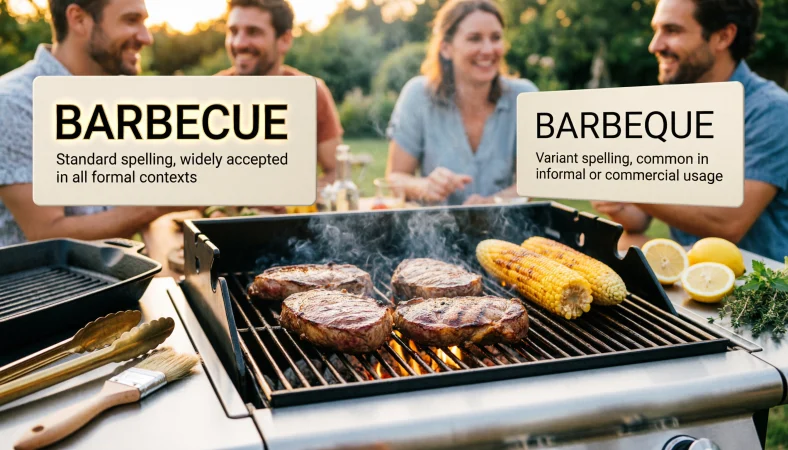
The standard spelling is barbecue, while barbeque is a common variant that appears in informal writing and commercial names. Both forms are understood to refer to cooking food over heat, usually outdoors, as well as the food or social event associated with it. For formal and standard English, barbecue is the preferred spelling.
The question of barbeque or barbecue comes up often because the word is commonly pronounced in a way that makes the shorter spelling seem natural. When people hear the word, the sound can easily lead them to write barbeque. That spelling feels logical, especially because English contains many words where the letters represent sounds in less predictable ways.
However, spelling conventions matter when you’re writing an article, menu, invitation, school assignment, business description, or product listing. Using the less standard form can make otherwise polished content look careless or inconsistent.
The confusion becomes even more interesting because barbeque is not simply a meaningless collection of letters. It has appeared in real English usage and can be found in names, branding, and informal contexts. Still, that does not make it the preferred standard spelling.
Understanding the difference is therefore less about pronunciation and more about knowing which form works best in standard English.
Barbeque vs Barbecue: What’s the Difference?
The two spellings refer to the same general concept, but they do not have equal status in standard English.
Barbecue is the standard spelling. It functions primarily as a noun and can also function as a verb.
As a noun, it can refer to a method of cooking, the food prepared using that method, or an outdoor social gathering centered around grilled or slowly cooked food.
For example:
We are having a barbecue this Saturday.
As a verb, barbecue describes the act of cooking food using a barbecue method.
We plan to barbecue chicken for dinner.
Barbeque is a variant spelling. It is widely recognizable, but it is generally less preferred in edited standard English. You may encounter it in business names, restaurant names, product branding, signs, advertisements, and informal writing.
| Spelling | Part of speech | Standard status | Typical meaning | Example |
| Barbecue | Noun | Standard | Outdoor meal, cooking method, or food | We had a barbecue yesterday. |
| Barbecue | Verb | Standard | To cook food using barbecue methods | They barbecue ribs on weekends. |
| Barbeque | Noun | Variant | Same general meaning as barbecue | The barbeque was crowded. |
| Barbeque | Verb | Variant | Same general meaning as barbecue | They barbeque meat outside. |
For most writing situations, barbecue is the better choice.
Quick recap
Barbecue is the standard spelling.
Barbeque is a recognized variant but is less common in standard edited writing.
Both forms can refer to cooking, food, or a social gathering.
When accuracy and professionalism matter, choose barbecue.
Is Barbeque vs Barbecue a Grammar, Vocabulary, or Usage Issue?
This is primarily a spelling and usage issue, not a grammar issue.
Grammar concerns how words work together in sentences. Both barbecue and barbeque can function as nouns and verbs, so the sentence structure itself does not determine which spelling is correct.
Consider these sentences:
We are having a barbecue.
We are having a barbeque.
The grammar of both sentences is understandable. The difference is spelling preference and standard usage.
In formal writing, barbecue is the safer choice because it is the established standard spelling. It is the form most appropriate for edited articles, educational materials, professional communication, menus, and general informational content.
Are the two spellings interchangeable?
They can be understood as referring to the same thing, but they are not equally preferred.
If you’re writing a casual message to a friend, barbeque will normally be understood without difficulty.
If you’re writing a professional article, school paper, restaurant menu, business page, or official document, barbecue is the stronger choice.
Formal versus informal usage
Formal writing generally favors barbecue.
Informal writing may contain barbeque, particularly because the spelling reflects how some speakers perceive the pronunciation.
There is also an important exception. A business may deliberately use Barbeque in its official name. In that situation, changing the spelling would mean changing the business name itself.
Academic versus casual usage
Academic writing should normally use barbecue.
Casual writing allows more flexibility, although choosing the standard spelling still makes the writing cleaner.
The same principle applies to digital content. A social media post may contain barbeque without causing confusion, but an educational article benefits from the standard form.
When Should You Use Barbecue?
Barbecue should be your default spelling whenever you want the standard form of the word.
It works in professional, academic, informational, and casual writing. It also works when the word functions as either a noun or a verb.
Workplace example
The company will host a barbecue for employees next Friday.
This sentence is appropriate for an internal announcement or workplace email.
Another example is:
We will barbecue the food at the outdoor company event.
Here, barbecue functions as a verb.
Academic example
Barbecue traditions vary significantly across different regions.
This spelling is appropriate in an essay discussing food culture, regional traditions, or cooking methods.
Technology example
Food delivery applications, recipe platforms, and smart cooking devices may use barbecue in their descriptions.
For example:
The smart thermometer helps users monitor meat while it is cooking on a barbecue.
The standard spelling makes the content immediately clear to a broad audience.
Usage recap
Choose barbecue when you want the standard English spelling.
It works for both noun and verb uses.
It is the safest option for professional, academic, commercial, and informational writing.
When Might You See Barbeque?
Barbeque is a variant spelling that appears in real world usage. It is especially noticeable in business names, restaurant branding, advertisements, signs, menus, and informal communication.
The spelling probably feels natural because it resembles the way many speakers pronounce the word. English spelling often develops in ways that do not perfectly match pronunciation, so people sometimes create alternative spellings based on what they hear.
For example:
We are going to a barbeque tonight.
A reader will understand the sentence immediately.
However, if you’re writing your own sentence rather than reproducing a proper name, barbecue remains the better standard choice.
Workplace example
A company might advertise:
Join us for our annual barbeque.
This may appear in casual promotional material. There is nothing about the meaning that prevents understanding, but a professionally edited version would normally use barbecue.
Academic example
An academic paper should generally avoid barbeque unless the spelling itself is being discussed or quoted as part of a proper name.
Technology example
A recipe application may contain user generated content with barbeque. That does not necessarily mean the application considers it the preferred spelling. User generated content often contains regional and informal variants.
Usage recap
Barbeque is understandable and established as a variant.
It can appear naturally in informal contexts.
For your own standard writing, however, barbecue remains the stronger choice.
When You Should NOT Use Barbeque or Barbecue
Knowing when not to use a spelling can be just as useful as knowing which spelling is preferred.
1. Do not use barbeque in formal writing when barbecue is intended
A school essay or professional report should normally use the standard spelling.
2. Do not change an official business name
If a restaurant officially spells its name Barbeque, preserve that spelling when referring to the business.
3. Do not assume barbeque is completely wrong
Calling it an impossible spelling would be inaccurate. It exists as a recognized variant and appears in real usage.
4. Do not use barbecue when copying an exact brand name
If a company has deliberately chosen Barbeque as part of its official name, reproduce the name accurately.
5. Do not confuse barbecue with a single cooking technique
Barbecue can describe different cooking traditions. Some involve slow cooking at relatively low temperatures, while others involve grilling over direct heat.
6. Do not assume every outdoor cooking method is technically barbecue
In everyday speech, people may call many forms of outdoor cooking a barbecue. Culinary terminology can be more specific.
7. Do not switch spellings randomly
Consistency matters. If an article uses barbecue throughout, suddenly using barbeque can look like a spelling error.
8. Do not let pronunciation determine spelling
The sound of a word does not always tell you its standard written form.
Common Mistakes and Decision Rules
| Correct sentence | Incorrect or less preferred sentence | Explanation |
| We are having a barbecue tonight. | We are having a barbeque tonight. | Barbecue is the standard spelling. |
| She loves barbecue chicken. | She loves barbeque chicken. | The standard spelling is preferred in edited writing. |
| They barbecue meat every weekend. | They barbeque meat every weekend. | Barbecue is the standard verb spelling. |
| The barbecue starts at six. | The barbeque starts at six. | The standard noun spelling is barbecue. |
| The restaurant serves barbecue ribs. | The restaurant serves barbeque ribs. | Standard food writing normally uses barbecue. |
| The restaurant is officially called Barbeque House. | The restaurant is officially called Barbecue House. | Preserve an official name exactly as the business uses it. |
Decision Rule Box
- If you are writing a normal English sentence, use barbecue.
- If you are reproducing a business name, product name, or other official name that uses barbeque, preserve that spelling.
- If you encounter barbeque in informal writing, understand it as a variant rather than automatically treating it as meaningless or unintelligible.
Barbeque and Barbecue in Modern Technology and AI Tools
Digital platforms have made spelling variations more visible.
Search engines, recipe applications, artificial intelligence systems, food delivery platforms, and social media sites encounter both forms. An AI system can generally understand that barbeque and barbecue are closely related, especially when the surrounding sentence clearly describes food or outdoor cooking.
However, understanding a variant is different from recommending it.
When generating polished content, an AI writing tool will usually benefit from selecting the standard spelling. This is particularly important for articles, recipes, menus, product descriptions, and educational material.
Search behavior can also include both spellings because users do not always search with the standard form. A well written article can acknowledge the variant while consistently using barbecue as the preferred spelling.
For content creators, the practical lesson is straightforward. Search engines can understand spelling variations, but clear standard language still improves readability and professionalism.
Where Did the Word Barbecue Come From?
The history of barbecue is more interesting than its spelling suggests.
The English word is generally traced to a term associated with Indigenous Caribbean language and early European descriptions of cooking methods in the Caribbean. Spanish writers recorded related forms, and the word eventually entered English.
Over time, the word developed several related meanings. It could refer to a cooking structure, a method of preparing food, the food itself, and eventually a social gathering centered around the meal.
The spelling also changed as the word moved between languages and varieties of English. This history helps explain why English has produced multiple forms, including barbecue and barbeque.
The letters in barbecue may look unusual to modern English speakers. That unusual appearance probably contributes to the popularity of alternative spellings.
Yet unusual spelling does not mean incorrect spelling. Many English words preserve historical patterns that no longer correspond neatly to modern pronunciation.
Why Is Barbecue Spelled That Way?
One reason barbecue causes confusion is its unusual combination of letters.
Many English speakers expect a word with the sound commonly associated with barbecue to have a simpler spelling. Barbeque appears more intuitive because the letters seem to represent the familiar pronunciation.
But English spelling is not purely phonetic.
Words often preserve historical spellings even after pronunciation changes. The standard spelling barbecue is one example of how historical vocabulary can produce a form that looks less predictable than the pronunciation.
This also explains why people may write barbeque without realizing they have departed from the preferred standard.
The important point is that spelling familiarity and spelling correctness are not always the same thing.
An Expert Perspective on Barbecue Usage
A useful principle for writers is to separate understandability from standard usage.
“A familiar variant can be understandable without being the preferred standard form.”
That distinction explains barbeque perfectly.
Readers usually understand what barbeque means. The spelling does not create a serious communication barrier. However, standard edited English generally favors barbecue.
Good writing is not simply about whether readers can understand a word. It is also about consistency, convention, audience expectations, and accuracy.
For that reason, writers should normally choose barbecue while recognizing that barbeque exists in everyday language and commercial usage.
Two Practical Case Studies
Case Study One: A Food Website
Imagine a recipe website preparing an article about outdoor cooking.
The writer uses barbeque throughout because that is the spelling they commonly see in social media posts. Readers can understand the article, but the inconsistent spelling may make the content appear less polished.
The editor changes the standard terminology to barbecue throughout the article.
The result is greater consistency and a more professional presentation without changing the meaning of the content.
The variant can still be mentioned when explaining the spelling question.
Case Study Two: A Restaurant Name
Now imagine a restaurant whose official name contains Barbeque.
An editor might be tempted to correct the name to Barbecue because the latter is the standard spelling. That would be a mistake.
Proper names should normally be reproduced accurately. Changing the spelling could make the business difficult to identify or create an incorrect reference.
The correct approach is to preserve the official name while using barbecue in the surrounding descriptive text when appropriate.
Error Prevention Checklist
Always use barbecue when
- You are writing standard English.
- You are preparing an academic assignment.
- You are writing an informational article.
- You are creating professional business content.
- You are describing barbecue food in a recipe.
- You are using the word as a noun or verb.
Use barbeque carefully when
- You are reproducing an official name.
- You are quoting informal material.
- You are discussing spelling variants.
- You are preserving a brand’s chosen spelling.
Never treat barbeque as
- A completely meaningless spelling.
- A grammar error in every possible context.
- A spelling that must be changed inside an official proper name.
Related Spelling Confusions You Should Master
English contains many spelling pairs that create similar uncertainty. Understanding them can improve both everyday writing and professional content.
- Color or colour: Regional spelling differences between American and British English.
- Favorite or favourite: Another common regional spelling difference.
- Offense or offence: A spelling variation with different regional preferences.
- Realized or realised: A common difference between American and British English.
- Center or centre: A standard regional spelling distinction.
- Theater or theatre: Both forms are established, with regional preferences.
- Traveler or traveller: A spelling difference involving consonant doubling.
- Canceled or cancelled: Another regional spelling variation.
- Aging or ageing: Different standard forms in different varieties of English.
- Modeling or modelling: A similar regional spelling distinction.
These examples show why spelling questions cannot always be answered by simply labeling one form wrong. Some differences involve regional English, while others involve standard versus variant usage.
FAQs
Is barbecue or barbeque the correct spelling?
Barbecue is the standard spelling in English. Barbeque is a recognized variant that appears in informal writing, commercial names, and branding.
Is barbeque a misspelling of barbecue?
It can be considered a nonstandard or variant spelling in ordinary edited English, but it is not meaningless. The form appears in real usage and may be deliberately used in names and branding.
Why is barbecue spelled with a q?
The spelling reflects the historical development of the word rather than a simple modern phonetic system. English has retained the established spelling even though its pronunciation may make the spelling seem unusual.
Can I use barbeque in formal writing?
You can be understood if you use it, but barbecue is the safer and more standard choice for formal writing.
Is barbeque an acceptable spelling in American English?
Barbeque appears in American English, especially in informal contexts and names. However, barbecue remains the standard spelling for general writing.
What is the difference between barbecue and barbeque?
The two forms generally refer to the same concept, but barbecue is the established standard spelling while barbeque is a less preferred variant.
Should I write BBQ or barbecue?
BBQ is a common abbreviation used in casual, commercial, and digital contexts. Barbecue is better when you want the full standard word, especially in formal or educational writing.
Is barbecue a noun or a verb?
It can be both. As a noun, it can describe a cooking method, food, or social event. As a verb, it means to cook food using barbecue methods.
Why do people spell barbecue as barbeque?
The variant likely feels intuitive because it resembles the pronunciation more closely to many speakers. Familiar sound patterns can influence how people spell words they hear.
Conclusion:
When choosing between barbeque and barbecue, the safest rule is simple: use barbecue as the standard spelling in ordinary English writing. It works as both a noun and a verb and is appropriate for professional, academic, educational, and general content.
Barbeque is still understandable and appears in informal usage, business names, restaurant branding, advertisements, and other real world contexts. Therefore, it is too broad to say that the spelling has no place in English.
The key is context. If you’re writing your own sentence, barbecue is normally the best choice. If you’re reproducing an official name that deliberately uses barbeque, keep the original spelling.
Once you understand that distinction, the barbeque or barbecue question becomes much easier to answer accurately and consistently.